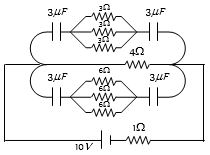
In the following figure, the charge on each condenser in the steady state will be.....$\mu C$
Medium
Download our app for free and get started
(d) In steady state current flows through $4\, \Omega$ resistance only and it is $i = \frac{{10}}{{(4 + 1)}} = 2\,amp$.
Potential difference across $4\, \Omega$ resistance is $V = 2 \times 4 = 8\,volt$
Hence, potential difference across each capacitor is $4\,V$
So charge on each capacitor $Q = 3 \times 4 = 12 \,\mu C$.

Download our appand get started for free
Experience the future of education. Simply download our apps or reach out to us for more information. Let's shape the future of learning together!No signup needed.*
Similar Questions
- 1Heat produced in a wire of resistance $R$ due to current flowing at constant potential difference is proportional toView Solution
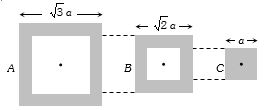
- 2Following figure shows cross-sections through three long conductors of the same length and material, with square cross-section of edge lengths as shown. Conductor $B$ will fit snugly within conductor $A$, and conductor $C$ will fit snugly within conductor $B$. Relationship between their end to end resistance isView Solution
- 3Two wires that are made up of two different materials whose specific resistance are in the ratio $2 : 3$, length $3 : 4$ and area $4 : 5$. The ratio of their resistances isView Solution
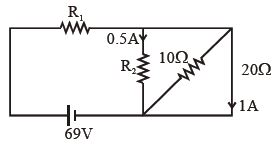
- 4In the circuit shown in the given figure the resistance $R_1$ and $R_2$ are respectivelyView Solution
- 5View SolutionThe temperature at which thermal electric power of a thermo couple becomes zero is called
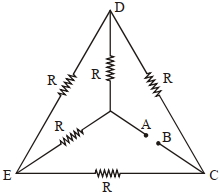
- 6Five equal resistances are connected in a network as shown in figure. The net resistance between the points $A$ and $B$ isView Solution
- 7The charge flowing through a resistance $R$ varies with time as $Q = 2t - 8t^2$. The total heat produced in the resistance is (for $0 \leq t \leq \frac{1}{8}$)View Solution
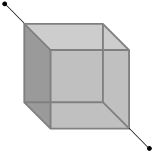
- 8Twelve wires of equal length and same cross-section are connected in the form of a cube. If the resistance of each of the wires is $R$, then the effective resistance between the two diagonal ends would beView Solution
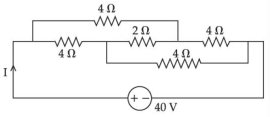
- 9The current $I$ in the given circuit will be $......A$View Solution
- 10An ideal gas mixture filled inside a balloon expands according to the relation $PV^{2/3} =$ constant. The temperature inside the balloon isView Solution