MCQ
In the gas equation $\text{PV = RT, V}$ is the volume of:
  • $1$ mol of gas
  • B
    $1g$ of gas
  • C
    Gas
  • D
    $1$ litre of gas

Answer

Correct option: A.
$1$ mol of gas
For an Ideal Gas, $\text{PV = nRT}$
Here $V$ is the volume of $n$ moles of gas.
Thus for $\text{PV = (1)RT, V}$ is the volume of $1$ mol of gas.

Need a full question paper?

Generate a complete, print-ready paper with questions like this in minutes — across 16+ boards, with answer keys.

Start Generating Free

Similar questions

Two particles $A$ and $B$, move with constant velocities ${\vec v_1}$ and ${\vec v_2}$. At the initial moment their position vectors are ${\vec r_1}$ and ${\vec r_2}$ respectively. The condition for their collision is
In order to raise a mass of $100\,kg$ a man of mass $60\,kg$ fastens a rope to it and passes the rope over a smooth pulley. He climbs the rope with an acceleration $5g/4$ relative to the rope. The tension in the rope is ....... $N$. $(g = 10\,m/s^2)$
Two uniform circular discs are rotating independently in the same direction around their common axis passing through their centres. The moment of inertia and angular velocity of the first disc are $0.1 \;kg - m ^{2}$ and $10\; rad \,s^{-1}$ respectively while those for the second one are $0.2 \;kg - m ^{2}$ and $5\; rad \,s ^{-1}$ respectively. At some instant they get stuck together and start rotating as a single system about their common axis with some angular speed. The Kinetic energy of the combined system is ...........$J$
A solid uniform sphere having a mass $M$, radius $R$ and moment of inertia of $\frac{2}{5} M R^2$ rolls down a plane inclined at an angle $\theta$ to the horizontal starting from rest. The coefficient of static friction between the sphere and the plane is $\mu_s$. Then,
A projectile is fired at an angle of $45^o $ with the horizontal . Elevation angle of the projectile at its highest point as seen from the point of projection, is 
A particle of mass $10\,g$ moves in a straight line with retarcation $2x$, where $x$ is the displacement in $SI$ units. Its loss of kinetic energy for above displacement is $\left(\frac{10}{x}\right)^{- n }\, J$. The value of $n$ will be $............$.
The dimensions of $\left(\frac{ B ^{2}}{\mu_{0}}\right)$ will be.

(if $\mu_{0}$ : permeability of free space and $B$ : magnetic field)
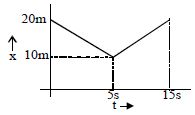
Position-time graph for a particle of mass $100g$ is as shown in figure then impulse  acting on the particle at $t = 5$ second is ............ $N-s$
A particle of mass $'{m}'$ is moving in time $'t'$ on a trajectory given by

$\overrightarrow{{r}}=10 \alpha {t}^{2}\, \hat{{i}}+5 \beta({t}-5)\, \hat{{j}}$

Where $\alpha$ and $\beta$ are dimensional constants. The angular momentum of the particle becomes the same as it was for ${t}=0$ at time ${t}=$ .....$seconds.$

A vernier callipers has $20$ divisions on the vernier scale, which coincides with $19^{\text {th }}$ division on the main scale. The least count of the instrument is $0.1 \mathrm{~mm}$. One main scale division is equal to $. . .  . . ..$ $\mathrm{mm}$