MCQ
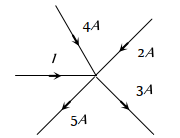
In the given current distribution what is the value of $I$

Image

  • A
    $3 A$
  • B
    $8 \mathrm{~A}$
  • $2 A$
  • D
    $5 A$

Answer

Correct option: C.
$2 A$
(c) From Kirchoffs junction Law$\Rightarrow 4+2+i-5-3=0 \Rightarrow i=2 A$

Need a full question paper?

Generate a complete, print-ready paper with questions like this in minutes — across 16+ boards, with answer keys.

Start Generating Free

Similar questions

A telescope has an objective lens of $10 \mathrm{~cm}$ diameter and is situated at a distance of one kilometre from two objects. The minimum distance between these two objects, which can be resolved by the telescope, when the mean wavelength of light is $5000 \mathring A$, is of the order of
The energy that should be added to an electron, to reduce its deBroglie wavelengths from $10^{-10} \mathrm{~m}$ to $0.5 \times 10^{-10} \mathrm{~m}$, will be
The temperature of reservoir of Carnot's engine operating with an efficiency of $70 \%$ is $1000 K$. The temperature of its sink is
A clock which keeps correct time at $20^{\circ} C$, is subjected to $40^{\circ} C$. If coefficient of linear expansion of the pendulum is $12 \times 10^{-6} /{ }^{\circ} C$. How much will it gain or loose in time
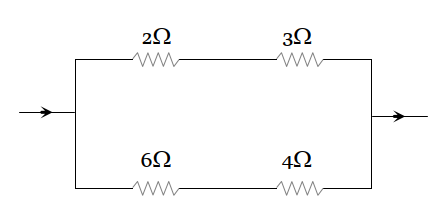
In the circuit as shown in the figure, the heat produced by $6$ oh resistance due to current flowing in it is $60$ calorie per second. Th heat generated across $3\ ohm$ resistance per second will be
Image
If $x$ is the distance of an object from the focus of a concave mirror and $y$ is the distance of image from the focus, then which of the following graphs is correct between $x$ and $y$
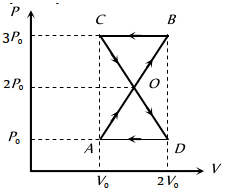
A thermodynamic system undergoes cyclic process $A B C D A$ as shown in figure. The work done by the system isImage
The vector $\quad \vec{P}=a \hat{i}+\hat{a j}+3 \hat{k} \quad$ and $\quad \vec{Q}=\hat{a i}-2 \hat{j}-\hat{k} \quad$ are perpendicular to each other. The positive value of $a$ is
The core of a transformer is laminated to reduce energy losses due to
A force $F$ is needed to break a copper wire having radius $R$. The force needed to break a copper wire of radius $2 R$ will be