In the given circuit all resistances are of value $R\,ohm$ each. The equivalent resistance between $A$ and $B$ is
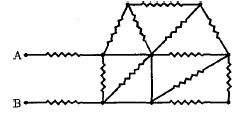
JEE MAIN 2018, Diffcult
Download our app for free and get started
${\mathrm{R}_{\text {scries }}=\mathrm{R}_{1}+\mathrm{R}_{2}+\ldots \ldots+\mathrm{R}_{\mathrm{n}}} $
${\frac{1}{\mathrm{R}_{\mathrm{parallel}}}=\frac{1}{\mathrm{R}_{1}}+\frac{1}{\mathrm{R}_{2}}+\ldots \ldots+\frac{1}{\mathrm{R}_{\mathrm{n}}}}$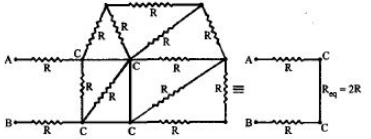

Download our appand get started for free
Experience the future of education. Simply download our apps or reach out to us for more information. Let's shape the future of learning together!No signup needed.*
Similar Questions
- 1Two electric bulbs marked $25\ W - 220\ V$ and $100\ W - 220\ V$ are connected in series to a $440\ V$ supply. Which of the bulbs will fuse?View Solution
- 2The specific resistance of a wire is $\rho $, its volume is $3\,{m^3}$ and its resistance is $3\, ohms$, then its length will beView Solution
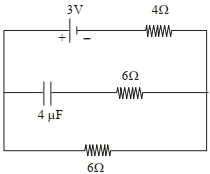
- 3A wire of resistance $R$ and radius $r$ is stretched till its radius became $r / 2$. If new resistance of the stretched wire is $x R$, then value of $x$ is $\qquad$View Solution
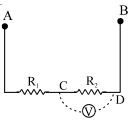
- 4Resistances $R_1$ and $R_2$ each $60\,\Omega$ are connected in series as shown in figure. The Potential difference between $A$ and $B$ is kept $120$ volt. Then what ............. $V$ will be the reading of voltmeter connected between the point $C$ and $D$ if resistance of voltmeter is $120\,\Omega .$View Solution
- 5View SolutionIn charging a battery of motor-car, the following effect of electric current is used
- 6View SolutionA constant voltage is applied between two ends of a metallic wire. If the length is halved and the radius of the wire is doubled, the rate of heat developed in the wire will be
- 7View SolutionThe magnitude and direction of the current in the circuit shown will be
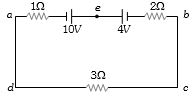
- 8View SolutionThe equivalent resistance of resistors connected in series is always
- 9It is preferable to measure the $e.m.f.$ of a cell by potentiometer than by a voltmeter because of the following possible reasons.View Solution
$(i)$ In case of potentiometer, no current flows through the cell.
$(ii)$ The length of the potentiometer allows greater precision.
$(iii)$ Measurement by the potentiometer is quicker.
$(iv)$ The sensitivity of the galvanometer, when using a potentiometer is not relevant.
Which of these reasons are correct? - 10In the network shown below, the charge accumulated in the capacitor in steady state will be ........... $\mu C$View Solution