Question
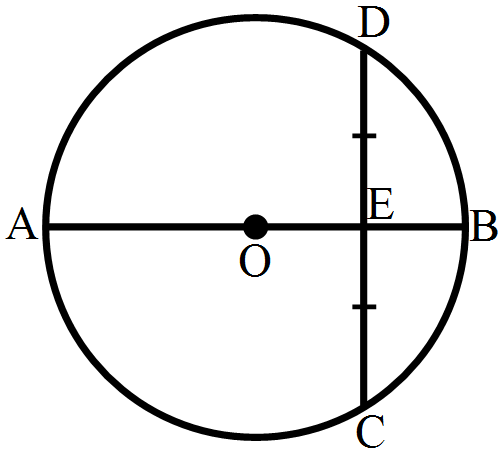
In the given figure, a circle with centre $O$ is given in which a diameter $AB$ bisects the chord $CD$ at a point E such that $CE = ED = 8cm$ and$ EB = 4\ cm$. Find the radius of the circle.
Answer

AB is the diameter of the circle with centre $O$, which bisects the chord $CD$ at point $E$.
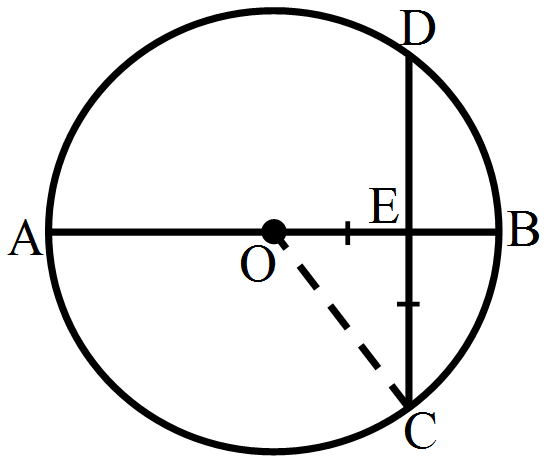
Given: $CE = ED = 8\ cm$ and $EB = 4\ cm$ Join $OC$.

Let $OC = OB = rcm$ [Radii of a circle]
Then $OE = (r - 4)\ cm$
Now, in right angled $\triangle\text{OEC},$
we have: $OC^2 = OE^2 + EC^2$[Pythagoras theorem]
$\Rightarrow r^2 = (r - 4)^2 + 8^2 $
$\Rightarrow r^2 = r^2 - 8r + 16 + 64 $
$\Rightarrow r^2 = r^2 + 8r = 80 $
$\Rightarrow 8r = 80$
$\Rightarrow\ \text{r}=\Big(\frac{80}{8}\Big)\text{cm}=10\text{cm}$
$\Rightarrow r = 10\ cm$ Hence, the required radius of the circle is $10\ cm$.

Need a full question paper?

Generate a complete, print-ready paper with questions like this in minutes — across 16+ boards, with answer keys.

Start Generating Free

Similar questions

If ABC and BDE are two equilateral triangles such that D is the mid-point of BC, then find $\text{ar}(\triangle\text{ABC}) : \text{ar}(\triangle\text{BDE}).$
The line segments joining the midpoints M and N of parallel sides AB and DC respectively of a trapezium ABCD is perpendicular to both the sides AB and DC. Prove that AD = BC.
The diagonals of a cyclic quadrilateral are at right angles. Prove that the perpendicular from the point of their intersection on any side when produced backwards, bisects the opposite side.
In figure, ABCD is a parallelogram. O is any point on AC. PQ || AB and LM || AD. Prove that: $\text{ar}(||^{\text{gm}}\text{ DLOP})=\text{ar}(||^{\text{gm}}\text{ BMOQ}).​​​$
Explain, by taking a suitable example, how the arithmetic mean alters by:
  1. Adding a constant k to each term.
  2. Subtracting a constant k from each term.
  3. Multiplying each term by a constant k.
  4. Dividing each term by non-zero constant k.
The point Q( -3, -2) lies on a line parallel to the Y-axis. Write the equation of the line and draw its graph.
Verify the division algorithm for the polynomials
$p(x) = 2x^4 - 6x^3 + 2x^2 - x + 2$ and $g(x) = x + 2.$
Solve the following simultaneous equations : $\frac{x}{3}+\frac{y}{4}=4 ; \frac{x}{2}-\frac{y}{4}=1$
Mr. Sayyad kept ₹ 40,000 in a bank at 8% compound interest for 2 years. Mr. Fernandes invested ₹ 1,20,000 in a mutual fund for 2 years. After 2 years, Mr. Fernandes got ₹ 1,92,000. Whose investment turned out to be more profitable?
Two circles with centres O and O' intersect at two points A and B. A line PQ is drawn parallel to OO' through A or B, intersecting the circles at P and Q. Prove that PQ = 2OO'.