MCQ
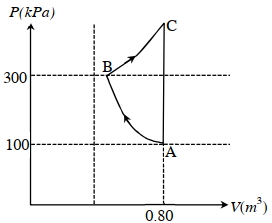
In the given $P$-V diagram, a monoatomic gas $\left(\gamma=\frac{5}{3}\right)$ is first compressed adiabatically from state $A$ to state $B$. Then it expands isothermally from state $B$ to state $C$. [Given: $\left(\frac{1}{3}\right)^{0.6} \simeq 0.5, \ln 2 \simeq 0.7$ ].

Which of the following statement($s$) is(are) correct?

$(A)$ The magnitude of the total work done in the process $A \rightarrow B \rightarrow C$ is $144 kJ$.

$(B)$ The magnitude of the work done in the process $B \rightarrow C$ is $84 kJ$.

$(C)$ The magnitude of the work done in the process $A \rightarrow B$ is $60 kJ$.

$(D)$ The magnitude of the work done in the process $C \rightarrow A$ is zero.
  • A
    $A,B,C$
  • $B,C,D$
  • C
    $A,B$
  • D
    $A,C$

Answer

Correct option: B.
$B,C,D$
b
For adiabaric process $( A \rightarrow B )$

$P_A V_x^t=P_x V_x^t$

$10^2 \times(0.8)^{\frac{2}{2}}=3 \times 10^2\left(V_n\right)^{\frac{2}{1}}$

$\Rightarrow V_x=0.8 \times\left(\frac{1}{3}\right)^{0.2}=0.4$

Wodk doue in process $A \rightarrow B$

$W_{c x}=\frac{P_s V_0-P_x V_x}{\gamma-1}$

$\Rightarrow W_{\text {sx }}=\frac{10^2 \times 0.8-3 \times 10^2 \times 0.4}{\frac{5}{3}-1}$

$\Rightarrow W_{\text {As }}=-60 lJ =\Rightarrow\left|W_{\lambda \Omega}\right|=60 lJ$

Work done in process $B \rightarrow C$ (Isothermal process)

$W_{x=}=n R T / n \frac{V_8}{V_x}=P_x V_x \ell m \frac{V_8}{V_x}$

$\Rightarrow W_{x c}=3 \times 10^2 \times 0.4 \ln \frac{0.8}{0.4}$

$\Rightarrow W_{s c}=34 kJ$

Wodk doue in process $C \rightarrow A$

$W_{C_A}=P \Delta V=0 \quad(\because \Delta V=0)$

So toral work done in the process $A \rightarrow B \rightarrow C$

$W_{A B C}=W_{A \triangle}+W_{y C}+W_{C A}=-60+84+0$

$W_{A B C}=24 kJ$

So comect options are $(B,C.D)$

Need a full question paper?

Generate a complete, print-ready paper with questions like this in minutes — across 16+ boards, with answer keys.

Start Generating Free

Similar questions

Pressure is applied to an enclosed fluid. It is:
A body released from the top of alls through a height of $5\ m$ during the first second of its fall and $35\ m$ during the last second of its fall. The height of the tower is:
A uniform meter scale is supported from its $20\ cm$ mark. A body suspended from $10\ cm$ mark keeps the scale horizontal. However, the scale gets unbalanced if the body is completely immersed in water. To regain the balance the body is shifted to the $8\ cm$ mark. Therefore, the specific gravity of the material of the body is
In a Vernier Calipers. $10$ divisions of Vernier scale is equal to the $9$ divisions of main scale. When both jaws of Vernier calipers touch each other, the zero of the Vernier scale is shifted to the left of $zero$ of the main scale and $4^{\text {th }}$ Vernier scale division exactly coincides with the main scale reading. One main scale division is equal to $1\,mm$. While measuring diameter of a spherical body, the body is held between two jaws. It is now observed that zero of the Vernier scale lies between $30$ and $31$ divisions of main scale reading and $6^{\text {th }}$ Vernier scale division exactly. coincides with the main scale reading. The diameter of the spherical body will be $.......cm$
The coefficient of superficial expansion of a solid is $2 \times 10^{-5} {°C^{-1}}$. It's coefficient of linear expansion is
Two forces $P + Q$ and $P -Q$ make angle $2 \alpha$ with each other and their  resultant make $\theta$ angle with bisector of angle between them. Then :
A stone of mass $900 \mathrm{~g}$ is tied to a string and moved in a vertical circle of radius $1 \mathrm{~m}$ making $10\  \mathrm{rpm}$. The tension in the string, when the stone is at the lowest point is (if $\pi^2=9.8$ and $g=9.8 \mathrm{~m} / \mathrm{s}^2$ )
A large tank is filled with water to a height $H$. A small hole is made at the base of the tank. It takes ${T_1}$ time to decrease the height of water to $\frac{H}{\eta }\,(\eta > 1)$; and it takes ${T_2}$ time to take out the rest of water. If ${T_1} = {T_2}$, then the value of $\eta $ is
A person supports a book between his finger and thumb as shown (the point of grip is assumed to be at the corner of the book). If the book has a weight of $W$ then the person is producing a torque on the book of 
A thin square plate of side $2\ m$ is moving at the interface of two very viscous liquids of viscosities ${\eta _1} = 1$ poise and ${\eta _2} = 4$ poise respectively as shown in the figure. Assume a linear velocity distribution in each fluid. The liquids are contained between two fixed plates. $h_1 + h_2 = 3\ m$ . A force $F$ is required to move the square plate with uniform velocity $10\ m/s$ horizontally then the value of minimum applied force will be ........ $N$