One proton beam enters a magnetic field of ${10^{ - 4}}$ $T$ normally, Specific charge = ${10^{11}}\,C/kg.$ velocity = ${10^7}\,m/s$. What is the radius of the circle described by it....$m$
Easy
Download our app for free and get started
(b) $r = \frac{{mv}}{{qB}} = \frac{{{{10}^7}}}{{{{10}^{11}} \times {{10}^{ - 4}}}} = 1m\;(\;q/m = {10^{11}}C/kg)$

Download our appand get started for free
Experience the future of education. Simply download our apps or reach out to us for more information. Let's shape the future of learning together!No signup needed.*
Similar Questions
- 1A particle of charge $q$ and mass $m$ moving with a velocity $v$ along the $x$-axis enters the region $x > 0$ with uniform magnetic field $B$ along the $\hat k$ direction. The particle will penetrate in this region in the $x$-direction upto a distance $d$ equal toView Solution
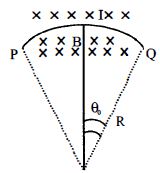
- 2A wire carrying current $I$ is tied between points $P$ and $Q$ and is in the shape of a circular arc of radius $R$ due to a uniform magnetic field $B$ (perpendicular to the plane of the paper, shown by $\times \times \times $) in the vicinity of the wire. If the wire subtends an angle $2\theta_0$ at the centre of the circle (of which it forms an arc) then the tension in the wire isView Solution
- 3A current of $i$ ampere is flowing in an equilateral triangle of side $a$. The magnetic induction at the centroid will beView Solution
- 4A vertical straight conductor carries a current vertically upwards. A point $P$ lies to the east of it at a small distance and another point $Q$ lies to the west at the same distance. The magnetic field at $P$ isView Solution
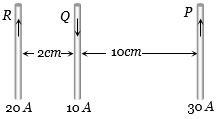
- 5Three long, straight and parallel wires carrying currents are arranged as shown in figure. The force experienced by $10\, cm$ length of wire $Q$ isView Solution
- 6View SolutionIf a charged particle goes unaccelerated in a region containing electric and magnetic fields
- 7A particle of charge $q$ and mass $m$ starts moving from the origin under the action of an electric field $\vec E = {E_0}\hat i$ and $\vec B = {B_0}\hat i$ with velocity ${\rm{\vec v}} = {{\rm{v}}_0}\hat j$. The speed of the particle will become $2v_0$ after a timeView Solution
- 8An electron, a proton, a deuteron and an alpha particle, each having the same speed are in a region of constant magnetic field perpendicular to the direction of the velocities of the particles. The radius of the circular orbits of these particles are respectively $R_e, R_p, R_d \,$ and $\, R_\alpha$. It follows thatView Solution
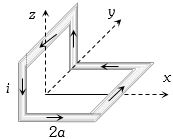
- 9A non-planar loop of conducting wire carrying a current $I$ is placed as shown in the figure. Each of the straight sections of the loop is of length $2a$. The magnetic field due to this loop at the point $P$ $(a,0,a)$ points in the directionView Solution
- 10Two very long, straight and parallel wires carry steady currents $I$ and $I$ respectively. The distance between the wires is $d$. At a certain instant of time, a point charge $q$ is at a point equidistant from the two wires in the plane of the wires. Its instantaneous velocity $v$ is perpendicular to this plane. The magnitude of the force due to the magnetic field acting on the charge at this instant isView Solution