MCQ
In the phenomenon of work done by variable forces, the forces:
  • A
    Remain constant.
  • B
    Don't remain constant.
  • C
    Increase.
  • D
    Decrease.

Answer

  1. Don't remain constant.

Explanation:

The variable forces are the non-constant forces that changes with maybe time, distance or any other variable.

Need a full question paper?

Generate a complete, print-ready paper with questions like this in minutes — across 16+ boards, with answer keys.
Start Generating Free

Similar questions

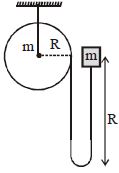
Mass of the pulley is $m$ & radius is $R$. Assume pulley to be uniform disc. Pulley is free to rotate about an axis passing through its centre and perpendicular to its plane. String is massless & inextensible. String is wrapped on the pulley. There is no slipping between string and pulley. The length of the string which is not wrapped on the pulley is $2R$. Block of mass $m$ is released from the position as shown in the figure. The impulse exerted by the string on the pulley at the moment string becomes taut is $J. \frac{2m \sqrt{gR}}{J}$ is equal to.
A body $A$ is thrown up vertically from the ground with a velocity $v _0$ and another body $B$ is simultaneously dropped from a height H . They meet at a height $\frac{H}{2}$, if $v _0$ is equal to:
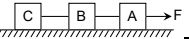
Three identical blocks of masses $m=2\; k g$ are drawn by a force $F=10.2\; N$ with an acceleration of $0.6\; ms ^{-2}$ on a frictionless surface, then what is the tension (in $N$) in the string between the blocks $B$ and $C$?
Put a uniform meter scale horizontally on your extended index fingers with the left one at $0.00 cm$ and the right one at $90.00 cm$. When you attempt to move both the fingers slowly towards the center, initially only the left finger slips with respect to the scale and the right finger does not. After some distance, the left finger stops and the right one starts slipping. Then the right finger stops at a distance $x_R$ from the center ( $50.00 cm$ ) of the scale and the left one starts slipping again. This happens because of the difference in the frictional forces on the two fingers. If the coefficients of static and dynamic friction between the fingers and the scale are $0.40$ and $0.32$ , respectively, the value of $x_R($ in $cm )$ is. . . . . . . 
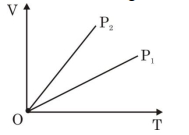
The given figure represents two isobaric processes for the same mass of an ideal gas, then
A body of mass $5 \,kg$  explodes at rest into three fragments with masses in the ratio $1 : 1 : 3$. The fragments with equal masses fly in mutually perpendicular directions with speeds of $21 \,m/s$. The velocity of the heaviest fragment will be
In case of earth:
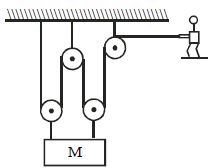
Find Mechanical advantage for pulling mass $M$ by the person
Given below are two statements:

Statement $I :$ A second's pendulum has a time period of $1$ second.

Statement $II :$ It takes precisely one second to move between the two extreme positions.

In the light of the above statements, choose the correct answer from the options given below:

An object thrown vertically upwards with a velocity of 25m/ s takes 4sec to reach the thrower. What is displacement of the object?