Question
In the solar system, which is conserved

Answer

In the solar system, the orbit of a planet is an ellipse with the Sun at one of the two foci.

velocity of the planet at every point on orbit will not be same, so momentum and Kinetic energy can not be conserved. The angular velocity will also vary. But the total enengy $(K E+P E)$ will remain conserved for the system.

Need a full question paper?

Generate a complete, print-ready paper with questions like this in minutes — across 16+ boards, with answer keys.

Start Generating Free

Similar questions

Identify the product formed in the above reaction: 
An ideal gas has volume ${V_0}$ at ${27^o}C.$ It is heated at constant pressure so that its volume becomes $2{V_0}.$ The final temperature is
In a Young's double slit experiment, $16$ fringes are observed in a certain segment of the screen when light of wavelength $700 \,nm$ is used. If the wavelength of light is changed to $400 \,nm$, the number of fringes observed in the same segment of the screen would be........
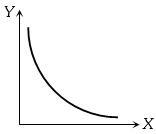
What physical quantities may $X$ and $Y$ represent ? ($Y$ represents the first mentioned quantity)
A parallel plate capacitor of capacity ${C_0}$ is charged to a potential ${V_0}$

$(i)$ The energy stored in the capacitor when the battery is disconnected and the separation is doubled ${E_1}$

$(ii)$ The energy stored in the capacitor when the charging battery is kept connected and the separation between the capacitor plates is doubled is ${E_2}.$

Then ${E_1}/{E_2}$ value is
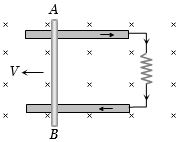
Consider the situation shown in the figure. The wire $AB$ is sliding on the fixed rails with a constant velocity. If the wire $AB$ is replaced by semicircular wire, the magnitude of the induced current will
Two different magnets are tied together and allowed to vibrate in a horizontal plane. When their like poles are joined, time period of oscillation is $5 \,s$ and with unlike poles joined, time period of oscillation is $15 \,s$. The ratio of their magnetic moments is
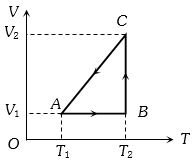
A cyclic process for $1\, mole$ of an ideal gas is shown in figure in the $V-T,$ diagram. The work done in $AB, BC$ and $CA$ respectively
A disc rotating about its axis from rest, acquires the angular speed $100 \,rev/s$ in $4$ second. The angle rotated by it during these four seconds (in radian) is ...... $\pi$
The speed of electromagnetic wave in vacuum depends upon the source of radiation