MCQ
In which one of the following gaseous equilibria ${K_p}$ is less than ${K_c}$
  • A
    ${N_2}{O_4}$ $ \rightleftharpoons $  $2N{O_2}$
  • B
    $2HI$ $ \rightleftharpoons $ ${H_2} + {I_2}$
  • $2S{O_2} + {O_2}$ $ \rightleftharpoons $  $2S{O_3}$
  • D
    ${N_2} + {O_2}$ $ \rightleftharpoons $  $2NO$

Answer

Correct option: C.
$2S{O_2} + {O_2}$ $ \rightleftharpoons $  $2S{O_3}$
(c) ${K_p} = {K_c}{(RT)^{\Delta n}}$

$\Delta n = - 1$ for reaction $2S{O_2} + {O_2}$ $ \rightleftharpoons $  $2S{O_3}$

So for this reaction ${K_p}$ is less than ${K_c}$.

Need a full question paper?

Generate a complete, print-ready paper with questions like this in minutes — across 16+ boards, with answer keys.

Start Generating Free

Similar questions

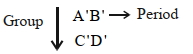
Consider the following elements.

Which of the following is/are true about $\mathrm{A}^{\prime}, \mathrm{B}^{\prime}, \mathrm{C}^{\prime}$ and $\mathrm{D}^{\prime}$ ?

$A$. Order of atomic radii: $\mathrm{B}^{\prime}<\mathrm{A}^{\prime}<\mathrm{D}^{\prime}<\mathrm{C}^{\prime}$

$B$. Order of metallic character: $\mathrm{B}^{\prime}<\mathrm{A}^{\prime}<\mathrm{D}^{\prime}<\mathrm{C}^{\prime}$

$C$. Size of the element : $\mathrm{D}^{\prime}<\mathrm{C}^{\prime}<\mathrm{B}^{\prime}<\mathrm{A}^{\prime}$

$D$. Order of ionic radii : $\mathrm{B}^{\prime+}<\mathrm{A}^{\prime+}<\mathrm{D}^{\prime+}<\mathrm{C}^{\prime+}$

Choose the correct answer from the options given below :
If compound $MX_4$ has $\mu\, = 0$ then most probable geometry will be
Lindane can be obtained by reaction of benzene with
The $d-$orbital involved in $s{p^3}d$ hybridisation is
One mole of an ideal gas at $25\,^oC$ expands its volume from $1\,L$ to $4\,L$ at  constant temperature. What work (in $J$) is done if gas expands against vaccum $(P_{ext} = 0)$?
Which of the following is the best scientific method to test the presence of water in a liquid
One mole of ${N_2}{H_4}$ loses $10\, mol$ of electrons to form a new compound $Y$. Assuming that all nitrogen appear in the new compound, what is the oxidation state of ${N_2}$ in $Y$ ? (There is no change in the oxidation state of hydrogen)
The $"O - N - O"$ bond angle is maximum in
Photochemical smog is also called as :
Oxidation state of iodine in $\mathrm{ICl}_2{ }^{-}$​ is :