Question
In Young’s double $-$ slit experiment using monochromatic light of wavelength $\lambda, $ the intensities of two sources is $I.$  What is the intensity of light at a point where path difference between wave front is $\lambda / 4$ ?

Answer

$\lambda_1=4 \times 10^{-7} m \lambda_2=6 \times 10^{-7} m$
Distance at which dark fringe is observed $x=\left(n+\frac{1}{2}\right) \frac{\lambda D}{d}$
First Dark fringe for $\lambda_1 d_1=\frac{1}{2} \frac{4 \times 10^{-7}}{10^{-2}} m=2 \times 10^{-5} m$
First Dark fringe for $\lambda_2 d_2=\frac{1}{2} \frac{6 \times 10^{-7}}{10^{-2}} m=3 \times 10^{-5} m$
First dark fringe will be the distance where both dark fringes will coincide
i.e $\text {LCM}$ of $d_1 \ d_1$ i.e.
$ 2 \times 10^{-5} m \times 3 \times 10^{-5} m$
$=6 \times 10^{-5} m$

Need a full question paper?

Generate a complete, print-ready paper with questions like this in minutes — across 16+ boards, with answer keys.
Start Generating Free

Similar questions

Define electric flux. Write its $S.I.$ units. A spherical rubber balloon carries a charge that is uniformly distributed over its surface. As the balloon is blown up and increases in size, how does the total electric flux coming out of the surface change? Give reason.
The decay constant of $\text{ }^{197}_{80}\text{Hg} \ ($electron capture to $\text{ }^{197}_{79}\text{Au})$ is $1.8 \times 10^{-4} S^{-1}$.
  1. What is the half $-$ life?
  2. What is the average $-$ life?
  3. How much time will it take to convert $25\%$ of this isotope of mercury into gold?
Obtain Faraday's law of induction explaining Faraday's experiments regarding electric induction with reference to magnetic flux.
A projectile is fired from the top of a 40m high cliff with an initial speed of 50m/s at an unknown angle. Find its speed when it hits the ground.
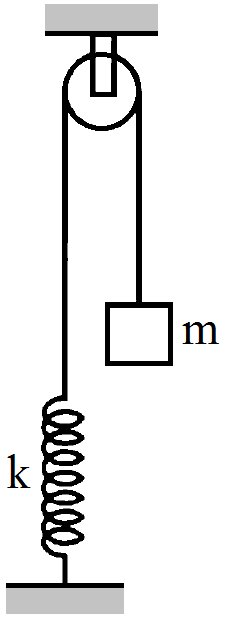
Consider the situation shown in figure. Initially the spring is unstretched when the system is released from rest. Assuming no friction in the pulley, find the maximum elongation of the spring.
Consider two particles A and B having equal charges and placed at some distance. The particle A is slightly displaced towards B. Does the force on B increase as soon as the particle A is displaced? Does the force on the particle A increase as soon as it is displaced?
de Broglie wavelength associated with an electron accelerated through a potential difference V is $\lambda$ What will be the de Broglie wavelength when the accelerating potential is increased to 4V?
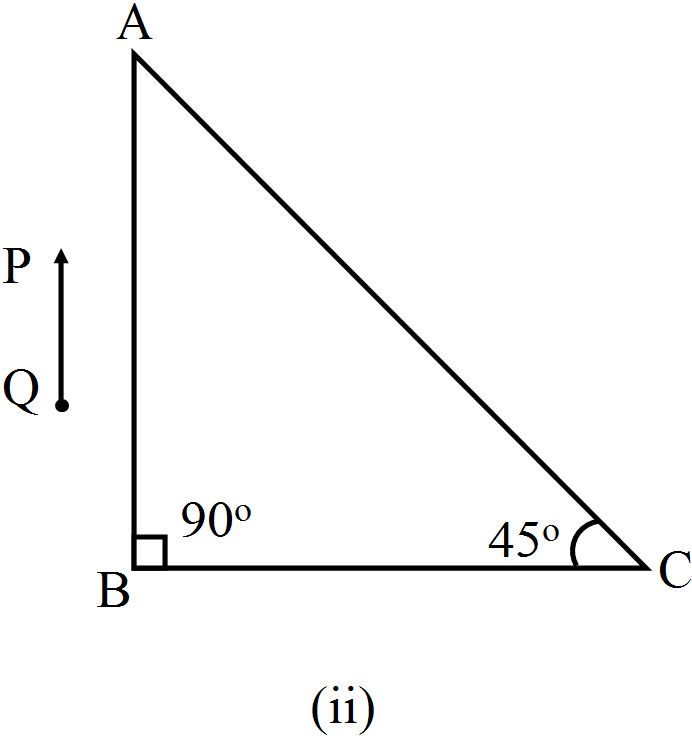
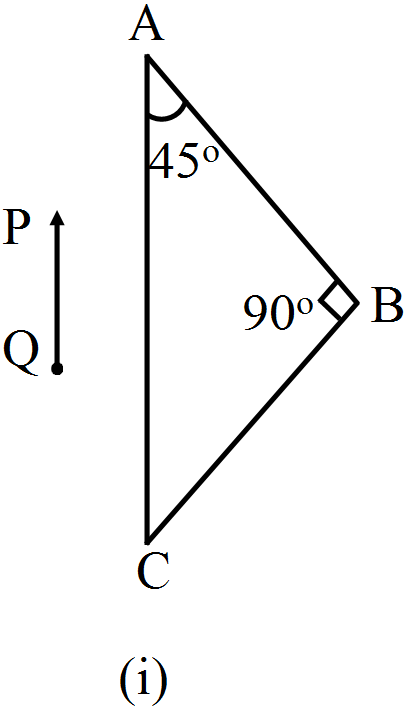
A right-angled crown glass prism with critical angle 41° is placed before an object, PQ in two positions as shown in the figures (i) and (ii). Trace the paths of the rays from P and Q passing through the prisms in the two cases.
A 1.0 m long metallic rod is rotated with an angular frequency of 400 rad$s ^{-1}$ about an axis normal to the rod passing through its one end. The other end of the rod is in contact with a circular metallic ring. A constant and uniform magnetic field of 0.5 T parallel to the axis exists everywhere. Calculate the emf developed between the centre and the ring.
Why are elemental dopants for Silicon or Germanium usually chosen from group XIII or group XV?