Questions

2 Marks Questions

Take a timed test

6 questions · self-marked practice — reveal the answer and mark yourself.

Question 12 Marks
A beam of light consisting of two wavelengths $, 4000 \mathring A$ and $6000 \mathring A ,$ is used to obtain interference fringes in a Young’s double $-$ slit experiment. What is the least distance from the central maximum where the dark fringe is obtained?
Answer
For a fringe of width $\beta$ formed on the screen at distance $D$ from the slits the angular fringe width would be
$\theta=\frac{\beta}{D}=\frac{D \lambda / d}{D}=\frac{\lambda}{d}$
or $ d=\frac{\lambda}{\theta}$
Let the wavelength in water be $\lambda ′$ and the angular fringe width be $\theta ’ ,$ then
$ d =\frac{\lambda^{\prime}}{\theta^{\prime}} $
$\therefore \frac{\lambda}{\theta}=\frac{\lambda^{\prime}}{\theta^{\prime}}$
or  $ \theta^{\prime} =\frac{\lambda^{\prime}}{\lambda} \theta$
$=\frac{\lambda / \mu}{\lambda} \theta$
$=\frac{\theta}{\mu}$
$=\frac{0.2^{\circ}}{4 / 3}$
$=0.15^{\circ}$
View full question & answer
Question 22 Marks
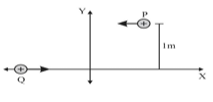
$P$ and $Q$ are two identical charged particles each of mass $4 \times 10^{-26} \ kg$ and charge $4.8 \times 10^{-19} C$, each moving with the same speed of $2.4 \times 10^5 m / s$ as shown in the figure. The two particles are equidistant $(0.5 m)$ from the vertical $Y -$ axis. At some instant, a magnetic field $B$ is switched on so that the two particles undergo head $-$ on collision.

Image
Find $–$
$(I)$ the direction of the magnetic field and
$(II)$ the magnitude of the magnetic field applied in the region.
Answer
$(i)$ The direction of the magnetic field is perpendicular and inward into the plane of the paper
$(ii)$ For a head $-$ on collision to take place, the radius of the path of each ion should be equal to $0.5 m$.
$r=\frac{m v}{q B}=0.5 m$
$B =\frac{m v}{q r}=\frac{4 \times 10^{-26} \times 2.4 \times 10^5}{4.8 \times 10^{-19} \times 0.5}$
$B=0.04 T$
View full question & answer
Question 32 Marks
In Young’s double $-$ slit experiment using monochromatic light of wavelength $\lambda, $ the intensities of two sources is $I.$  What is the intensity of light at a point where path difference between wave front is $\lambda / 4$ ?
Answer
$\lambda_1=4 \times 10^{-7} m \lambda_2=6 \times 10^{-7} m$
Distance at which dark fringe is observed $x=\left(n+\frac{1}{2}\right) \frac{\lambda D}{d}$
First Dark fringe for $\lambda_1 d_1=\frac{1}{2} \frac{4 \times 10^{-7}}{10^{-2}} m=2 \times 10^{-5} m$
First Dark fringe for $\lambda_2 d_2=\frac{1}{2} \frac{6 \times 10^{-7}}{10^{-2}} m=3 \times 10^{-5} m$
First dark fringe will be the distance where both dark fringes will coincide
i.e $\text {LCM}$ of $d_1 \ d_1$ i.e.
$ 2 \times 10^{-5} m \times 3 \times 10^{-5} m$
$=6 \times 10^{-5} m$
View full question & answer
Question 42 Marks
What should be the radius ‘r’ of nearest possible orbits of satellite of mass ‘m’ revolving around the planet of mass ‘M’ as per Bohr Postulates in terms of m, M, G, h where G is Gravitational constant and h is plank’s constant.
Answer
$\frac{n h}{2 \Omega}= mvr$ (As Per Bohr's Modal) (i)
As Centripetal force is provided by gravity,
$\frac{m v^2}{r}=\frac{G M m}{r^2}$
Or, $V ^2=\frac{G M}{r}$
From equation (i)
Or, $V ^2=\left\{\frac{n h}{2 \Omega m r}\right\}^2$
or, $\frac{G M}{r}=\left\{\frac{n h}{2 \Omega m r}\right\}^2$
or, $r =\frac{n^2 h^2}{4 \pi^2 m^2 G M}$
View full question & answer
Question 52 Marks
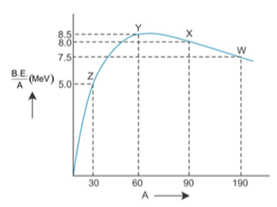
Binding energy per nucleon vs mass number curve for nuclei is shown in the figure. W, X, Y and Z are four nuclei indicated on the curve. Identify which of the following nuclei is most likely to undergo
(i) Nuclear Fission
(ii) Nuclear Fusion.
Justify your answer.

Image
Answer
(i) Nuclear fission –W
Reason: As W has binding energy per nucleon less then Y and X and nucleus is larger in size.
(ii) Nuclear fusion-Z
Reason: As Z has binding energy per nucleon more then Y and X and nucleus is smaller in size.
View full question & answer
Question 62 Marks
A platinum surface having work function 5.63 eV is illuminated by a monochromatic source of $1.6 \times 10^{15} Hz$ Hz. What will be the minimum wavelength associated with the ejected electron.
Answer
Given $\emptyset_0=5.63 eV =5.63 \times 1.6 \times 10^{-19} J$
$v=1.6 \times 10^{15} Hz$
$K . E .=h v-\emptyset_0=\frac{h c}{\lambda}$
$\lambda=\frac{h c}{h v-\emptyset_0}$
$=\frac{6.63 \times 10^{-34} \times 3 \times 10^8}{6.63 \times 10^{-34} \times 1.6 \times 10^{15}-5.63 \times 1.6 \times 10^{-19}}$
$=\frac{19.89 \times 10^{-26}}{1.6 \times 10^{-19}(6.63-5.63)}$
$=\frac{19.89 \times 10^{-26}}{1.6 \times 10^{15}}$ $=12.4 \times 10^{-7} m$
View full question & answer