Question
Indicate the $\sigma$ and $\pi$ bonds in the following molecules:
$\mathrm{CH}_3 \mathrm{NO}_2$.

Answer


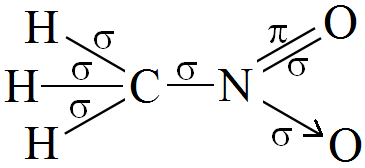
The $\sigma$ and $\pi$ bonds are indicated below:

$3\text{C}-\text{H }\sigma-\text{bonds}$
$1\text{C}-\text{N }\sigma-\text{bonds}$
$1\text{N}-\text{O }\sigma-\text{bond}$
$1\text{N}-\text{O }\pi -\text{bond}$

Need a full question paper?

Generate a complete, print-ready paper with questions like this in minutes — across 16+ boards, with answer keys.

Start Generating Free

Similar questions

A 5 litre cylinder contained 10 moles of oxygen gas at $27^{\circ} \mathrm{C}$. Due to sudden leakage through the hole, all the gas escaped into the atmosphere and the cylinder got empty. If the atmospheric pressure was 1.0 atm, calculate the work done by the gas.
$\left[\mathrm{R}=0.0821 \mathrm{~L} \mathrm{~atm} \mathrm{~K}^{-1} \mathrm{~mol}^{-1} ; 1 \mathrm{~L} \mathrm{~atm}=101.3 \mathrm{~J}\right]$
What is the difference between vapour and gas?
An alkane $\mathrm{C}_8 \mathrm{H}_{18}$ is obtained as the only product on subjecting a primary alkyl halide to Wurtz reaction. On monobromination this alkane yields a single isomer of a tertiary bromide. Write the structure of alkane and the tertiary bromide.
Derive the relationship between isothermal and free expansion of an ideal gas.
  1. What are fullerenes? How are they prepared?
  2. Classify the following compounds into acidic, basic and amphoteric oxides:
$\mathrm{Al}_2 \mathrm{O}_3, \mathrm{Cl}_2 \mathrm{O}_7$
Write IUPAC name of following compounds :
(i) 1, 3-diethyl-2, 3-dimethylbutane
(ii) 2-ethyl-3-isobutylpentane
(iii) 2, 5-diisopropylhexane
(iv) 1, 1-dimethyl-2, 2-diethylpropane
What is photoelectric effect and also tell the results of its experiment?
How much copper can be obtained from 100 g of copper sulphate $\left(\mathrm{CuSO}_4\right)$ ?
What do you mean by Boyle temperature? Give its expression and its relation with inversion temperature.
(i) Bond length, depends on hybridization Explain.
(ii) The bond enthalpy of $F - F$ is less than that of Cl-Cl, why?