MCQ
$\int_{}^{} {\sin (\log x)dx = } $
  • A
    $\frac{1}{2}x[\cos (\log x) - \sin (\log x)]$
  • B
    $\cos (\log x) - x$
  • $\frac{1}{2}x[\sin (\log x) - \cos (\log x)]$
  • D
    $ - \cos \log x$

Answer

Correct option: C.
$\frac{1}{2}x[\sin (\log x) - \cos (\log x)]$
c
(c) Let $I = \int_{}^{} {\sin (\log x)\,dx} $
Put $\log x = t \Rightarrow x = {e^t} \Rightarrow dx = {e^t}dt,$ then
$I = \int_{}^{} {\sin t\,.\,{e^t}\,dt} = \sin t\,.\,{e^t} - \int_{}^{} {{e^t}.\,\cos t\,dt} $
$ = \sin t\,.\,{e^t} - [\cos t\,.\,{e^t} + \int_{}^{} {{e^t}.\sin t\,dt} ]$
$ \Rightarrow 2I = \sin t\,.\,{e^t} - \cos t\,.\,{e^t}$
$ \Rightarrow I = \int_{}^{} {\sin \,(\log x)\,dx} $$ = \frac{1}{2}x\,[\sin \,(\log x) - \cos \,(\log x)]$.

Need a full question paper?

Generate a complete, print-ready paper with questions like this in minutes — across 16+ boards, with answer keys.

Start Generating Free

Similar questions

Consider the system of equations $\mathrm{ax}+\mathrm{by}=0, \mathrm{cx}+\mathrm{dy}=0$, where $\mathrm{a}, \mathrm{b}, \mathrm{c}, \mathrm{d} \in\{0,1\}$.

$STATEMENT -1$ : The probability that the system of equations has a unique solution is $3 / 8$. and $STATEMENT - 2$: The probability that the system of equations has a solution is $1$ .
$\int_{}^{} {\frac{{\sin 2x}}{{\sin 5x\sin 3x}}} \;dx = $
Order and degree of the differential equation $\left(1+\left(\frac{d y}{d x}\right)^3\right)^{\frac{7}{3}}=7 \frac{d^2 y}{d x^2}$ are respectively
If a dice is thrown $7$ times, then the probability of obtaining $5$ exactly $4$ times is
If $f(x)$ be such that $f(x) = max (|2-x|, 2-x^3), x \in R$
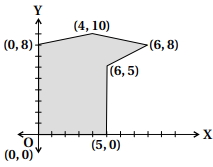
The feasible solution for a $LPP$ is shown in Figure Let $z=3 x-4 y$ be the objective function. Minimum of $Z$ occurs at $....$
A triangular park is enclosed on two sides by a fence and on the third side by a straight river bank. The two sides having fence are of same length $x$. The maximum area enclosed by the park is
The vector equation r = i − 2j − k + t(6j − k) represents a straight line passing through the points:
Each side of equilateral is increasing at the rate of 8cm/hr. The rate of increase of its area when side 2cm, is:
The probability of men getting a certain disease is $\frac{1}{2}$ and that of women getting the same disease is $\frac{1}{5}$. The blood test that identifies the disease gives the correct result with probability $\frac{4}{5}$. Suppose a person is chosen at random from a group of $30$ males and $20$ females, and the blood test of that person is found to be positive. What is the probability that the chosen person is a man?