MCQ
Inter atomic forces are:
  • A
    Attractive in long range.
  • B
    Repulsive in short range.
  • C
    Negligible in gases.
  • D
    All (a), (b) and (c).

Answer

  1. All (a), (b) and (c).

Explanation:

Interatomic forces are attractive in long range and repulsive in short range and negligible in gases.

Need a full question paper?

Generate a complete, print-ready paper with questions like this in minutes — across 16+ boards, with answer keys.
Start Generating Free

Similar questions

What is the angular velocity of earth
Surface tension of a soap solution is $1.9 \times {10^{ - 2}}N/m$. Work done in blowing a bubble of $2.0\, cm$ diameter will be
Resonance is an example of
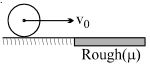
$A$ ring of mass $M$ and radius $R$ sliding with a velocity $v_0$ suddenly enters into rough surface where the coefficient of friction is $\mu$ , as shown in figure.  Choose the correct statement $(s)$
For angles of projection of a projectile at angle $(45^o  +\theta)$ and $(45^o  -\theta ) $ , the horizontal range described by the projectile are in the ratio of 
A block of mass $100\, gm$ slides on a rough horizontal surface. If the speed of the block decreases from $10 \,m/s$ to $5\, m/s,$ the thermal energy developed in the process is............. $J$
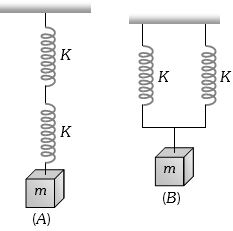
Two identical spring of constant $K$ are connected in series and parallel as shown in figure. A mass $m$ is suspended from them. The ratio of their frequencies of vertical oscillations will be
Match List$-I$ with List$-II$

List$-I$ List$-II$
$(a)$ $h$ (Planck's constant) $(i)$ $\left[ M L T ^{-1}\right]$
$(b)$ $E$ (kinetic energy) $(ii)$ $\left[ M L ^{2} T ^{-1}\right]$
$(c)$ $V$ (electric potential) $(iii)$ $\left[ M L ^{2} T ^{-2}\right]$
$(d)$ $P$ (linear momentum) $( iv )\left[ M L ^{2} I ^{-1} T ^{-3}\right]$

Choose the correct answer from the options given below
What is the phase difference between two successive crests in the wave
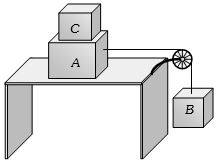
Two masses $A$ and $B$ of $10\, kg$ and $5 \,kg$ respectively are connected with a string passing over a frictionless pulley fixed at the corner of a table as shown. The coefficient of static friction of $A$ with table is $0.2$. The minimum mass of $C$ that may be placed on $A$ to prevent it from moving is ........ $kg$