Question
Internal forces acting within a system of particles can alter

Answer

(c)

The kinetic energy of the system, but not the linear momentum of the system as $F_{\text {ext }}=0$. So momentum will be conserved

Need a full question paper?

Generate a complete, print-ready paper with questions like this in minutes — across 16+ boards, with answer keys.
Start Generating Free

Similar questions

The ratio of the forces between two small spheres with constant charge $(a)$ in air $(b)$ in a medium of dielectric constant $K$ is
An object is placed on the axis of a convex lens. Its image is formed $80\,cm$ from the object. The magnification is $3$ . The focal length of the lens is.....$cm$
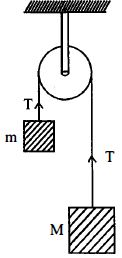
Two blocks of masses $m$ and $M$ are connected by means of a metal wire of cross-sectional area $A$ passing over a frictionless fixed pulley as shown in the figure. The system is then released. If $M = 2\, m$, then the stress produced in the wire is
Certain radio-active substance reduces to $25\%$ of its value in $16$ days. Its half-life is ........ $days$ 
The height upto which water will rise in a capillary tube will be
Two identical conducting rods are first connected independently to two vessels, one containing water at $100^o C$ and the other containing ice at $0^oC$. In the second case, the rods are joined end to end and connected to the same vessels. Let ${q_1}$ and ${q_2}$ $g / s$ be the rate of melting of ice in two cases respectively. The ratio of ${q_1}/{q_2}$ is
A monochromatic light wave with wavelength $\lambda_1$ and frequency $v_1$ in air enters another medium. If the angle of incidence and angle of refraction at the interface are $45^{\circ}$ and $30^{\circ}$ respectively, then the wavelength $\lambda_2$ and frequency $v_2$ of the refracted wave are :
At nodes in stationary waves
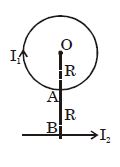
In the diagram, $I_1$ , $I_2$ are the strength of the currents in the loop and infinite long straight conductor respectively. $OA = AB = R$ . The net magnetic field at the centre $O$ is zero. Then the ratio of the currents in the loop and the straight conductor is 
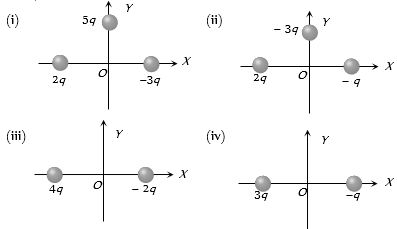
In the following four situations charged particles are at equal distance from the origin. Arrange them the magnitude of the net electric field at origin greatest first