Question
Show that for a projectile the angle between the velocity and the x-axis as a function of time is given by, $\theta(\text{t})=\tan^{-1}\Big(\frac{\text{u}_\text{oy}-\text{gt}}{\text{u}_\text{ox}}\Big)$
Answer

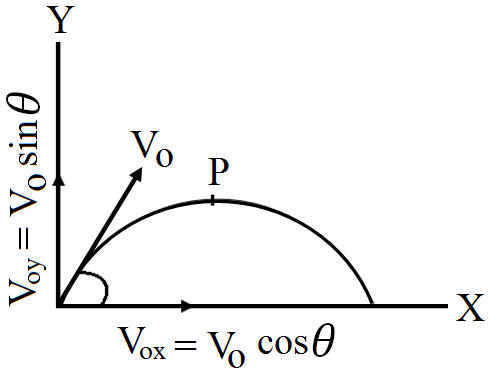
Let $v_{ox}$ and $v_{0y}$ respectively be the initial components of the velocity of the projectile along horizontal (x) and vertical (y) directions. Let $v_x$ and $v_y$ respectively be the horizontal and vertical components of velocity at a point P.
Time taken by the projectile to reach point P = t Applying the first equation of motion along the vertical and horizontal directions, we get: $v_y = v_{oy} = gt$ And $v_x = v_{ox}$
$\therefore\tan\theta=\frac{\text{v}_\text{y}}{\text{v}_\text{x}}=\frac{\text{v}_\text{oy}-\text{gt}}{\text{v}_\text{ox}}$ $\theta=\frac{\tan^{-1}(\text{v}_\text{oy}-\text{gt})}{\text{v}_\text{ox}}$

Need a full question paper?

Generate a complete, print-ready paper with questions like this in minutes — across 16+ boards, with answer keys.
Start Generating Free

Similar questions

Consider the situation of the previous problem. Suppose the block of mass $m_1$ is pulled by a constant force $F_1$ and the other block is pulled by a constant force $F_2$. Find the maximum elongation that the spring will suffer.
An air bubble of volume $1.0cm^3$ rises from the bottom of a lake 40m deep at a temperature of 12°C. To what volume does it grow when it reaches the surface, which is at a temperature of 35°C?
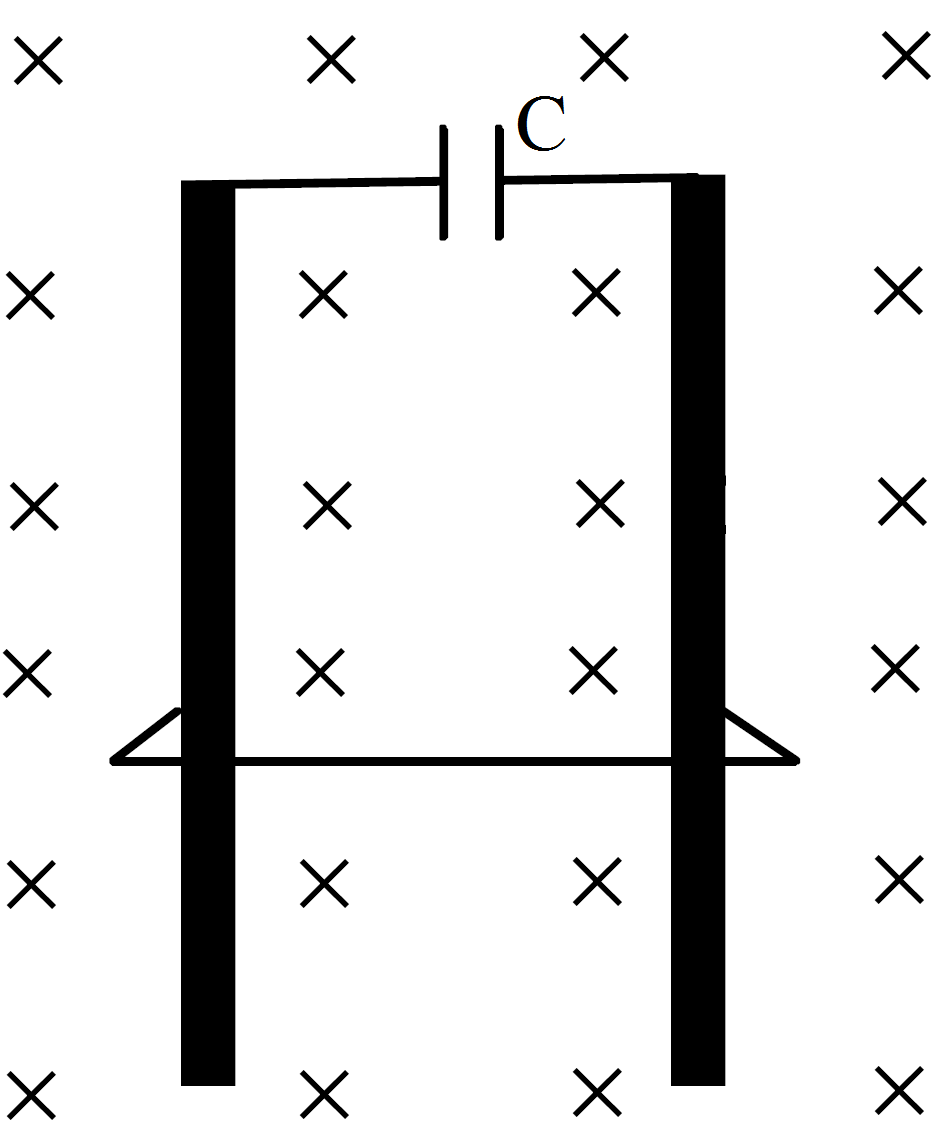
A wire of mass m and length l can slide freely on a pair of smooth, vertical rails (figure). A magnetic field B exists in the region in the direction perpendicular to the plane of the rails. The rails are connected at the top end by a capacitor of capacitance C. Find the acceleration of the wire neglecting any electric resistance.
Position $x$, time of particle moving in onedimensional motion depends on as follows :
$x=5+5 t-t^2$
(All quantities are in SI units) For this motion draw (i) displacement-time (ii) Velocity-time (iii) Acceleration-time graphs for the time interval $t=0 sec$ to $t=6 sec$ and describe the motion.
Explain free simple harmonic oscillation. Taking any one example, explain that the period and frequency of free oscillation depend only on the ratio of mass and stiffness of the objects.
Prove that if a, and a, are the amplitudes of two interfering waves $\phi$ and is their phase difference, the amplitude of the resultant wave is given by,
$\text{a}^2=\text{a}^2_1+\text{a}^2_2+2\text{a}_1\text{a}_2\cos\phi$
Consider the situation of the previous problem:
  1. Find the tension in the string in equilibrium.
  2. Suppose the ball is slightly pushed aside and released. Find the time period of the small oscillations.
A bat is flitting about in a cave, navigating via ultrasonic beeps. Assume that the sound emission frequency of the bat is $40 kHz$. During one fast swoop directly toward a flat wall surface, the bat is moving at $0.03$ times the speed of sound in air. What frequency does the bat hear reflected off the wall?
A $10kW$ drilling machine is used to drill a bore in a small aluminium block of mass $8.0kg$. How much is the rise in temperature of the block in $2.5$ minutes,assuming $50\%$ of power is used up in heating the machine itself or lost to the surroundings. Specific heat of aluminium = $0.91J g^{–1} K^{–1}$.
A point particle of mass $0.1kg$ is executing S.H.M. of amplitude of $0.1m$. When the particle passes through the mean position, its kinetic energy is $8 \times 10^{-3}$ joule. Obtain the equation of motion of this particle if the initial phase of oscillation is $45^\circ$