A 3m long ladder weighing 20 kg leans on a frictionless wall. Its feet rest on the floor 1 m from the wall as shown in Fig.6.27. Find the reaction forces of the wall and the floor.
Example-(6.9)
Download our app for free and get started
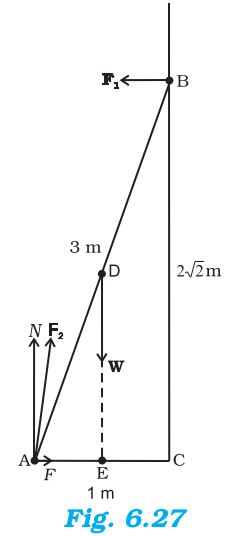
The ladder $AB$ is $3 m$ long, its foot $A$ is at distance $A C=1 m$ from the wall. From Pythagoras theorem, $BC =2 \sqrt{2} m$. The forces on the ladder are its weight $W$ acting at its centre of gravity D, reaction forces $F_1$ and $F_2$ of the wall and the floor respectively. Force $F_1$ is perpendicular to the wall, since the wall is frictionless. Force $F_2$ is resolved into two components, the normal reaction $N$ and the force of friction $F$. Note that $F$ prevents the ladder from sliding away from the wall and is therefore directed toward the wall.
For translational equilibrium, taking the forces in the vertical direction,
$
N-W=0 \quad\quad\text{(i)}
$
Taking the forces in the horizontal direction,
$
F-F_1=0 \quad\quad\text{(ii)}
$
For rotational equilibrium, taking the moments of the forces about A,
$
2 \sqrt{2} F_1-(1 / 2) W=0 \quad\quad\text{(iii)}
$
Now $\quad W=20 g =20 \quad 9.8 N =196.0 N$
From (i) $N=196.0 N$
From (iii) $F_1=W / 4 \sqrt{2}=196.0 / 4 \sqrt{2}=34.6 N$
From (ii) $F=F_1=34.6 N$
$
F_2=\sqrt{F^2+N^2}=199.0 N
$
The force $F_2$ makes an angle $\alpha$ with the horizontal,
$
\tan \alpha=N / F=4 \sqrt{2}, \quad \alpha=\tan ^{-1}(4 \sqrt{2}) \approx 80^{\circ}
$

Download our appand get started for free
Experience the future of education. Simply download our apps or reach out to us for more information. Let's shape the future of learning together!No signup needed.*
Similar Questions
- 1View SolutionA ball is whirled in a circle by attaching it to a fixed point with a string. Is there an angular rotation of the ball about its centre? If yes, is this angular velocity equal to the angular velocity of the ball about the fixed point?
- 2View SolutionA solid sphere rolls down two different inclined planes of the same heights but different angles of inclination.
- Will it reach the bottom with the same speed in each case?
- Will it take longer to roll down one plane than the other?
- If so, which one and why?
- 3In the HCl molecule, the separation between the nuclei of the two atoms is about $1.27\mathring{\text{A}}\big(1\mathring{\text{A}}= 10^{-10} \text{m}\big).$ Find the approximate location of the CM of the molecule, given that a chlorine atom is about 35.5 times as massive as a hydrogen atom and nearly all the mass of an atom is concentrated in its nucleus.View Solution
- 4A uniform sphere of mass m and radius R is placed on a rough horizontal surface. The sphere is struck horizontally at a height h from the floor. Match the following:View Solution
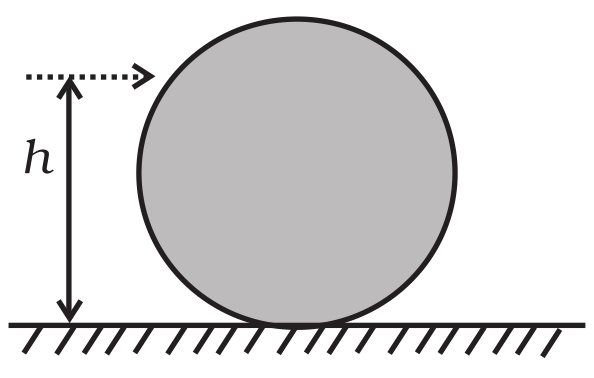
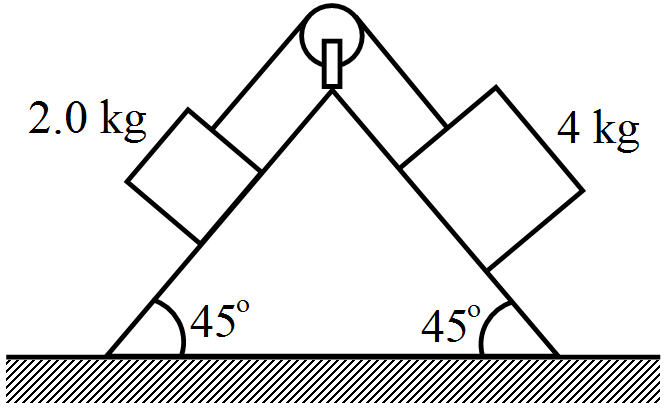
a. $\text{h}=\frac{\text{R}}{2}$ i. Sphere rolls without slipping with a constant velocity and no loss of energy. b. $\text{h}=\text{R}$ ii. Sphere spins clockwise, loses energy by friction. c. $\text{h}=\frac{3\text{R}}{2}$ iii. Sphere spins anti-clockwise, loses energy by friction. d. $\text{h}=\frac{7\text{R}}{5}$ iv. Sphere has only a translational motion, looses energy by friction. - 5The pulley shown in figure has a radius $10cm$ and moment of inertia $0.5kg-m^2$ about its axis. Assuming the inclined planes to be frictionless, calculate the acceleration of the $4.0kg$ block.View Solution
- 6The angular speed of a motor wheel is increased from $1200$ rpm to $3120$ rpm in $16$ seconds. $(i)$ What is its angular acceleration, assuming the acceleration to be uniform? $(ii)$ How many revolutions does the engine make during this time?View Solution
- 7A uniform square plate S(side c) and a uniform rectangular plate R(sides b, a) have identical areas and masses:View Solution
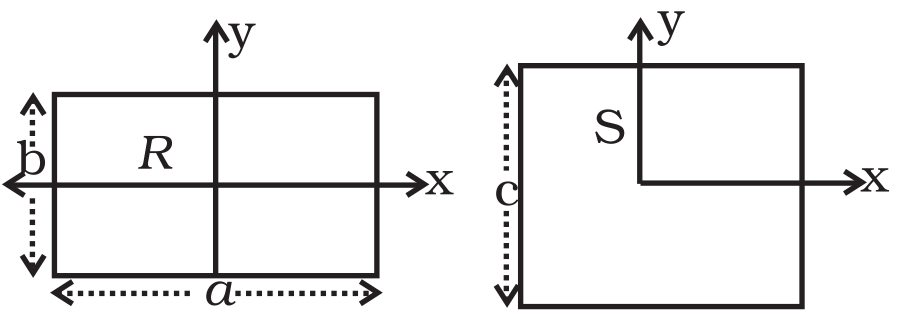
Show that:- $\frac{\text{I}_\text{xR}}{\text{I}_\text{xS}}<1$
- $\frac{\text{I}_\text{ys}}{\text{I}_\text{ys}}>1$
- $\frac{\text{I}_{2\text{R}}}{\text{I}_{2\text{s}}}>1$
- 8View SolutionA uniform rod of mass m and length l is struck at an end by a force F perpendicular to the rod for a short time interval t. Calculate:
- The speed of the centre of mass.
- The angular speed of the rod about the centre of mass.
- The kinetic energy of the rod.
- The angular momentum of the rod about the centre of mass after the force has stopped to act. Assume that t is so small that the rod does not appreciably change its direction while the force acts.
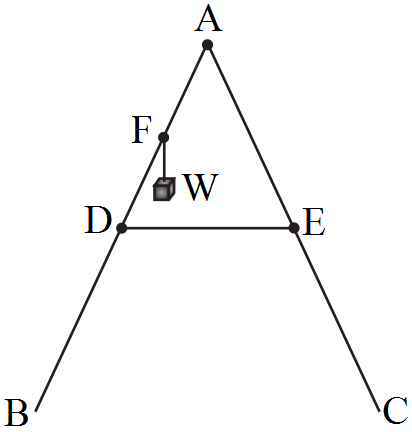
- 9As shown in the two sides of a step ladder BA and CA are $1.6m$ long and hinged at A. A rope DE, $0.5m$ is tied half way up. A weight $40kg$ is suspended from a point F, 1.2m from B along the ladder BA. Assuming the floor to be frictionless and neglecting the weight of the ladder, find the tension in the rope and forces exerted by the floor on the ladder. (Take $g = 9.8m/s^2$) (Hint: Consider the equilibrium of each side of the ladder separately).View Solution
- 10Point masses $m_1$ and $m_2$ are placed at the opposite ends of a rigid rod of length L, and negligible mass. The rod is to be set in rotation about an axis perpendicular to it. Find the position on this rod through which the axis should pass in order that the work required to set the rod in rotation with angular velocity $\omega_0$ should be minimum.View Solution