MCQ
જો $f(x) = max(sinx, sin^{-1}(cosx))$, તો 
  • A
    $ƒ$ એ દરેક બિંદુએ સતત થાય.
  • B
    $ƒ$ એ $1$ બિંદુએ અસતત થાય.
  • C
    $ƒ$ એ $2$ બિંદુએ અસતત થાય.
  • D
    $ƒ$ એ અનંત બિંદુએ અસતત થાય.

Answer

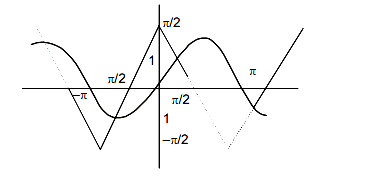
Given, $f(x)=\max \sin x, \sin ^{-1}(\cos x)$

$g(x)=\sin ^{-1}(\cos x)=\left\{\begin{array}{ll}\pi / 2-x & 0

$n(x)=\sin x$

Plotting on graph from graph, it is clear that $f(x)$ is continuous everywhere, Hence, shape points are not differentiable
Need a full question paper?

Generate a complete, print-ready paper with questions like this in minutes — across 16+ boards, with answer keys.

Start Generating Free

Similar questions

નીચેનામાંથી ક્યુ વિધાન એક-એક તો છે પણ વ્યાપત નથી.
$\mathop {\lim }\limits_{n \to \infty } \frac{1}{{{1^3} + {n^3}}} + \frac{4}{{{2^3} + {n^3}}} + .... + \frac{1}{{2n}} = . . . ..$
$\frac{{dy}}{{dx}} = \frac{{px + q}}{{ry + s}}$ નું ઉકેલ પરવલય દર્શાવે તો $.............$
જો $f\left( x \right) = f\left( {\pi + e - x} \right)$ અને $\int\limits_e^\pi {f\left( x \right)dx = \frac{2}{{e + \pi }}} $ તો $\int\limits_e^\pi {x\,\,f\left( x \right)dx = ..........} $
જો $A$ અને $B$ એ સ્વૈર અચળાંક છે હોય તો $y = A\cos \omega t + B\sin \omega t$ નું વિકલ સમીકરણ મેળવો.
$\cos \left[ {2{{\cos }^{ - 1}}\frac{1}{5} + {{\sin }^{ - 1}}\frac{1}{5}} \right] = $
પરવલયો $\mathrm{y}=4 \mathrm{x}-\mathrm{x}^2$ અને $3 \mathrm{y}=(\mathrm{x}-4)^2$ વડે આવૃત પ્રદેશનું ક્ષેત્રફળ મેળવો.
જો $P = \left[ {\begin{array}{*{20}{c}}
  1&0&0 \\ 
  3&1&0 \\ 
  9&3&1 
\end{array}} \right]$ અને $Q = [q_{ij}]$ એ $3\times3$ શ્રેણિક છે કે જેથી  $Q -P^5 = I_3$. તો $\frac{{{q_{21}} + {q_{31}}}}{{{q_{32}}}} =$
જો $A, B , C$ એ અનુક્રમે ત્રણ ભિન્ન ધન સદિશો $\hat i + \hat j,\,\hat i - \hat j,\,p\hat i - q\hat j + r\hat k$ છે અને બિંદુઓ $A, B , C$ એ રેખીય હોય તો નીચેનામાંથી ક્યુ વિધાન સાચુ છે ?
વિધેય $\cos ^{-1}\left(\frac{2 \sin ^{-1}\left(\frac{1}{4 x^{2}-1}\right)}{\pi}\right)$ નો પ્રદેશ $\dots\dots$છે.