MCQ
જો $f(x) = x{e^{x(1 - x)}}$, તો $f(x)$ એ . . .
- ✓$\left[ { - {1 \over 2},\,1} \right]$ પર વધતું
- B$R$ પર ઘટતું
- C$R$ પર વધતું
- D$\left[ { - {1 \over 2},1} \right]$ પર ઘટતું
$ = \,\,{e^{x(1 - x)}}\{ 1 + x(1 - 2x)\} = {e^{x(1 - x)}}.( - 2{x^2} + x + 1)$
Now by the sign-scheme for $ - 2{x^2} + x + 1$
$f'(x) \ge 0,$ if $x\, \in \,\left[ { - \frac{1}{2},\,1} \right],$ because ${e^x}(1 - x)$ is always positive.
So, $f(x)$ is increasing on $\left[ { - \frac{1}{2},\,1} \right]$.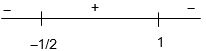
Generate a complete, print-ready paper with questions like this in minutes — across 16+ boards, with answer keys.
$f\left( x \right) = \left\{ \begin{gathered} x{\left\{ x \right\}^2},x \notin I \hfill \\ x\,\,\,\,\,\,\,\,\,\,,x \in I \hfill \\ \end{gathered} \right.,$
હોય તો નિચેનામાંથી ક્યુ સાચુ છે ?
(જ્યા $\{.\}$ એ અપૂર્ણાક વિધેય છે)