MCQ
જો વિધેય $f:N \to Z$ ; $f(n) = \left\{ \begin{array}{l}\frac{{n - 1}}{2},\;{\rm{when}}\;n\;{\rm{is}}\;{\rm{odd}}\\ - \frac{n}{2},\;{\rm{when\, }}n{\rm{\, is\, even}}\end{array} \right.$ એ $......$
  • A
    એક$-$એક છે અને વ્યાપ્ત નથી
  • B
    એક$-$એક નથી અને વ્યાપ્ત છે.
  • એક$-$એક અને વ્યાપ્ત
  • D
    એક$-$એક અને વ્યાપ્ત બંને નથી

Answer

Correct option: C.
એક$-$એક અને વ્યાપ્ત
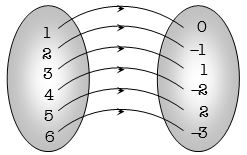
$f:N \to I$
$f(1) = 0,\,f(2) = - 1,\,f(3) = 1,\,f(4) = - 2,\,f(5) = 2$
and $f(6) = - 3$ so on.
In this type of function every element of set $A$ has unique image in set $B$ and there is no element left in set $B$. 
Hence $f$ is one$-$one and onto function.

Need a full question paper?

Generate a complete, print-ready paper with questions like this in minutes — across 16+ boards, with answer keys.

Start Generating Free

Similar questions

$\int \frac{x-1}{(x+1)^2} d x=\ .......... $
જો $f\left( x \right) = \int\limits_1^x {\sqrt {2 - {t^2}} dt.} $ તો ${x^2} - f'\left( x \right) = 0$ નાવાસ્તવિકબીજો $ = ...........$ થાય
જો $\left| {\,\begin{array}{*{20}{c}}{{a_1}}&{{b_1}}&{{c_1}}\\{{a_2}}&{{b_2}}&{{c_2}}\\{{a_3}}&{{b_3}}&{{c_3}}\end{array}\,} \right| = 5$; તો $\left| {\,\begin{array}{*{20}{c}}{{b_2}{c_3} - {b_3}{c_2}}&{{c_2}{a_3} - {c_3}{a_2}}&{{a_2}{b_3} - {a_3}{b_2}}\\{{b_3}{c_1} - {b_1}{c_3}}&{{c_3}{a_1} - {c_1}{a_3}}&{{a_3}{b_1} - {a_1}{b_3}}\\{{b_1}{c_2} - {b_2}{c_1}}&{{c_1}{a_2} - {c_2}{a_1}}&{{a_1}{b_2} - {a_2}{b_1}}\end{array}\,} \right|$ = . . .
$3$  કક્ષાવાળા વાસ્તવિક ચોરસ શ્રેણિકોના ગણ પર વ્યાખ્યાયિત સંબંધ $ R $ નીચે મુજબ લો. $R = \{(A,B)| A=P^{-1}BP $ જયાં $P$  સામાન્ય શ્રેણિક છે. $\} $

વિધાન $1:$ $R$  એ સામ્ય સંબંધ છે.

વિધાન $2$:કોઇપણ બે $3$$ \times $$3$ શ્રેણિકો $M,N$ માટે જેનાં પ્રતિવિધેયો મળે તો $(MN)^{-1} = N^{-1}M^{-1}$

જો $\int_{\log 2}^{x} \frac{du}{(e^u-1)^{\frac{1}{2}}}=\frac{\pi}{6},$ તો $e^x=\ ............ $
જો $F(\alpha ) = \left[ {\begin{array}{*{20}{c}}{\cos \alpha }&{ - \sin \alpha }&0\\{\sin \alpha }&{\cos \alpha }&0\\0&0&1\end{array}} \right]$, કે જ્યાં $\alpha \in R.$ તો ${[F(\alpha )]^{ - 1}} =\ .... . . .$
વિધેય $f(x) = \left\{ {\begin{array}{*{20}{c}}   {sgn \left( {\left[ x \right]} \right)\,\,\,\,;\,\,\,x \ne I} \\   {\left[ {sgn \left( x \right)} \right]\,\,\,;\,\,\,x = I} \end{array}} \right.$ એ . . .       (જ્યાં [.] એ મહતમ પૂર્ણાંક વિધેય છે અને  $sgn\ x$ એ ચિહ્ન વિધેય છે.)
વિધેય $x^x(x > 0) $ નું ન્યૂનત્તમ મૂલ્ય ક્યાં આગળ છે?
જો $A = \int\limits_1^{\sin \theta } {\frac{t}{{1 + {t^2}}}} dt$ અને  $B = \int\limits_1^{\cos ec\theta } {\frac{dt}{{t\left( {1 + {t^2}} \right)}}} $ , (કે જ્યાં  $\theta  \in \left( {0,\frac{\pi }{2}} \right))$, હોય તો  $\left| {\begin{array}{*{20}{c}}
A&{{A^2}}&{ - B}\\
{{e^{A + B}}}&{{B^2}}&{ - 1}\\
1&{{A^2} + {B^2}}&{ - 1}
\end{array}} \right|$ ની કિમંત મેળવો.
$\int\limits_{\pi /4}^{3\pi /4} {\frac{{dx}}{{1 + \cos x}}}   =$