MCQ
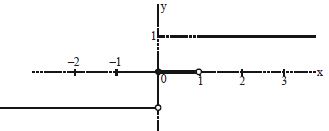
વિધેય $f(x) = \left\{ {\begin{array}{*{20}{c}}   {sgn \left( {\left[ x \right]} \right)\,\,\,\,;\,\,\,x \ne I} \\   {\left[ {sgn \left( x \right)} \right]\,\,\,;\,\,\,x = I} \end{array}} \right.$ એ . . .       (જ્યાં [.] એ મહતમ પૂર્ણાંક વિધેય છે અને  $sgn\ x$ એ ચિહ્ન વિધેય છે.)
  • A
    $x = 2$ આગળ સતત છે પરંતુ વિકલનીય નથી.
  • B
    દરેક પૂર્ણાંક આગળ અસતત છે.
  • માત્ર  $x = 0\,\,$ અને $1$ વિકલનીય નથી.
  • D
    દરેક પ્રાકૃતિક સંખ્યા માટે વિકલનીય નથી.
Answer

Correct option: C.
માત્ર  $x = 0\,\,$ અને $1$ વિકલનીય નથી.
c

Need a full question paper?

Generate a complete, print-ready paper with questions like this in minutes — across 16+ boards, with answer keys.

Start Generating Free

Similar questions

દીકગુણોતરો  $1,\,\,1,\,\,2$ અને $\sqrt 3 \,\, - \,\,1,\,\, - \,\,\sqrt 3 \,\, - \,\,1,\,\,4$ વાળી રેખાઓ વચ્ચેનો ખૂણો
ધારો કે બે ઘટનાઓ  $E_{1}$ અને $E_{2}$ માટે શરતી સંભાવનાઓ $P \left( E _{1} \mid E _{2}\right)=\frac{1}{2}$, $P \left( E _{2} \mid E _{1}\right)=\frac{3}{4}$ અને $P \left( E _{1} \cap E _{2}\right)=\frac{1}{8}$છે. તો,
${\tan ^{ - 1}}\,\left[ {\frac{{\sqrt {1 + {x^2}} + \sqrt {1 - {x^2}} }}{{\sqrt {1 + {x^2}} - \sqrt {1 - {x^2}} }}} \right] = $
ધારોકે $\alpha \in(0, \infty)$ અને $\mathrm{A}=$ $=\left[\begin{array}{lll}1 & 2 & \alpha \\ 1 & 0 & 1 \\ 0 & 1 & 2\end{array}\right]$જો $\operatorname{det}\left(\operatorname{adj}\left(2 A-A^{\mathrm{T}}\right) \cdot \operatorname{adj}\left(A-2 A^{\mathrm{T}}\right)\right)=2^8$ હોય, તો $(\operatorname{det}(A))^2$....................
જો A અને B કોણ પણ બે ઘટનાઓ હૉય $P(A)+P(B)-P(A \cap B)=P(A)$ તો _____________
જો $f(x) = \cos x,0 \le x \le {\pi \over 2}$, તો વાસ્તવિક સંખ્યા $‘c’$ મધ્યકમાન પ્રમેયનો ઉપયોગ કરી ને મેળવો.
અહી $\mathrm{y}=\mathrm{y}(\mathrm{x})$ એ વિકલ સમીકરણ $(y+1) \tan ^{2} x d x+\tan x d y+y d x=0$ $x \in\left(0, \frac{\pi}{2}\right)$ નો  ઉકેલ દર્શાવે છે . જો  $\lim _{x \rightarrow 0+} x y(x)=1$, તો  $\mathrm{y}\left(\frac{\pi}{4}\right)$ ની કિમંત મેળવો.
$\int_{}^{} {\frac{{{{\sin }^8}x - {{\cos }^8}x}}{{1 - 2{{\sin }^2}x{{\cos }^2}x}}\;dx = } $
ધારો કે $f: \mathbb{R} \rightarrow \mathbb{R}$ એ એવું ત્રીવિક્લનીય વિધેય છે કે જેથી $f(0)=0, f(1)=1, f(2)=-$ $1, f(3)=2$ અને $f(4)=-2$. તો $\left(3 f^{\prime} f^{\prime \prime}+f f^{\prime \prime}\right)(x)$ નાં શૂન્યની ન્યૂનતમ સંખ્યા ......... છે.
$\int_{}^{} {\frac{{\sin x + {\rm{cosec}}\,x}}{{\tan x}}dx = } $