MCQ
$K.E.$ of gas molecules is zero at:
  • A
    $0^\circ C$
  • B
    $273^\circ t$
  • $-273^\circ C$
  • D
    None of the above

Answer

Correct option: C.
$-273^\circ C$

Need a full question paper?

Generate a complete, print-ready paper with questions like this in minutes — across 16+ boards, with answer keys.

Start Generating Free

Similar questions

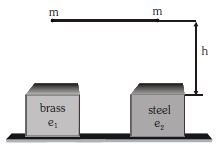
A dumbbell consisting of two masses $m$ each, connected by a light rigid rod of length $l$, falls on two pads of equal height, one steel and the other brass through a height $h$. The coefficient of restitution are $e_1$ and $e_2$ ($e_1 < e_2$). To what maximum height will the centre of mass of the dumbbell rise after bouncing of the pads?
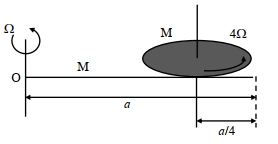
A thin rod of mass $M$ and length $a$ is free to rotate in horizontal plane about a fixed vertical axis passing through point $O$. A thin circular disc of mass $M$ and of radius $a / 4$ is pivoted on this rod with its center at a distance $a / 4$ from the free end so that it can rotate freely about its vertical axis, as shown in the figure. Assume that both the rod and the disc have uniform density and they remain horizontal during the motion. An outside stationary observer finds the rod rotating with an angular velocity $\Omega$ and the disc rotating about its vertical axis with angular velocity $4 \Omega$. The total angular momentum of the system about the point $O$ is $\left(\frac{ M a^2 \Omega}{48}\right) n$. The value of $n$ is. . . . .
The respective speeds of the molecules are $1, 2, 3, 4$ and $5\, km/sec.$ The ratio of their $r.m.s. $ velocity and the average velocity will be
Stationary waves
The plot that depicts the behavior of the mean free time $t$ (time between two successive collisions) for the molecules of an ideal gas, as a function of temperature $(T)$, qualitatively, is (Graphs are schematic and not drawn to scale)
Displacement between maximum potential energy position and maximum kinetic energy position for a particle executing $S.H.M.$ is
One large soap bubble of diameter D breaks into 27 bubbles having surface tension T. The change in surface energy is
$A$ slender uniform rod of length $\lambda$ is balanced vertically at a point $P$ on a horizontal surface having some friction. If the top of the rod is displaced slightly to the right, the position of its centre of mass at the time when the rod becomes horizontal :
A round body is given translational velocity and released on a surface that has friction. Then
A slender rod of mass $M$ and length $L$ is hinged about an end to swing freely in a vertical plane. However, its density is nonuniform and varies linearly from hinged end to the free end doubling its value. The moment of inertia of the rod, about the rotation axis passing through the hinge point is