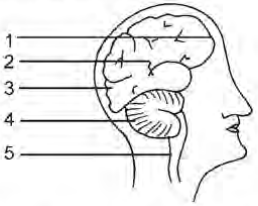
Question
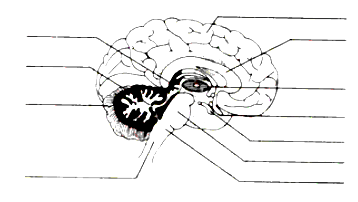
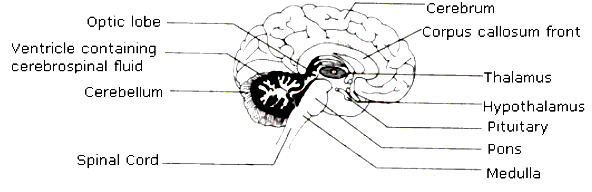
Label the following diagram :
Answer

(b) Longitudinal section of Human brain :

Need a full question paper?

Generate a complete, print-ready paper with questions like this in minutes — across 16+ boards, with answer keys.
Start Generating Free

Similar questions

Leaves of the sensitive plant wilt and droop down on a slight touch. What mechanism brings about this change?
How can the knowledge of processes of reproduction help people in limiting the size of their families? Give two concrete examples
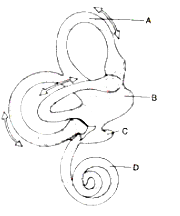
The diagram alongside represents the structure found in the inner ear. Study the same and then answer the questions that follow:
(i) Name the parts labelled A, B, C and D.
(ii) Name the parts of the ear responsible for transmitting impulses to the brain.
(iii) Name the part labelled above which is responsible for:
1. Static equilibrium. 2. Dynamic equilibrium. 3. Hearing
(iv) Name the audio receptor cells which pick up vibrations.
(v) Name the fluid present in the inner ear.
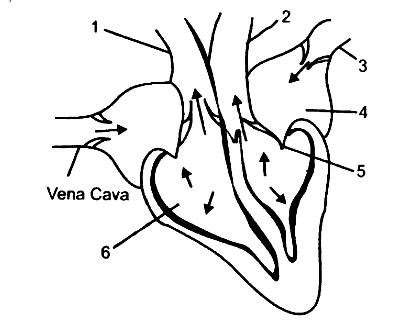
The diagram given below represents the human heart in one phase of its activity. Study the same and then answer the questions that follow:

(i) Name the phase.
(ii) Which parts of the heart are contracting in this phase ? Give a reason to support your answer.
(iii) Name the part numbered 1 to 6.
(iv) What type of blood flows through the parts marked ‘1’ and ‘2’?
(v) How many valves are closed in this phase?
List two major harmful effects of the following:
Too much gaseous exhausts containing $CO_2$​​​​​​​ and $SO_2.$
Industrial melanism provides a good example of natural selection. Discuss.
Draw the diagram external features of the heart.
Given below is a portion of the diagram to show the diagrammatic highly magnified view of a single human sperm. Complete the diagram to show its normal structure.
Study the diagram and answer the following questions:

Image
(i) What disabilities would result from damage to part 3 and damage to part 4?
(ii) Name the brain membranes.
(iii) What is meningitis?
Match the items of column I with those of column II
Column I Column II
1β  (beta) cells of islets of
Langerhans
acondition due to undersecretion of
thyroxine in adults
2Thyroid bGlucocorticoids
3Cretinism cExophthalmic goitre
4Addison's disease dIncreases heart beat
5Hypothyroidism eThyroxine
6Myxoedema fAdrenal cortex
7Adrenaline Under secretion of
thyroxine in a
child
hUnder secretion of
thyroxine in a
child