Questions

[3 marks Question Answer]

🎯

Test yourself on this topic

10 questions · timed · auto-graded

Question 13 Marks
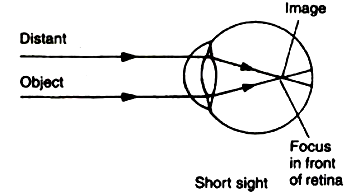
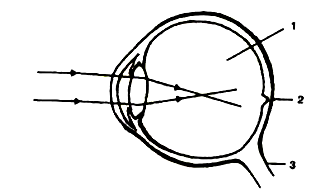
Given alongside is a diagram depicting a defect of the human eye. Study the same and then answer the questions that follow:
(i) Identify the defect.
(ii) Name the parts labelled 1, 2 and 3.
(iii) Give labelled two possible reasons for this eye defect.
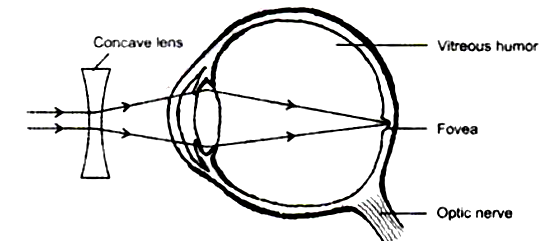
(iv) Draw a labelled diagram to show how the above mentioned defect is rectified.
Answer
(i) Myopia.
(ii) 1. Vitreous humor
2. Fovea
3. Optic nerve
(iii) 1. Lengthening of the eyeball from front to back.
2. Lens is too curved.
(iv) Correction of Myopia:
View full question & answer
Question 23 Marks
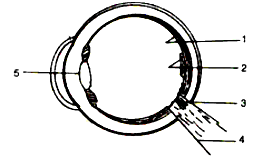
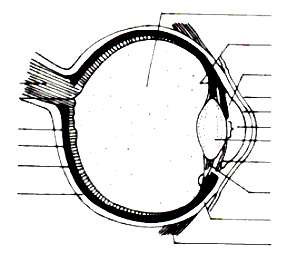
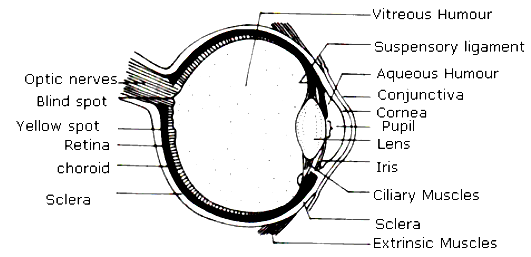
The diagram alongside represents a section of a mammalian eye.
(i) Label the parts 1 to 5 of the diagram.
(ii) State the function of the parts labelled 4 and 5.
(iii) With the help of a diagram show the short sightedness.
Answer
(i) 1- Retina
2 - Yellow spot
3 - Blind spot
4 - Optic nerve
5 - Lens
(ii) Optic nerves - It transmits the impulses to the brain.
Lens - It focuses the image on the retina.
(iii) Short sightedness:
View full question & answer
Question 33 Marks
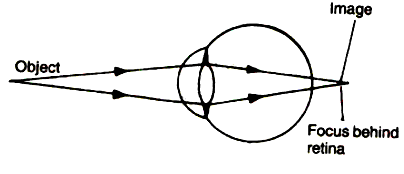
The diagram alongside represents a certain defect of vision of the human eye.
(i) Name the defect.
(ii) Describe briefly the condition in the eye responsible for the defect.
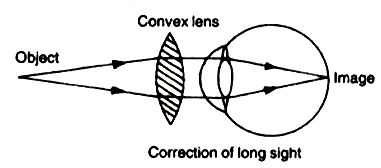
(iii) Redraw the figure by adding a suitable lens correcting the defect. Label the parts through which light-rays pass.
(iv) What special advantage do human beings derive in having both eyes facing forward?
Answer
(i) Hypermetropia.
(ii) There are two main conditions in the eye which is responsible for this defect :
1. Shortening of the eyeball from front to back.
2. The lens is less concave.
(iii) Correction of Hypermetropia:

(iv) Both the eyes facing forward helps in judging the depth or relative distance. This is due to overlapping images formed in brain from both eyes which focus on an object together at one time.
View full question & answer
Question 43 Marks
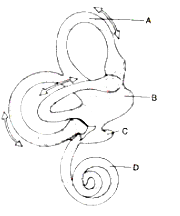
The diagram alongside represents the structure found in the inner ear. Study the same and then answer the questions that follow:
(i) Name the parts labelled A, B, C and D.
(ii) Name the parts of the ear responsible for transmitting impulses to the brain.
(iii) Name the part labelled above which is responsible for:
1. Static equilibrium. 2. Dynamic equilibrium. 3. Hearing
(iv) Name the audio receptor cells which pick up vibrations.
(v) Name the fluid present in the inner ear.
Answer
(i) A - Semi-circular canal
B - Utriculus
C - Sacculus
D - Cochlea
(ii) Auditory nerve.
(iii) 1. Utriculus and sacculus
2. Semi-circular canal
3. Cochlea
(iv) Sensory cells of organ of Corti
(v) Perilymph
View full question & answer
Question 63 Marks
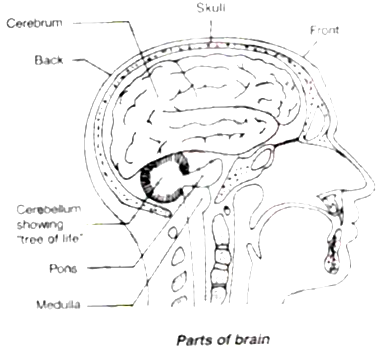
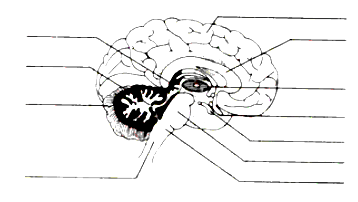
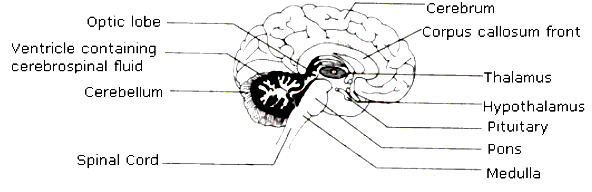
Draw a diagram of the side view of human brain and label the part which suits the following functions/ descriptions:
(i) It lies below and behind the cerebrum. It consists of three parts.
(ii) It is a cross-wise broad band of fibres which comments medulla oblongata, cerebellum and cerebrum.
(iii) It is the lower most and hinder part of the brain which continues below into spinal cord
(iv) It is a small thick-walled area which lies hidden below the cerebrum.
(v) It is the largest part of the brain which constitutes more than 80% and possesses 6-7 billion neurons.
(vi) It takes part in relaying sensory impulses and regulation of smooth muscle activity?
Answer

(i) Cerebellum
(ii) Cerebral peduncles
(iii) Medulla oblongata
(iv) Olfactory lobes
(v) Cerebrum
(vi) Diencephalon
View full question & answer
Question 73 Marks
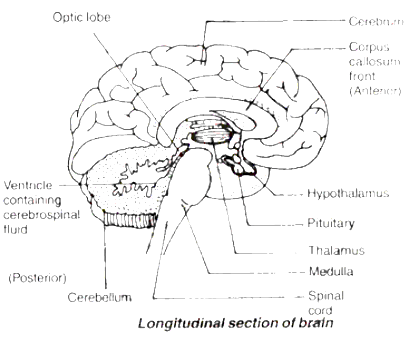
Draw a well-labelled diagram of the vertical section of mammalian brain.
Answer
vertical section of Mammalian brain :
View full question & answer
Question 103 Marks
Distinguish between the following pair of words:
Myopia and hypermetropia
Answer
Myopia hypermetropia
(i) The image of distant object is produced in the front and not on the retina .(i) The image is produced beyond the retina as the light rays are unable to converge on the retina.
(ii) It results from abnormally long eyeball .(ii) It results from abnormally short eyeball.
(iii) The defect can be produced by high convexity of the lens .(iii) The defect can be produced by low convexity of the lens .
(iv) It can be corrected by the use of spectacles having concave lens .(iv) It can be corrected by the use of spectacles having convex lens .
View full question & answer
[3 marks Question Answer] - Biology STD 10 Questions - Vidyadip