Question
LED is a p-n junction diode which is:

Answer

  1. Forward biased.
Explanation:
An LED is a light emitting diode. The LED emits light when it is forward biased and it emits no light when it is reverse biased. The intensity of light is proportional to the square of the current flowing through the device.
When a junction diode is forward biased, energy is released at the junction due to recombination of electrons and holes. In the junction diode made of gallium arsenide or indium phosphide, the energy is released in visible region. Thus, light is emitted form the diode and hence the name 'light emitting diode'.

Need a full question paper?

Generate a complete, print-ready paper with questions like this in minutes — across 16+ boards, with answer keys.
Start Generating Free

Similar questions

The state of charge inside a closed surface is changed in such a way that total charge remains constant, the flow of electric flux from the closed surface:
The slopes of anode and mutual characteristics of a triode are $0.02\ mA\  V^{–1}$ and $1\ mA\  V^{–1}$ respectively. What is the amplification factor of the valve
A body has its centre of mass at the origin. the x-coordinates of the particles:
  1. May be all positive.
  2. May be all negative.
  3. May be all non-negative.
  4. May be positive for some cases and negative in other cases.
A unitless quantity:
  1. Never has a non-zero dimension.
  2. Always has a non-zero dimension.
  3. May have a non-zero dimension.
  4. Does not exist.
Magnifying glass forms:
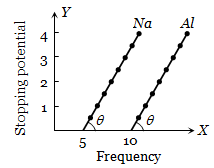
From the figure describing photoelectric effect we may infer correctly that         
Two bulbs, one of 50 watt and another of 25 watt are connected in series to the mains. The ratio of the currents through them is(a) 2 : 1(b) 1 : 2(c) 1 : 1(d) Without voltage, cannot be calculated
   
   
An electric dipole is placed at the centre of a sphere, choose the correct options:
A constant current i is maintained in a solenoid. Which of the following quantities will increase if an iron rod is inserted in the soleniod along axis?
  1. Magnetic field at the centre.
  2. Mangetic flux linked with the solenoid.
  3. Self-inductance of the solenoid.
  4. Rate of Joule heating.
A P-type semiconductor has acceptor levels $57\ meV$ above the valence band. The maximum wavelength of light required to create a hole is $($Planck’s constant $h = 6.6 \times 10^{-34} J-s)$