Question
Let a source of alternating e.m.f. $\text{E} = \text{E}_\circ\sin\omega\text{t}$ be connected to a circuit containing a pure inductance L. If I is the value of instantaneous current in the circuit, then $\text{I}=\text{I}_\circ\sin\Big(\omega\text{t}-\frac{\pi}{2}\Big).$ The inductive reactance limits the current in a purely inductive circuit and is given by $\text{X}_\text{L}= \text{W}_\text{L}.$
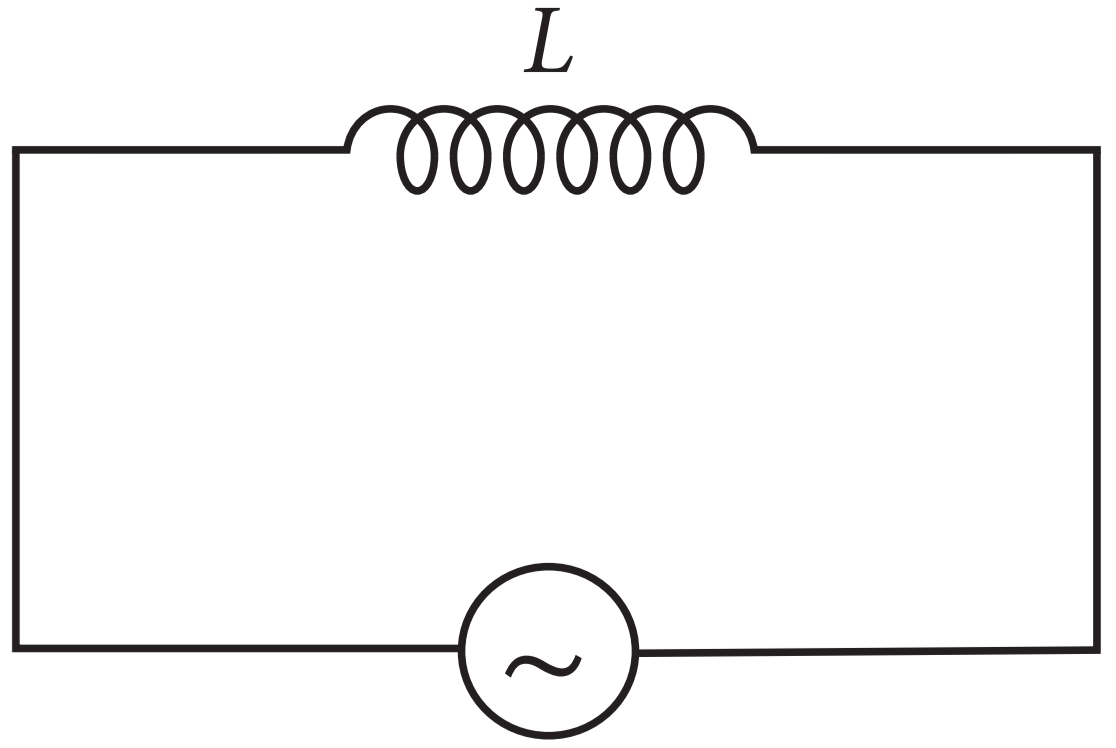
  1. A 100 hertz a.c. is flowing in a 14mH coil. The reactance is:
  1. $15\Omega$
  2. $7.7\Omega$
  3. $8.8\Omega$
  4. $10\Omega$
  1. In a pure inductive circuit, resistance to the flow of current is offered by:
  1. Resistor
  2. Inductor
  3. Capacitor
  4. Resistor and inductor
  1. In a inductive circuit, by what value of phase angle does alternating current lags behind e.m.f.?
  1. 45º
  2. 90º
  3. 120º
  4. 75º
  1. How much inductance should be connected to 200V, 50Hz a.c. supply so that a maximum current of 0.9A flows through it?
  1. 5H
  2. 1H
  3. 10H
  4. 4.5H
  1. The maximum value of current when inductance of 2H is connected to 150V, 50Hz supply is:
  1. 0.337A
  2. 0.721A
  3. 1.521A
  4. 2.522A

Answer

  1. (c) $8.8\Omega$
Explanation:
Inductive reactance,
$\text{X}_\text{L}= \text{W}_\text{L}=2\pi\mu\text{L}$
$=2\pi\times100\times14\times10^{-3}$
$\text{X}_\text{L}=8.8\Omega$
  1. (b) Inductor
  2. (b) 90º
Explanation:
In an inductor vol tag: leads the current by $\frac{\pi}{2}$ or current lags the voltage by $\frac{\pi}{2}.$
  1. (b) 1H
Explanation:
The current in the inductor coil is given by,
$\text{I}_0=\frac{\text{E}_0}{\text{X}_\text{L}}=\frac{\sqrt{2}\text{E}_\text{V}}{2\pi\mu\text{L}}$
$\text{L}=\frac{\sqrt{2}\text{E}_\text{V}}{2\pi\mu\text{I}_0}=\frac{1.414\times200}{2\times3.14\times50\times0.9}=1\text{H}$
  1. (a) 0.337A
Explanation:
Inductive reactance,
$\text{X}_\text{L}= \text{W}_\text{L}=2\pi\mu\text{L}$
$=2\pi\times3.14\times50\times2=628\Omega$
$\text{I}_0=\frac{\text{E}_0}{\text{X}_\text{L}}$
$\Rightarrow\text{I}_0=\frac{\sqrt{2}\times\text{E}_\text{V}}{\text{X}_\text{L}}=\frac{\sqrt{2}\times150}{628}=0.337\text{A}$

Need a full question paper?

Generate a complete, print-ready paper with questions like this in minutes — across 16+ boards, with answer keys.

Start Generating Free

Similar questions

What is logic gate? Differentiate between AND gate and OR gate.
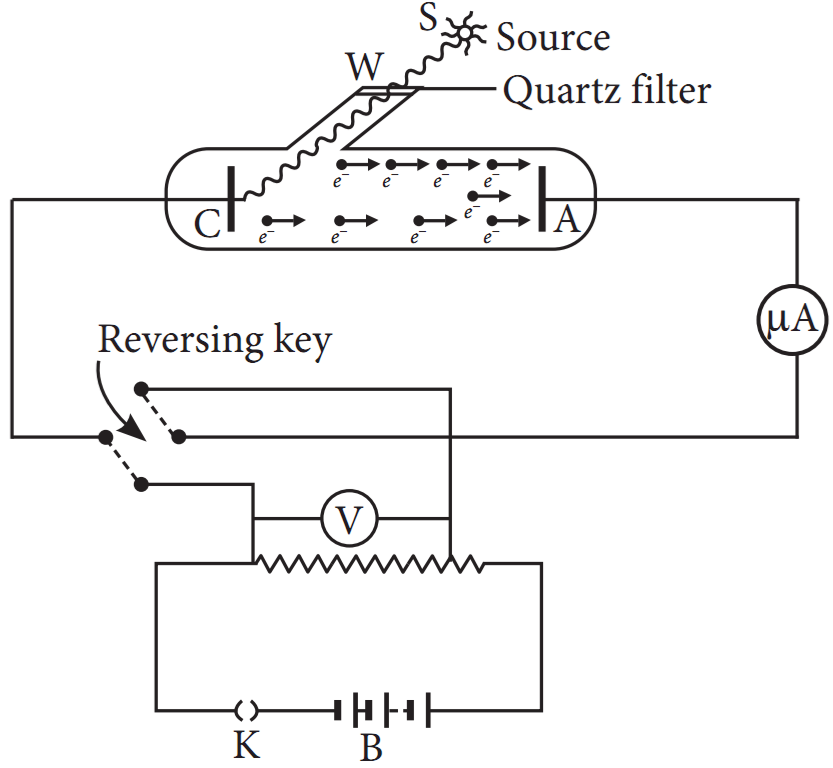
When a monochromatic radiations of suitable frequency obtained from source $S,$ after being filtered by a filter attached on the window $W,$ fall on the photosensitive place $C,$ the photo electrons are emitted from $C,$ which get accelerated towards the plate $A$ if it is kept at positive potential. These electrons flow in the outer circuit resulting in photoelectric current. Due to it, the microammeter shows a deflection. The reading of micrommeter measures the photoelectric current.

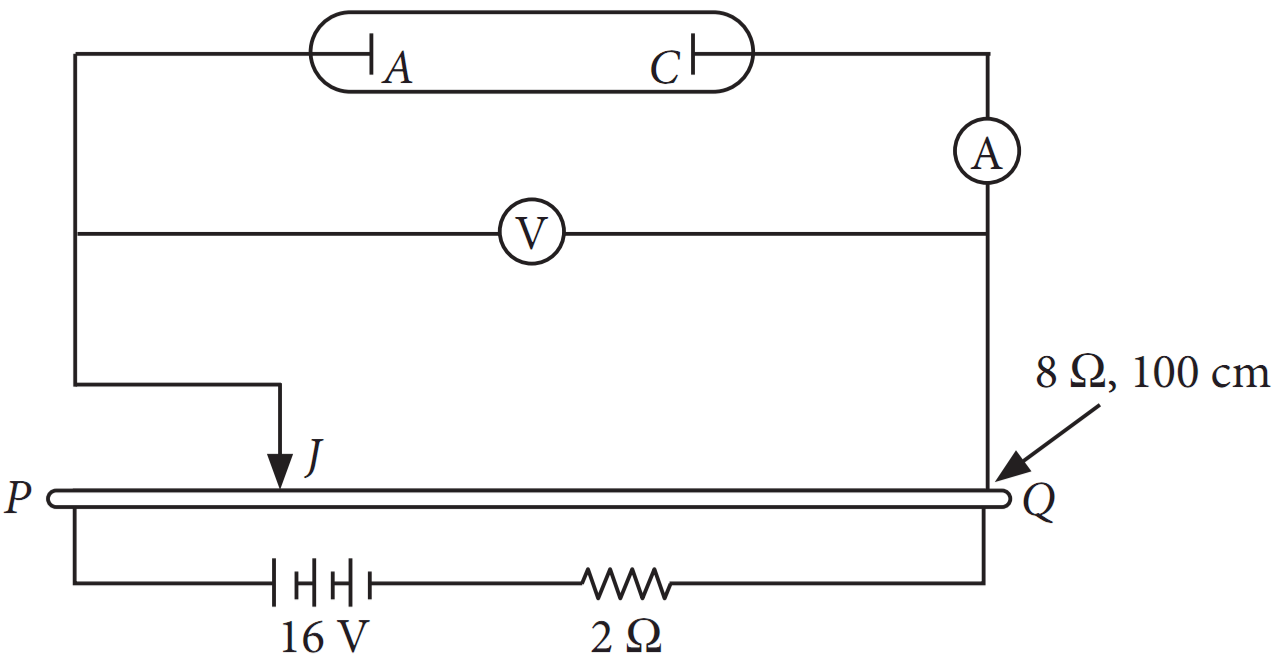
An experimental setup of verification of photoelectric effect is shown in figure. The voltage across the electrodes is measured with the help ofan ideal voltmeter, and which can be varied by moving jockey Jon the potentiometer wire. The battery used in potentiometer circuit is of $16 V$ and its internal resistance is $2\Omega$. The resistance of $100\ cm$ long potentiometer wire is $8\Omega$.

The photocurrent is measured with the help of an ideal ammeter. Two plates of potassium oxide of area $50\ cm^2$ at separation $0.5\ mm$ are used in the vacuum tube. Photocurrent in the circuit is very small, so we can treat the potentiometer circuit as an independent circuit.​​​​​​​
Light
$1$ Violet
$2$ Blue
$3$ Green
$4$ Yellow
$5$ Orange
$6$ Red
$\lambda(\text{in } \mathring{\text{A}})$
$4000-500$ $4500-5000$ $5000-5500$ $5500-6000$ $6000-6500$ $6500-7000$
  1. When radiation falls on the cathode plate, a current of $2\mu\text{A}$ is recorded in the ammeter. Assuming that the vacuum tube setup follows Ohm's law, the equivalent resistance of vacuum tube operating in the case when jockey is at end $P$ is:
  1. $8\times10^8\Omega$
  2. $16\times10^6\Omega$
  3. $8\times10^6\Omega$
  4. $10\times10^6\Omega$
  1. It is found that ammeter current remains unchanged $(2\mu\text{A})$ even when the jockey is moved from the end $P$ to the middle point of the potentiometer wire. Assuming that all the incident photons eject electrons and the power of the light incident is $4\times10^{-6}\Omega$. Then, the color of the incident light is:
  1. Green
  2. Violet
  3. Red
  4. Orange
  1. Which of the following colors may not give photoelectric effect for this cathode?
  1. Green
  2. Violet
  3. Red
  4. Orange
  1. When other light falls on the anode plate, the anuneter reading zero till jockey is moved from the end $P$ to the middle point of the wire $PQ$. Therefore, the deflection is recorded in the anuneter. The maximum kinetic energy of the emitted electron is:
  1. $16eV$
  2. $8eV$
  3. $4eV$
  4. $10eV$
  1. If the intensity of incident radiation is increased twice, the number of photoelectrons emitted per second will be:
  1. Halves
  2. Double
  3. Remain same
  4. Four times
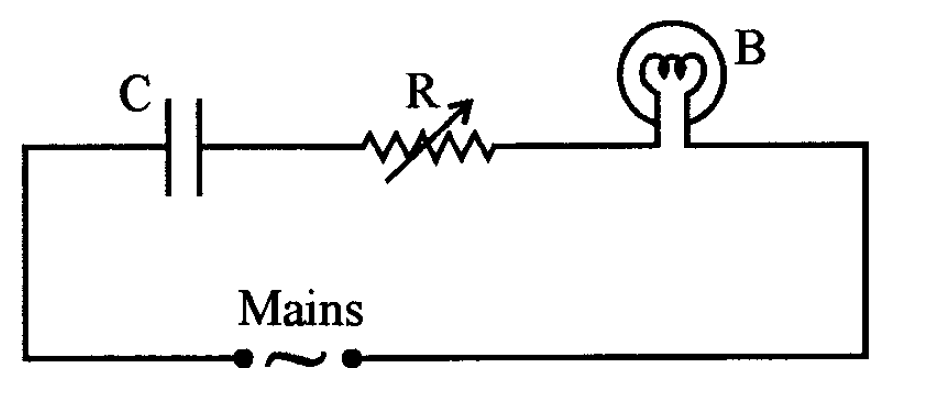
A capacitor'C', a variable resistor 'R' and a bulb 'B' are connected in series to the ac mains in circuit as shown. The bulb glows with some brightness. How will the glow of the bulb change if (i) a dielectric slab is introduced between the plates of the capacitor, keeping resistance R to be the same; (ii) the resistance R is increased keeping the same capacitance?
When a ferromagnetic material goes through a hysteresis loop, its thermal energy is increased. Where does this energy come from?
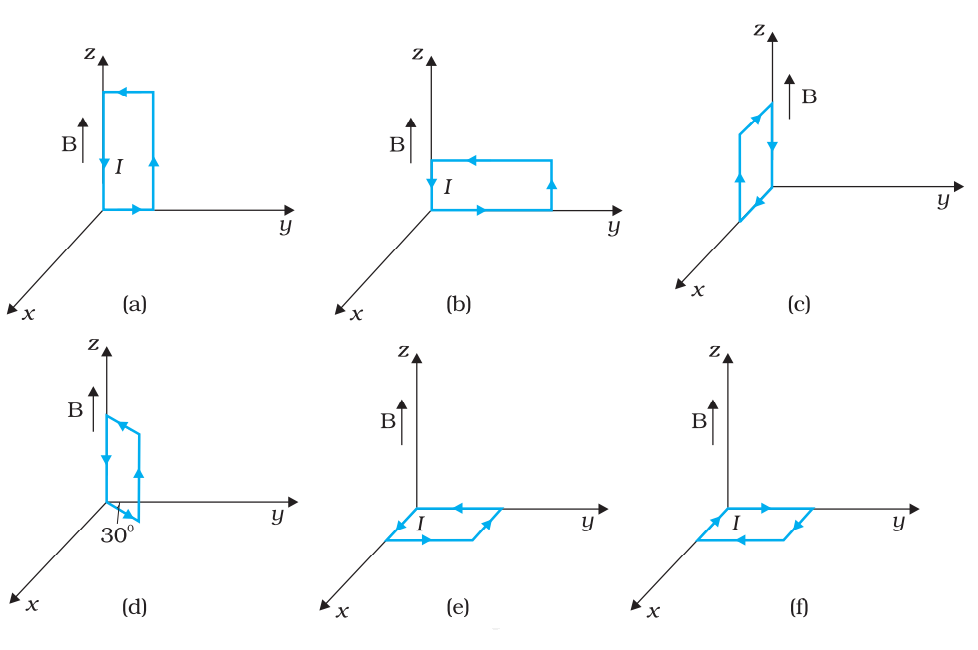
A uniform magnetic field of $3000 G$ is established along the positive $z-$ direction. $A$ rectangular loop of sides $10 \ cm $ and $5 \ cm$ carries a current of $12 A$. What is the torque on the loop in the different cases shown in Fig.? What is the force on each case? Which case corresponds to stable equilibrium?
An elevator is descending with uniform acceleration. To measure the acceleration, a person in the elevator drops a coin at the moment the elevator starts. The coin is 6ft above the floor of the elevator at the time it is dropped. The person observes that the coin strikes the floor in 1 second. Calculate from these data the acceleration of the elevator.
In how many bands the full range of radiowaves can be divided ? Describe about all the bands in brief.
  1. A small compass needle of magnetic moment $'m\ ’ $ is free to turn about an axis perpendicular to the direction of uniform magnetic field $'B\ ’$. The moment of inertia of the needle about the axis is $'I\ ’$. The needle is slightly disturbed from its stable position and then released. Prove that it executes simple harmonic motion. Hence deduce the expression for its time period.
  2. A compass needle, free to turn in a vertical plane orients itself with its axis vertical at a certain place on the earth. Find out the values of $(i)$ horizontal component of earth’s magnetic field and $(ii)$ angle of dip at the place.
A magnetic dipole of magnetic moment $0.72A-m^2$ is placed horizontally with the north pole pointing towards bsouth. Find the position of the neutral point if the horizontal component of the earth's magnetic field is $18\mu\text{T.}$
The radius of a thin hollow metal sphere (spherical shell) is 30 cm . And there is a charge of 500 $\mu C$ on that spherical shell. Find the electric field intensity at a distance.(i) 1 meter, (ii) 30 cm , (iii) 10 cm , from the centre of the cell.