Let $\bar v , \bar v_{rms}$ and $v_p$ respectively denote the mean speed, root mean square speed and most probable speed of the molecules in an ideal monoatomic gas at absolute temperature $T$. The mass of the molecule is $m$. Then
Medium


Download our appand get started for free
Experience the future of education. Simply download our apps or reach out to us for more information. Let's shape the future of learning together!No signup needed.*
Similar Questions
- 1View SolutionSupposing the distance between the atoms of a diatomic gas to be constant, its specific heat at constant volume per mole (gram mole) is
- 2Pressure versus temperature graph of an ideal gas at constant volume $V$ of an ideal gas is shown by the straight line $A$. Now mass of the gas is doubled and the volume is halved, then the corresponding pressure versus temperature graph will be shown by the lineView Solution
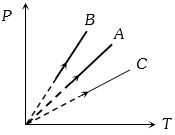
- 3In the absence of intermolecular force of attraction, the observed pressure $P$ will beView Solution
- 4The correct relation between the degree of freedom $f$ and the ratio of specific heat $\gamma$ isView Solution
- 5$N( < 100)$ molecules of a gas have velocities $1, 2, 3\,.\,.\,.\,.\,.N/km/s$ respectively. ThenView Solution
- 6For an ideal gas the instantaneous change in pressure $'{p} '$ with volume $'v'$ is given by the equation $\frac{{dp}}{{dv}}=-{ap} .$ If ${p}={p}_{0}$ at ${v}=0$ is the given boundary condition, then the maximum temperature one mole of gas can attain is :View Solution
(Here ${R}$ is the gas constant)
- 7View SolutionOne mole of a monoatomic ideal gas is mixed with one mole of a diatomic ideal gas. The molar specific heat of the mixture at constant volume is
- 8View SolutionBoyle's law holds for an ideal gas during
- 9An ideal gas equation can be written as $P=\frac{\rho R T}{M_{0}}$ where $\rho$ and $M_{0}$ are respectively,View Solution
- 10A flask is filled with $13\, gm$ of an ideal gas at ${27}^o C$ and its temperature is raised to ${52}^o C$. The mass of the gas that has to be released to maintain the temperature of the gas in the flask at ${52}^o C$ and the pressure remaining the same is ..... $g$View Solution