The correct relation between the degree of freedom $f$ and the ratio of specific heat $\gamma$ is
AIPMT 2000,JEE MAIN 2021, Medium


Download our appand get started for free
Experience the future of education. Simply download our apps or reach out to us for more information. Let's shape the future of learning together!No signup needed.*
Similar Questions
- 1Two gases occupy two containers $A$ and $B$ the gas in $A$, of volume $0.10\,m ^3$, exerts a pressure of $1.40\,MPa$ and that in $B$ of volume $0.15 m ^3$ exerts a pressure $0.7\,MPa$. The two containers are united by a tube of negligible volume and the gases are allowed to intermingle. Then if the temperature remains constant, the final pressure in the container will be (in MPa)View Solution
- 2A gas is filled in a vessel at a pressure given by $P = \left( {6.02 \times {{10}^{23}}} \right)kT$ where $k$ is the Boltzmann constant and $T$ is the absolute temperature. The number of molecules per unit volume of the gas isView Solution
- 3Find $\gamma$ for the mixture of $11\, gm CO _{2}$ and $14\, gm N _{2} ?$View Solution
- 4One mole of an ideal gas requires $207\, J$ heat to raise the temperature by $10 \,K$ when heated at constant pressure. If the same gas is heated at constant volume to raise the temperature by the same $10\, K,$ the heat required is ...... $J$View Solution
(Given the gas constant $R = 8.3J/mol{\rm{ - }}K$)
- 5An ideal gas filled in a cylinder occupies volume $V$. The gas is compressed isothermally to the volume $V/3$. Now, the cylinder valve is opened and the gas is allowed to leak keeping temperature same. What percentage of the number of molecules should escape to bring the pressure in the cylinder back to its original value?View Solution
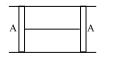
- 6A cylindrical tube of cross-sectional area $A$ has two air tight frictionless pistons at its two ends. The pistons are tied with a straight two ends. The pistons are tied with a straight piece of metallic wire. The tube contains a gas at atmospheric pressure $P_0$ and temperature $T_0$. If temperature of the gas is doubled then the tension in the wire isView Solution
- 7At $NTP$ the mass of one litre of air is $1.293\, gm.$ The value of specific gas constant will be ...... $J/K-gm$View Solution
- 8View SolutionThe vapour of a substance behaves as a gas
- 9View SolutionInternal forces acting in a system of particle can change
- 10View SolutionAt a given volume and temperature, the pressure of a gas