MCQ
Let $S$ be the set of all points in $(-\pi , \pi )$ at which the function, $f(x) = min\, \{sin\,x, cos\,x\}$ is non-differentiable. Then $S$ is a subset of which of the following?
  • A
    $\left\{ { - \frac{\pi }{4},0,\frac{\pi }{4}} \right\}$
  • $\left\{ { - \frac{{3\pi }}{4}, - \frac{\pi }{4},\frac{{3\pi }}{4},\frac{\pi }{4}} \right\}$
  • C
    $\left\{ { - \frac{\pi }{2}, - \frac{\pi }{4},\frac{\pi }{4},\frac{\pi }{2}} \right\}$
  • D
    $\left\{ { - \frac{{3\pi }}{4}, - \frac{\pi }{2},\frac{\pi }{2},\frac{{3\pi }}{4}} \right\}$
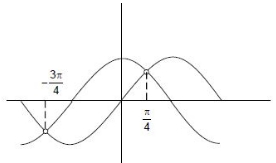
Answer

Correct option: B.
$\left\{ { - \frac{{3\pi }}{4}, - \frac{\pi }{4},\frac{{3\pi }}{4},\frac{\pi }{4}} \right\}$
b
Hence number of points where $f(x)$ is non-differentiable are $2$

which are $\frac{{ - 3\pi }}{4}$ and $\frac{\pi }{4}$

Need a full question paper?

Generate a complete, print-ready paper with questions like this in minutes — across 16+ boards, with answer keys.

Start Generating Free

Similar questions

For how many value $(s)$ of $x$ in the closed interval $[ - 4,\,\, - 1]$ is the matrix $\left[ {\begin{array}{*{20}{c}}3&{ - 1 + x}&2\\3&{ - 1}&{x + 2}\\{x + 3}&{ - 1}&2\end{array}} \right]$  singular
If $f(x) = {\tan ^{ - 1}}\left( {{{\sin x} \over {1 + \cos x}}} \right)$, then $f'\left( {{\pi \over 3}} \right) = $
If m[-3 amp; 4] + n[-3 amp; 4] = [10 amp;-11], then 3m + 7n =
  1. 3
  2. 5
  3. 10
  4. 1
The function $f(x) =$ ${x^{\frac{1}{{\ln \,x}}}}$
Let $f: R \rightarrow R$ be defined as

$f(x)=\left[\begin{array}{ll}{\left[e^{x}\right],} \,\,\,\,\,\,\,\,\,\,\,\,\, \,\,\,\,\,\,\,\,\,\,\,\,\, \,\,\,\,\,\,\,x<0 \\ a e^{x}+[x-1], \,\,\,\,\,\,\,\,\,0 \leq x<1 \\ b+[\sin (\pi x)], \,\,\,\,\,\,\,\,\,\,\,\,1 \leq x<2 \\ {\left[e^{-x}\right]-c,} \,\,\,\,\,\,\,\,\,\,\,\,\, \,\,\,\,\,\,\,\,\,x \geq 2\end{array}\right.$

where a,b,c $\in R$ and $[t]$ denotes greatest integer less than or equal to $t.$ Then, which of the following statements is true $?$

Function $f(x) = x - [\,x],$ where  $[ \, ] $ shows a greatest integer. This function is
If $A = \left[ {\begin{array}{*{20}{c}}4&{x + 2}\\{2x - 3}&{x + 1}\end{array}} \right]$is symmetric, then $ x =$
Consider the function $\mathrm{f}:\left[\frac{1}{2}, 1\right] \rightarrow \mathrm{R}$ defined by $f(x)=4 \sqrt{2} x^3-3 \sqrt{2} x-1$. Consider the statements

$(I)$ The curve $y=f(x)$ intersects the $x$-axis exactly at one point

$(II)$ The curve $y=f(x)$ intersects the $x$-axis at $\mathrm{x}=\cos \frac{\pi}{12}$

Then

Which of the following statements is incorrect for the function $g(\alpha)$ for $\alpha \in R$ such that

$g(\alpha)=\int_{\frac{\pi}{6}}^{\frac{\pi}{3}} \frac{\sin ^{\alpha} x}{\cos ^{\alpha} x+\sin ^{\alpha} x} d x$

If $\text{x}=\text{a}\cos^3\theta,\text{y}=\text{a}\sin^3,$ then $\sqrt{1+\Big(\frac{\text{dy}}{\text{dx}}\Big)^2}=$
  1. $\tan^2\theta$
  2. $\sec^2\theta$
  3. $\sec^2\theta$
  4. $|\sec\theta|$