MCQ
Let the angle between two nonzero vectors $\overrightarrow{\text{A}}$ and $\overrightarrow{\text{B}}$ be 120° and its resultant be $\vec{\text{c}}:$
  • A
    C must be equal to $|\text{A}-\text{B}|$
  • C must be less than $|\text{A}-\text{B}|$
  • C
    C must be greater than $|\text{A}-\text{B}|$
  • D
    C may be equal to $|\text{A}-\text{B}|$
Answer

Correct option: B.
C must be less than $|\text{A}-\text{B}|$
Here, we have three vector A, B and C.
$\big|\overrightarrow{\text{A}}+\overrightarrow{\text{B}}\big|^2=\big|\overrightarrow{\text{A}}\big|^2+\big|\overrightarrow{\text{B}}\big|^2+2\overrightarrow{\text{A}}.\overrightarrow{\text{B}} \ ...{\text{(i)}}$
$\big|\overrightarrow{\text{A}}-\overrightarrow{\text{B}}\big|^2=\big|\overrightarrow{\text{A}}\big|^2+\big|\overrightarrow{\text{B}}\big|^2-2\overrightarrow{\text{A}}.\overrightarrow{\text{B}} \ ...{\text{(ii)}}$
Subtracting (i) from (ii), we get:
$\big|\overrightarrow{\text{A}}+\overrightarrow{\text{B}}\big|^2-\big|\overrightarrow{\text{A}}-\overrightarrow{\text{B}}\big|^2=4\overrightarrow{\text{A}}.\overrightarrow{\text{B}}$
Using the resultant property $\overrightarrow{\text{C}}=\overrightarrow{\text{A}}+\overrightarrow{\text{B}},$ we get:
$\big|\overrightarrow{\text{C}}\big|^2-\big|\overrightarrow{\text{A}}-\overrightarrow{\text{B}}\big|^2=4\overrightarrow{\text{A}}.\overrightarrow{\text{B}}$
$\Rightarrow\big|\overrightarrow{\text{C}}\big|^2=\big|\overrightarrow{\text{A}}-\overrightarrow{\text{B}}\big|^2+4\overrightarrow{\text{A}}.\overrightarrow{\text{B}}$
$\Rightarrow\big|\overrightarrow{\text{C}}\big|^2=\big|\overrightarrow{\text{A}}-\overrightarrow{\text{B}}\big|^2+4\big|\overrightarrow{\text{A}}\big|.\big|\overrightarrow{\text{B}}\big|\cos120^{\circ}$
Since cosine is negative in the second quadrant, C must be less than $|\text{A}-\text{B}|.$

Need a full question paper?

Generate a complete, print-ready paper with questions like this in minutes — across 16+ boards, with answer keys.

Start Generating Free

Similar questions

Force $F$ applied on a body is written as $F =(\hat{ n } \cdot F ) \hat{ n }+ G$, where $\hat{ n }$ is a unit vector. The vector $G$ is equal to
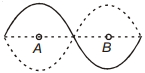
In the standing wave shown, particles at the positions $A$ and $B$ have a phase difference of
For a particle executing $\text{SHM}$ along $x-$axis force is given by:
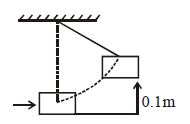
A bullet of mass $0.01\, kg$ and travelling at a speed of $500\, m/s$ strikes and passes horizontally through a block of mass $2\,kg$ which is suspended by string of string of length $5\,m$. The centre of gravity of the block is found to raise a vertical distance of $0.1\,m$. What is the speed of the bullet after it emerges from the block .......... $\mathrm{m}/ \mathrm{s}$ $[g = 9.8\,m/s^2]$ (time of passing of bullet is negligible)
The length, tension, diameter and density of a wire $B$ are double than the corresponding quantities for another stretched wire $A$. Then.
For ordinary terrestrial experiments, the observer in an inertial frame in the following cases is:
Escape velocity on earth is $11.2\, km/s$. What would be the escape velocity on a planet whose mass is $1000$ times and radius is $10$ times that of earth ......... $km/sec$​
The phase difference between the instantaneous velocity and acceleration of a particle executing simple harmonic motion is
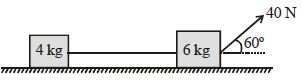
The tension in the string which connected the blocks as shown in the following figure  ............ $ N$
A block of mass $5 kg$ is at rest on a rough inclined surface. If angle of inclination of plane is $60^{\circ}$, then force applied by it on block is .......... $N$