MCQ
The phase difference between the instantaneous velocity and acceleration of a particle executing simple harmonic motion is
  • A
    $\pi$
  • B
    $2\pi $
  • $0.5\pi $
  • D
    $0$

Answer

Correct option: C.
$0.5\pi $
c
Let $y=A \sin \omega t$

$\frac{d y}{d t}=A \omega \cos \omega t=A \omega \sin \left(\omega t+\frac{\pi}{2}\right)$

Acceleration $=-A \omega^{2} \sin \omega t$

The phase difference between acceleration and velocity is $\pi / 2$

Need a full question paper?

Generate a complete, print-ready paper with questions like this in minutes — across 16+ boards, with answer keys.
Start Generating Free

Similar questions

The velocity of a particle is  $v=v_0 +gt+ft^2$. If its position is $x= 0$ at $t= 0 $, then its displacement after unit time ($t= 1$) is
At constant temperature, pressure is inversely proportional to volume is called as:
If two vectors $2\hat i + 3\hat j - \hat k$ and $ - 4\hat i - 6\hat j + \lambda \hat k$ are parallel to each other then value of $\lambda$ be
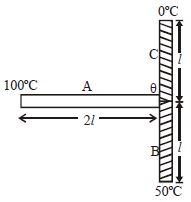
Three rods $A, B$ and $C$ of thermal conductivities $K, 2\,K$ and $4\,K$, cross-sectional  areas $A, 2\,A$ and $2\,A$ and lengths $2l, l$ and $l$ respectively are connected as shown  in the figure. If the ends of the rods are maintained at temperatures $100^o\,C, 50^o\,C$, and $0^o\,C$ respectively, then the temperature $\theta$ of the junction is ......... $^oC$
Relationship between $P,V,$ and $E$ for a gas is
The mean kinetic energy of a gas at $300\, K$ is $100\, J.$ The mean energy of the gas at $450\, K$ is equal to ...... $J$
Which of the following sets of concurrent forces may be in equilibrium
On a horizontal frictionless frozen lake, a girl $36 \,kg$ and a box $9 \,kg$ are connected to each other by means of a rope. Initially, they are $20 \,m$ apart. The girl exerts a horizontal force on the box, pulling it towards her. How far has the girl travelled when she meets the box?
When work is done on a body by an external force, its
Two particles are in $SHM$ in a straight line. Amplitude $A$ and time period $T$ of both the particles are equal. At time $t=0,$ one particle is at displacement $y_1= +A$ and the other at $y_2= -A/2,$ and they are approaching towards each other. After what time they cross each other ?