Question
Let $\varepsilon_1$ and $\varepsilon_2$ be the angles made by $\overrightarrow{\text{A}}$ and $-\overrightarrow{\text{A}}$ with the positive X-axis. Show that $\tan\varepsilon_1=\tan\varepsilon_2.$ Thus, giving tane does not uniquely determine the direction of $\overrightarrow{\text{A}}.$
Answer

If a vector A makes α with x-axis then -A makes an angle $(\pi+\alpha)=\beta$ with same positive direction of x-axis.$\Rightarrow\tan\beta=\tan(\pi+\alpha)=\tan\alpha \ ...\text{QED}$
So yes if we only give $\tan\theta$ of a vector where $\theta$ is the angle made by the x-axis, it doesn’t uniquely determine the direction of a vector.

Need a full question paper?

Generate a complete, print-ready paper with questions like this in minutes — across 16+ boards, with answer keys.

Start Generating Free

Similar questions

The centre of mass is defined as $\overrightarrow{\text{R}}=\frac{1}{\text{M}}\sum\limits_\text{i}\text{m}_\text{i}\overrightarrow{\text{r}_{\text{i}}}.$ Suppose we define "centre of charge" as $\overrightarrow{\text{R}}_\text{c}=\frac{1}{\text{Q}}\sum\limits_\text{i}\text{q}_\text{i}\overrightarrow{\text{r}_{\text{i}}}$ where $q_i$ represents the $i^{th}$ charge placed at $\overrightarrow{\text{r}_\text{i}}$ and $Q$ is the total charge of the system.
  1. Can the centre of charge of a two$-$charge system be outside the line segment joining the charges?
  2. If all the charges of a system are in $X-Y$ plane, is it necessary that the centre of charge be in $X-Y$ plane?
  3. If all the charges of a system lie in a cube, is it necessary that the centre of charge be in the cube?
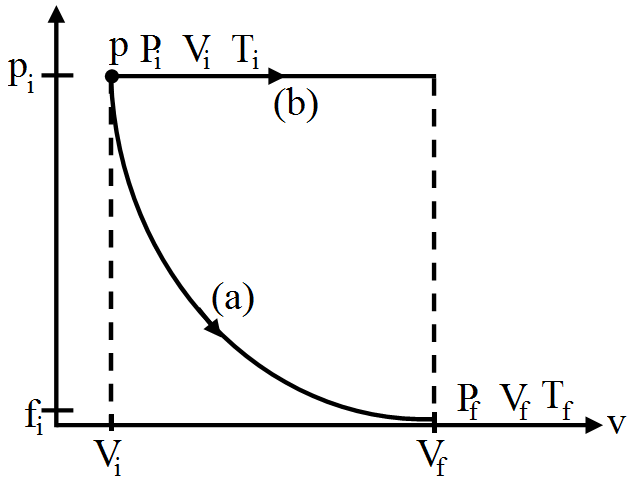
The initial state of a certain gas is $(P_i , V_i , T_i )$. It undergoes expansion till its volume becoms $V_f$ . Consider the following two cases:
  1. The expansion takes place at constant temperature.
  2. The expansion takes place at constant pressure.
Plot the $P-V$ diagram for each case. In which of the two cases, is the work done by the gas more?
The displacement vector of a particle of mass m is given by $\text{r}\text{(t})=\hat{\text{i}}\text{A}\cos\omega\text{t}+\hat{\text{j}}\text{B}\sin\omega\text{t}.$Show that the trajectory is an ellipse.
When will the motion of a simple pendulum be simple harmonic?
If $x = at^2 + bt + c$, where x is displacement as a function of time. Write the dimensions of a b and c.
A block placed on a rough horizontal surface is pulled by a horizontal force F. Let f be the force applied by the rough surface on the block. Plot a graph of f versus F.
Consider a simple pendulum, having a bob attached to a string, that oscillates under the action of the force of gravity. Suppose that the period
of oscillation of the simple pendulum depends on its length $(l),$ mass of the bob $(m)$ and acceleration due to gravity $(g)$. Derive the expression for its time period using method of dimensions.
If R be the horizontal range for inclination $\theta$ and h be the maximum height reached by the projectile, show that maximum range is given by $\frac{\text{R}^2}{8\text{h}}+2\text{h.}$
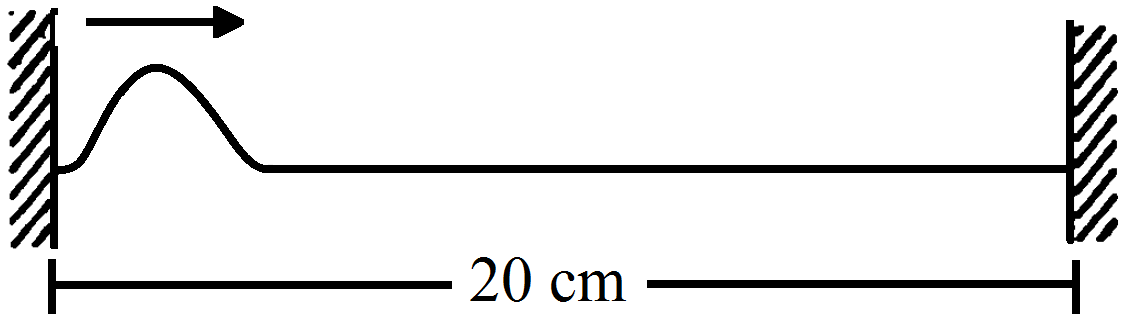
A string of length $20\ cm$ and linear mass density $0.40g/cm$ is fixed at both ends and is kept under a tension of $16N.$ A wave pulse is produced at $t = 0$ near an end as shown in figure, which travels towards the other end.
  1. When will the string have the shape shown in the figureagain
  2. Sketch the shape of the string at a time half of that found in part $(a)$.
At a time when the displacement is half the amplitude, what fraction of the total energy is kinetic and what fraction is the potential in S.H.M?