Question
List two advantages associated with water harvesting at the community level.

Answer

Water harvesting at the community level is capturing, collection and storage of rain water and surface run off for filling either small water bodies or recharging ground water. This is carried out through water shed management, check dams, earthen dams, roof top harvesting and filter wells in flood drains.
Benefits:
  1. It ensures water availability in non-rainy season,
  2. It reduces the chances of flooding during rainy season,
  3. Ground water level does not fall as it is regularly recharged,
  4. Ground water recharge is the best form of water harvesting as the water is filtered and free from contaminations. It also does not evaporate,
  5. Water becomes available for drinking as well as irrigation.

Need a full question paper?

Generate a complete, print-ready paper with questions like this in minutes — across 16+ boards, with answer keys.
Start Generating Free

Similar questions

An object is placed at a distance of 10cm from a convex mirror of focal length 5cm.
  1. Draw a ray-diagram showing the formation of image.
  2. State two characteristics of the image formed.
  3. Calculate the distance of the image from mirror.
Derive the expression for the heat produced due to a current ‘I’ flowing for a time interval ‘t’ through a resistor ‘R’ having a potential difference ‘V’ across its ends. With which name is the relation known? How much heat will an instrument of 12W produce in one minute if it is connected to a battery of 12V?
When the branches of a plant growing in the field are pulled towards the ground and a part of them is covered with moist soil (leaving the tips of the branches exposed above the ground), then after some time new roots develop from the parts of branches buried in the soil. On cutting these branches from the parent plant, new plants are produced from the cut parts of branches which had developed roots.
  1. What is this method of propagation of plants known as?
  2. What type of branches should a plant have to be able to be propagated by this method?
  3. Name any two plants which are grown for their flowers and propagated by this method.
  4. Name any two plants which are grown for their fruits and propagated by this method.
  5. Name one plant which gets propagated by this method naturally by forming runners (soft horizontal stems running above the ground).
  1. Draw a diagram of the longitudinal section of flower and label on it sepal, petal, ovary and stigma.
  2. Write the names of male and female reproductive parts of a flower.
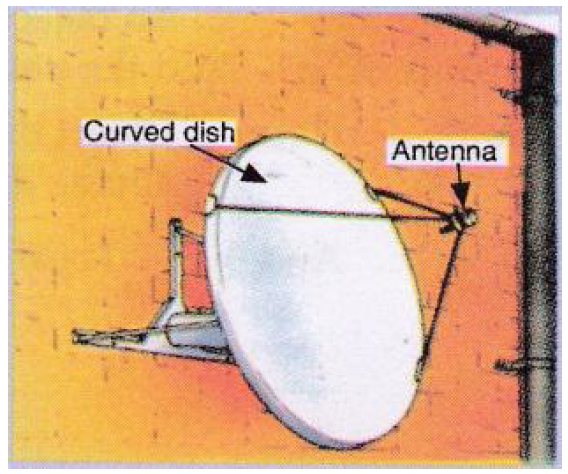
The diagram shows a dish antenna which is used to receive television signals from a satellite. The antenna (signal detector) is fixed in front of the curved dish.
  1. What is the purpose of the dish?
  2. Should it be concave or convex?
  3. Where should the antenna be positioned to receive the strongest possible signals?
  4. Explain what change you would expect in the signals if a larger dish was used.
Derive the expression for the heat produced due to a current 'l' flowing for a time interval 't' through a resistor 'R' having a potential difference 'V' across its ends. With which name is the
relation known? How much heat will an instrument of 12W produce in one minute if it is connected to a battery of 12V?
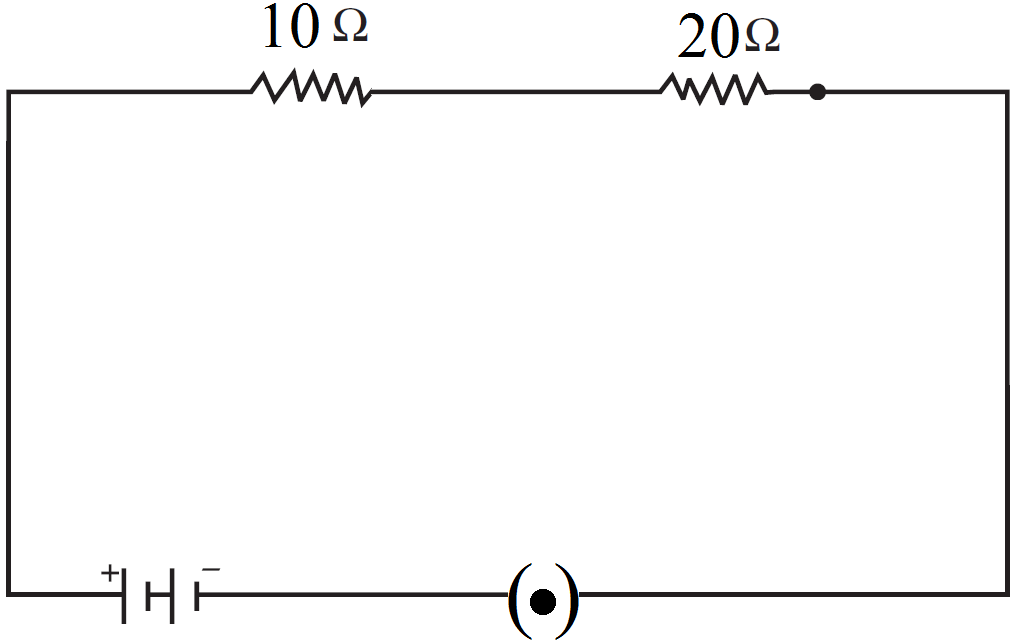
Study the following electric circuit and find.
  1. The current flowing in the circuit and
  2. The potential difference across $10\Omega$ resistor.
Elements forming ionic compounds attain noble gas configuration by either gaining or losing electrons from their outermost shells. Give reason to explain why carbon cannot attain noble gas configuration in this manner to form its compounds. Name the type of bonds formed in ionic compounds and in the compounds formed by carbon. Also give reason why carbon compounds are generally poor conductors of electricity.
Make a list of conventional and non-conventional sources of energy. Give a brief description of harnessing one nonconventional source of energy.
How would you distinguish between baking powder and washing soda by heating?
You are given a hammer, a battery, a bulb, wires and a switch.
  1. How could you use them to distinguish between samples of metals and non-metals?
  2. Assess the usefulness of these tests in distinguishing between metals and non-metals.