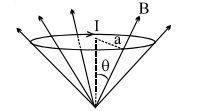
Magnetic field intensity at the centre of coil of $50$ $turns$, radius $0.5\, m$ and carrying a current of $2\, A$ is
Medium
Download our app for free and get started
(b) $B = \frac{{{\mu _0}Ni}}{{2r}} = \frac{{4\pi \times {{10}^{ - 7}} \times 50 \times 2}}{{2 \times 0.5}} = 1.25 \times {10^{ - 4}}\,T$

Download our appand get started for free
Experience the future of education. Simply download our apps or reach out to us for more information. Let's shape the future of learning together!No signup needed.*
Similar Questions
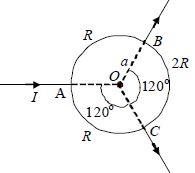
- 1The resistances of three parts of a circular loop are as shown in the figure. The magnetic field at the centre $O$ is :-View Solution
- 2A voltmeter having resistance of $50 × 10^3$ $Omega$ is used to measure the voltage in a circuit. To increase the range of measurement $3$ times the additional series resistance required isView Solution
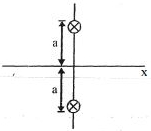
- 3Two straight infinitely long current carrying wires are kept along $z-$ axis at the coordinates $(0, a, 0)$ and $(0, -a, 0)$ respectively as shown in the figure. The current in each of the wire is equal and along negative $z-$ axis (into the plane of the paper). The variation of magnetic field on the $x-$ axis will be approximatelyView Solution
- 4A galvanometer has resistance of $7\,\Omega $ and gives a full scale deflection for a current of $1.0\, A$. How will you convert it into a voltmeter of range $10\, V$View Solution
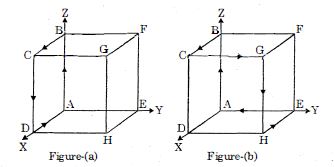
- 5Current $I$ is flowing along the path $ABCDA$ consisting of four edges of a cube (figure $-a$), produces a magnetic field $B_0$ at the centre of the cube. Find the magnetic field $B$ produced at the center of the cube by a current $I$ flowing along the path of the six edges $ABCGHEA$ (figure $b$)View Solution
- 6View SolutionA negatively charged particle projected towards east is deflected towards north by a magnetic field. The field may be
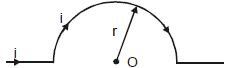
- 7A portion of a conductive wire is bent in the form of a semicircle of radius $r$ as shown below in fig. At the centre of semicircle, the magnetic induction will beView Solution
- 8A magnet of magnetic moment $ 20 $ $C.G.S.$ units is freely suspended in a uniform magnetic field of intensity $0.3 $ $ C.G.S.$ units. The amount of work done in deflecting it by an angle of $30°$ in $ C.G.S.$ units isView Solution
- 9View SolutionMark out the correct options.
- 10A circular current loop of radius a is placed in a radial field $B$ as shown. The net force acting on the loop isView Solution