Current $I$ is flowing along the path $ABCDA$ consisting of four edges of a cube (figure $-a$), produces a magnetic field $B_0$ at the centre of the cube. Find the magnetic field $B$ produced at the center of the cube by a current $I$ flowing along the path of the six edges $ABCGHEA$ (figure $b$)
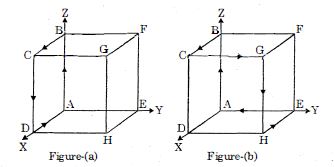
Medium

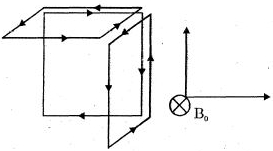

Download our appand get started for free
Experience the future of education. Simply download our apps or reach out to us for more information. Let's shape the future of learning together!No signup needed.*
Similar Questions
- 1Magnetic fields at two points on the axis of a circular coil at a distance of $0.05\, m$ and $0.2\, m$ from the centre are in the ratio $8: 1.$ The radius of coil is .......... $m$View Solution
- 2The magnetic field at the centre of coil of $n$ $turns$, bent in the form of a square of side $2l$ , carrying current $i$, isView Solution
- 3The magnetic field $d\overrightarrow B $ due to a small current element $d\overrightarrow {l\,} $ at a distance $\overrightarrow {r\,} $ and element carrying current $i$ isView Solution
- 4View SolutionA uniform electric field and a uniform magnetic field are produced, pointed in the same direction. An electron is projected with its velocity pointing in the same direction
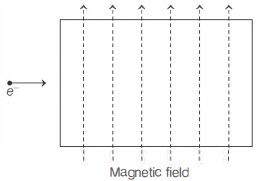
- 5View SolutionAn electron enters a chamber in which a uniform magnetic field is present as shown below. An electric field of appropriate magnitude is also applied, so that the electron travels undeviated without any change in its speed through the chamber. We are ignoring gravity. Then, the direction of the electric field is
- 6A wire bent in the shape of a regular $n$-polygonal loop carries a steady current $I$. Let $l$ be the perpendicular distance of a given segment and $R$ be the distance of a vertex both from the centre of the loop. The magnitude of the magnetic field at the centre of the loop is given byView Solution
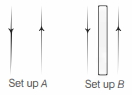
- 7In an experiment, set up $A$ consists of two parallel wires which carry currents in opposite directions as shown in the figure. $A$ second set up $B$ is identical to set up $A$, except that there is a metal plate between the wires. Let $F_A$ and $F_B$ be the magnitude of the force between the two wires in setup $A$ and setup $B$, respectively.View Solution
- 8A current of $200\ \mu \mathrm{A}$ deflects the coil of a moving coil galvanometer through $60^{\circ}$. The current to cause deflection through $\frac{\pi}{10}$ radian is:View Solution
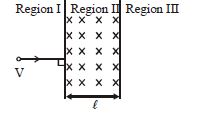
- 9A particle of mass $m$ and charge $q$ , moving with velocity $V$ enters region $II$ normal to the boundary as shown in the figure. Region $II$ has a uniform magnetic field $B$ perpendicular to the plane of the paper. The length of the region $II$ is $l$ . Choose the not correct choiceView Solution
- 10When a resistance of $5\,\Omega$ is shunted with a moving coil galvanometer, it shows a full scale deflection for a current of $250\,mA$, however when $1050\,\Omega$ resistance is connected with it in series, it gives full scale deflection for $25$ volt. The resistance of galvanometer is $......\,\Omega$.View Solution