MCQ
Mark the correct statements for a particle going on a straight line:
  • A
    If the velocity and acceleration have opposite sign, the object is slowing down.
  • B
    If the position and velocity have opposite sign, the particle is moving towards the origin.
  • If the velocity is zero at an instant, the acceleration should also be zero at that instant.
  • D
    If the velocity is zero for a time interval, the acceleration is zero at any instant within the time interval.
Answer

Correct option: C.
If the velocity is zero at an instant, the acceleration should also be zero at that instant.
$a.$ If the velocity and acceleration have opposite sign, the object is slowing down.
$b.$ If the position and velocity have opposite sign, the particle is moving towards the origin.
$d.$ If the velocity is zero for a time interval, the acceleration is zero at any instant within the time interval.
Explanation:
$a.$  Acceleration is given by
$-\text{a}=\frac{\text{dv}}{\text{dt}}$
$-\text{a}<0$
$\Rightarrow\frac{\text{dv}}{\text{dt}}<0$
$\Rightarrow\text{V}_{\text{final}}<\text{V}_{\text{initial}}$

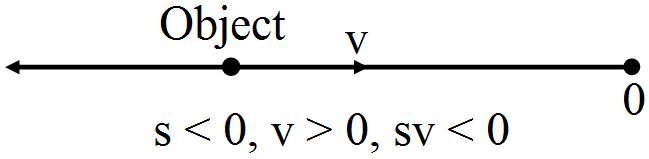
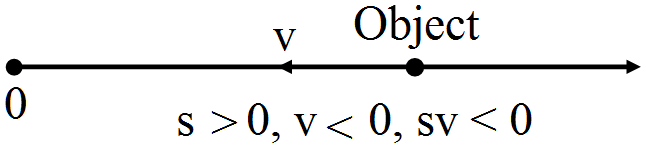
$b.$ If the position and velocity have opposite signs, the particle moves towards the origin. It can be explained by following figure:

Object is moving toward the origin.

Object is moving toward the origin.

$c.$ If the velocity is zero in a certain time interval, then the change in the velocity in that time interval will also be zero. As acceleration is rate of change of velocity, it will also be zero at an instant in that time interval.

Need a full question paper?

Generate a complete, print-ready paper with questions like this in minutes — across 16+ boards, with answer keys.

Start Generating Free

Similar questions

In a simple pendulum experiment for determination of acceleration due to gravity $(g)$, time taken for $20$ oscillations is measured by using a watch of $1\, second$ least count. The mean value of time taken comes out to be $30\,s$. The length of pendulum is measured by using a meter scale of least count $1\, mm$ and the value obtained is $55.0\, cm$. The percentage error in the determination of $g$ is close to  ........... $\%$
Two masses $m_1$ and $m_2$ are suspended together by a massless spring of constant $K$. When the masses are in equilibrium, $m_1$ is removed without disturbing the system. The amplitude of oscillations is
A solid cylinder is rolling down on an inclined plane of angle $\theta $. The coefficient of static friction between the plane and the cylinder is $\mu _s$. The condition for the cylinder not to slip is
A boat carrying steel balls is floating on the surface of water in a tank. If the balls are thrown into the tank one by one, how will it affect the level of water
The position vector of the centre of mass $\vec r\, cm$ of an asymmetric uniform bar of negligible area of cross-section as shown in figure is
Consider the efficiency of Carnot's engine is given by $\eta=\frac{\alpha \beta}{\sin \theta} \log _{e} \frac{\beta x}{k T}$, where $\alpha$ and $\beta$ are constants. If $T$ is temperature, $k$ is Boltzman constant, $\theta$ is angular displacement and $x$ has the dimensions of length. Then, choose the incorrect option.
A body moves on a frictionless plane starting from rest. If $\mathrm{S}_{\mathrm{n}}$ is distance moved between $\mathrm{t}=\mathrm{n}-1$ and $\mathrm{t}$ $=\mathrm{n}$ and $\mathrm{S}_{\mathrm{n}-1}$ is distance moved between $\mathrm{t}=\mathrm{n}-2$ and $t=n-1$, then the ratio $\frac{S_{n-1}}{S_n}$ is $\left(1-\frac{2}{x}\right)$ for $n$ $=10$. The value of $x$ is
The maximum error in the measurement of resistance, current and time for which current flows in an electrical circuit are $1 \%, 2 \%$ and $3 \%$ respectively. The maximum percentage error in the detection of the dissipated heat will be
Two capillary tubes of same diameter are put vertically one each in two liquids whose relative densities are $0.8$ and $0.6$ and surface tensions are $60$ and $50\, dyne/cm$ respectively Ratio of heights of liquids in the two tubes $\frac{h_1}{h_2}$ is
For a particle in a non-uniform accelerated circular motion