MCQ
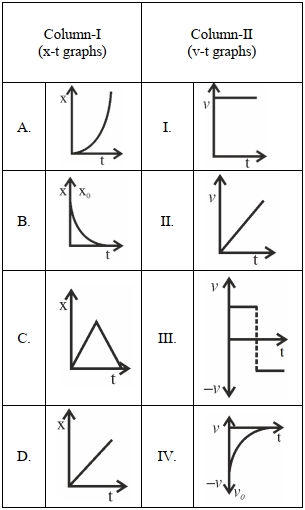
Match Column$-I$ with Column$-II :$

Choose the correct answer from the options given below:
  • $(A)-(II), (B)-(IV), (C)-(III), (D)-(I)$
  • B
    $(A)-( I), (B)-(II), (C)-(III), (D)-(IV)$
  • C
    $(A)-( II), (B)-(III), (C)-(IV), (D)-(I)$
  • D
    $(A)-(I), (B)-(III), (C)-(IV), (D)-(II)$

Answer

Correct option: A.
$(A)-(II), (B)-(IV), (C)-(III), (D)-(I)$
a
$\frac{d x}{d t}=\text { slope } \geq 0 \text { always increasing }$

$\text { (A - II) }$

$\frac{d x}{d t} < 0 \text {; and at } t \rightarrow \infty \frac{ dx }{ dt } \rightarrow 0$

$( B - IV )$

$\frac{ dx }{ dt } > 0 \text { for first half } \frac{ dx }{ dt } < 0 \text { for second half. }$

$\text { (C - III) }$

$\frac{ dx }{ dt }=\text { constant }$

$\text { (D - I) }$

Need a full question paper?

Generate a complete, print-ready paper with questions like this in minutes — across 16+ boards, with answer keys.

Start Generating Free

Similar questions

Air of density $1.2\,kg\,m^{-3}$ is blowing across the horizontal Wings of an aeroplane in such a way that its speeds above and below the wings are $150\,ms^{-1}$ and $100\,ms^{-1}$, respectively. The pressure difference between the upper and lower sides of the Wings, is ........ $Nm^{-2}$
Zero error of an instrument introduces
The extension of a wire by the application of load is $3$ $mm.$ The extension in a wire of the same material and length but half the radius by the same load is..... $mm$
The velocity of a small ball of mass ' $m$ ' and density $d _{1}$, when dropped in a container filled with glycerine, becomes constant after some time. If the density of glycerine is $d _{2}$, then the viscous force acting on the ball, will be
In order to shift a body of mass $m$ from a circular orbit of radius $3R$ to a higher radius $5R$ around the earth, the work done is
A given mass of a gas is allowed to expand freely until its volume becomes double. If ${C_b}$ and ${C_a}$ are the velocities of sound in this gas before and after expansion respectively, then ${C_a}$ is equal to
A particle is projected with velocity ${\upsilon _0}$ along $x - axis$. The deceleration on the particle is proportional to the square of the distance from the origin i.e., $a = \alpha {x^2}.$ The distance at which the particle stops is
Different physical quantities are given in Column - $\mathrm{I}$ and their dimensional formula are given in Column - $\mathrm{II}$. Match them appropriately.
Column - $\mathrm{I}$ Column - $\mathrm{II}$
$(a)$ Viscous force $(i)$ $\left[ {{M^1}{L^1}{T^{ - 2}}} \right]$
$(b)$ Coefficient of viscosity $(ii)$ $\left[ {{M^1}{L^{ - 1}}{T^{ - 1}}} \right]$
  $(iii)$ $\left[ {{M^1}{L^{ - 1}}{T^{ - 2}}} \right]$
The dimensions of pressure is equal to
The density $\rho$ of a liquid varies with depth h from the free surface as $\rho=\text{kh.}$ A small body of density $\rho_1$ is released from the surface of liquid. The body will: