Question
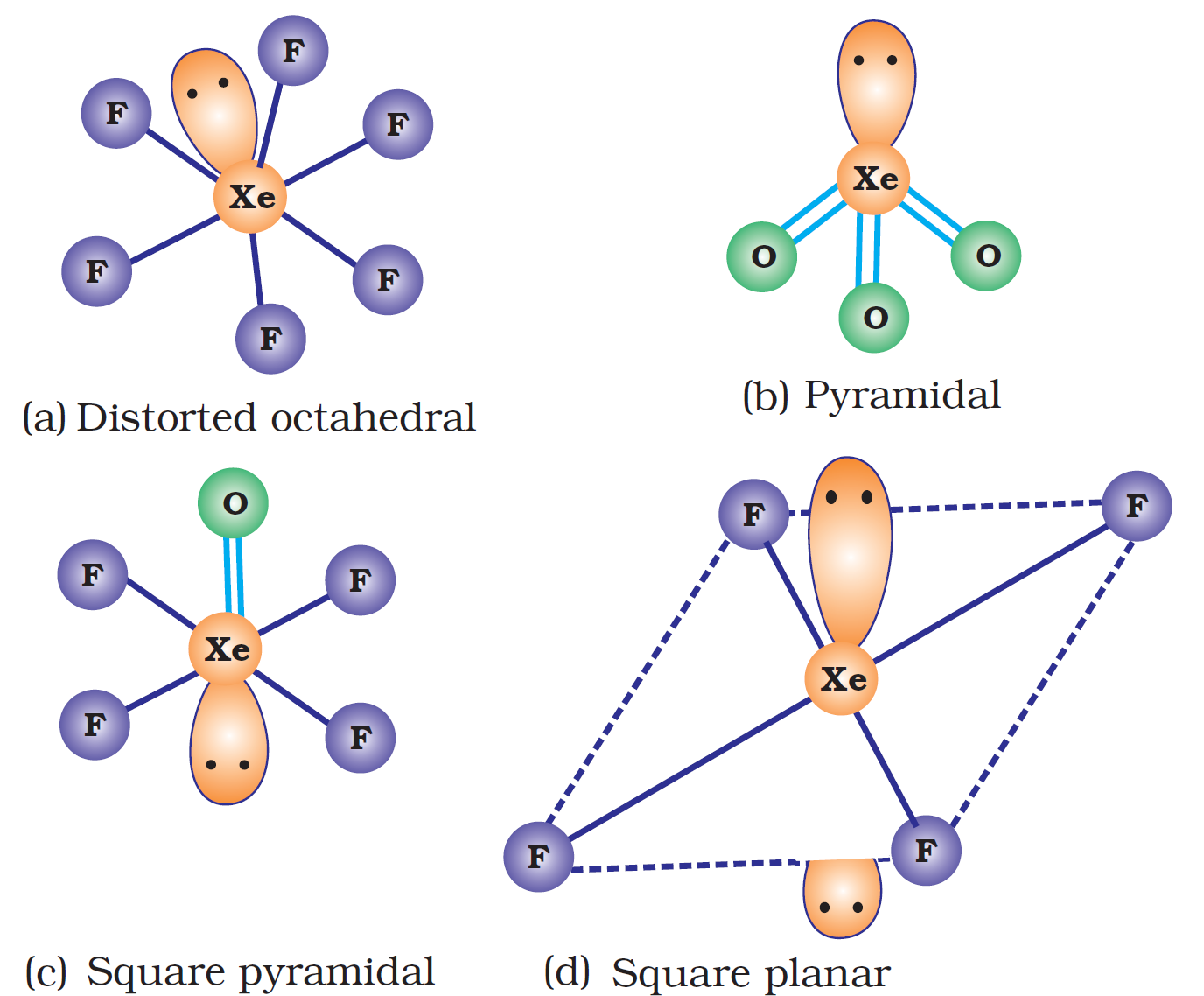
Match the compounds given in Column I with the hybridisation and shape given in Column II and mark the correct option.
  Column I   Column II
(A) $XeF_6$ (1) $sp^3d^3$– distorted octahedral
(B) $XeO_3$ (2) $sp^3d^2$ - square planar
(C) $XeOF_4$ (3) $sp^3$- pyramidal
(D) $XeF_4$ (4) $sp^3d^2$ - square pyramidal
  1. A (1) B (3) C (4) D (2)
  2. A (1) B (2) C (4) D (3)
  3. A (4) B (3) C (1) D (2)
  4. A (4) B (1) C (2) D (3)

Answer

  Column I   Column II
(A) $XeF_6$ (1) $sp^3d^3$ – distorted octahedral
(B) $XeO_3$ (3) $sp^3$​​​​​​​ - pyramidal
(C) $XeOF_4$ (4) $sp^3d^2$ - square pyramidal
(D) $XeF_4$ (2) $sp^3d^2​​​​​​​$​​​​​​​ - square planar
  1. A (1) B (3) C (4) D (2)
Explanation:

Need a full question paper?

Generate a complete, print-ready paper with questions like this in minutes — across 16+ boards, with answer keys.

Start Generating Free

Similar questions

Explain the terms primary and secondary structure of proteins. What is the difference between α-helix and β-pleated sheet structure of proteins?
Give reasons for each of the following:
  1. $\text{SiF}_{6}^{2-}$ is known but $\text{SiCl}_{6}^{2-}$ is not known.
  2. Sulphur in vapour state exhibits paramagnetic behaviour.
  3. $PbO_2$ is a stronger oxidizing agent than $SnO_2$.
  4. $H_3PO_2$ acts as a monobasic acid.
  5. Bond dissociation energy of $F_2$​​​​​​​ is less than that of $Cl_2$.
a. Account for the following:
i. Copper (I) compounds are white whereas Copper (II) compounds are coloured.
ii. Chromates change their colour when kept in an acidic solution.
iii. $Zn , Cd , Hg$ are considered as d-block elements but not as transition elements.
b. Calculate the spin-only moment of $Co ^{2+}( Z =27)$ by writing the electronic configuration of Co and $Co ^{2+}$.
Explain the structure of starch and cellulose.
An organic compound $A$ with molecular formula $C_7H_7NO$ reacts with $Br_2/aq.$ $KOH$ to give compound $B,$ which upon reaction with $NaNO_2$ and $HCl$ at $0^\circ C$ gives $C.$ Compound $C$ on heating with $CH_3CH_2OH$ gives a hydrocarbon $D.$ Compound $B$ on further reaction with $Br_2$ water gives white precipitate of compound $E.$ Identify the compound $A, B, C, D$ and $E;$ also justify your answer by giving relevant chemical equations.
  1. Which poisonous gas is evolved when white phosphorus is heated with conc. $NaOH$ solution? Write the chemical equation.
  2. Write the formula of first noble gas compound prepared by $N$. Bartlett. What inspired $N$. Bartlett to prepare this compound?
  3. Fluorine is a stronger oxidizing agent than chlorine. Why?
  4. Write one use of chlorine gas.
  5. Complete the following equation: $CaF_2 + H_2SO_4 \xrightarrow{\text{ }\ \ \ \ \ \ \ \ \ \ \ \ }$
Describe the common name system and IUPAC system of naming amines.
Show that in a cubic close packed structure, eight tetrahedral voids are present per unit cell.
Derive the Nernst equation and explain how $E_{\text {cell }}^{\circ}$ depends on concentration of ions.
  1. Draw the structures of the following:
  1. $H_2S_2O_7$.
  2. $HClO_3$.
  1. Explain the following observations:
  1. In the structure of $HNO_3$, the N–O bond.
$(121\ pm)$ is shorter than the N–OH bond $(140\ pm)$.
  1. All the P–Cl bonds in $PCl_5$​​​​​​​ are not equivalent.
  2. ICl is more reactive than $I_2$​​​​​​​.