Question 15 Marks
Give reasons for each of the following:
- $\text{SiF}_{6}^{2-}$ is known but $\text{SiCl}_{6}^{2-}$ is not known.
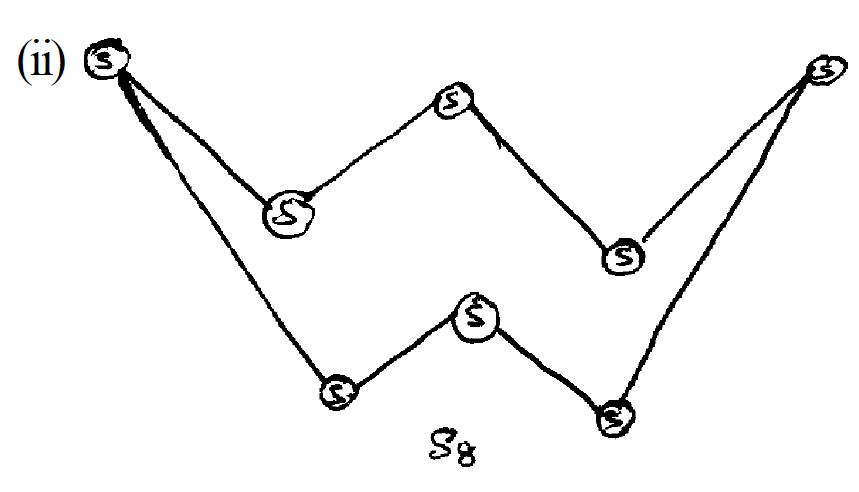
- Sulphur in vapour state exhibits paramagnetic behaviour.
- $PbO_2$ is a stronger oxidizing agent than $SnO_2$.
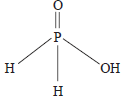
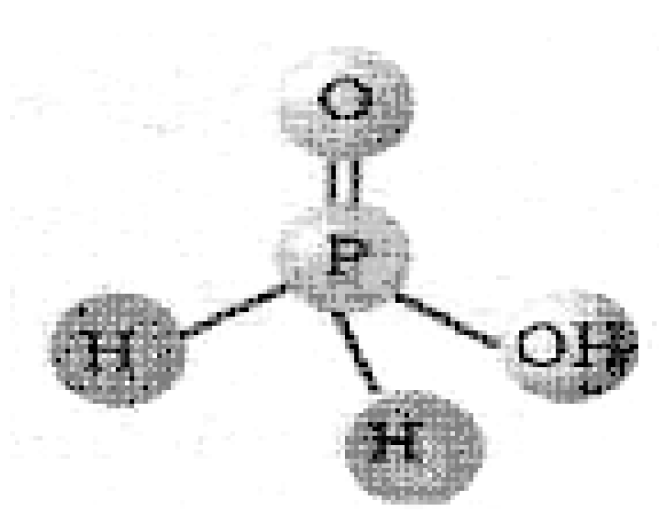
- $H_3PO_2$ acts as a monobasic acid.
- Bond dissociation energy of $F_2$ is less than that of $Cl_2$.
Answer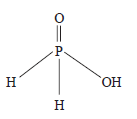
View full question & answer→- It is due to the small size of Fluorine (steric repulsion will be less in $\text{SiF}_{6}^{-2}$) Silicon cannot hold Chlorine atoms because of its larger size.
- In vapour state sulphur partly exists as $S_2$ molecule and $S_2$ molecule like $O_2$ has two unpaired electrons and hence exhibits paramagnetism.
- Because $Pb^{2+}$ is more stable than $Pb^{4+}$ due to inert pair effect whereas $Sn^{4+}$ is more stable than $Sn^{2+}$.
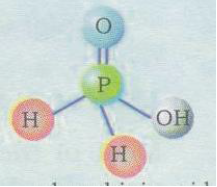
- Due to the presence of only one ionizable –OH group in $H_3PO_2$.
- $F_2$ is expected to have more bond dissociation energy due to its small bond length as compared to $Cl_2$. But actually the dissociation energy of $F_2$ is less because of greater repulsion in the non bonded electron pairs in $F_2$ molecule than in $Cl_2$.