Maximum amplitude(in $cm$) of $SHM$ so block A will not slip on block $B , K =100 N / m$
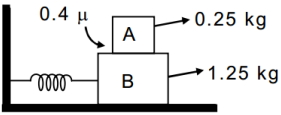
AIIMS 2019, Diffcult
Download our app for free and get started
The expression of force is given as,
$F = m \omega^{2} A =\mu mg$
So,
$A =\frac{\mu g }{\omega^{2}}$ And $\omega=\sqrt{\frac{ K }{ m }}$
So,
$\omega=\sqrt{\frac{100}{1.5}}$
Substitute the values.
$A =\frac{(0.4)(9.8)}{\left(\sqrt{\frac{100}{1.5}}\right)^{2}}$
$=6\, cm$

Download our appand get started for free
Experience the future of education. Simply download our apps or reach out to us for more information. Let's shape the future of learning together!No signup needed.*
Similar Questions
- 1In an experiment to determine the period of a simple pendulum of length $1\, m$, it is attached to different spherical bobs of radii $r_1$ and $r_2$ . The two spherical bobs have uniform mass distribution. If the relative difference in the periods, is found to be $5\times10^{-4}\, s$, the difference in radii, $\left| {{r_1} - {r_2}} \right|$ is best given by .... $cm$View Solution
- 2The time period of oscillations of a simple pendulum is $1$ minute. If its length is increased by $44 \%$. then its new time period of oscillation will be ......... $s$View Solution
- 3The displacement of an oscillator is given by $x = a\, \sin \, \omega t + b\, \cos \, \omega t$. where $a, b$ and $\omega$ are constant. Then :-View Solution
- 4Two identical springs have the same force constant $73.5 \,Nm ^{-1}$. The elongation produced in each spring in three cases shown in Figure-$1$, Figure-$2$ and Figure-$3$ are $\left(g=9.8 \,ms ^{-2}\right)$View Solution

- 5A body of mass $1\,kg$ is executing simple harmonic motion. Its displacement $y(cm)$ at $t$ seconds is given by $y = 6\sin (100t + \pi /4)$. Its maximum kinetic energy is ..... $J$View Solution
- 6The phase (at a time $t$) of a particle in simple harmonic motion tellsView Solution
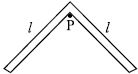
- 7A system of two identical rods ($L-$ shaped) of mass $m$ and length $l$ are resting on a peg $P$ as shown in the figure. If the system is displaced in its plane by a small angle $\theta ,$ find the period of oscillations :View Solution
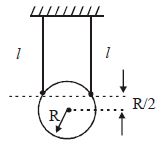
- 8A disc of mass $m$ and radius $R$ is attached to celling with the help of ropes of length $l$. Find the time period of small oscillation of disc in the plane of disc.View Solution
- 9The energy of a particle executing simple harmonic motion is given by $E = Ax^2 + Bv^2$, where $x$ is the displacement from mean position $x = 0$ and $v$ is the velocity of the particle at $x$ then choose the incorrect statementView Solution
- 10A block with mass $M$ is connected by a massless spring with stiffiess constant $k$ to a rigid wall and moves without friction on a horizontal surface. The block oscillates with small amplitude $A$ about an equilibrium position $x_0$. Consider two cases: ($i$) when the block is at $x_0$; and ($ii$) when the block is at $x=x_0+A$. In both the cases, a perticle with mass $m$ is placed on the mass $M$ ?View Solution
($A$) The amplitude of oscillation in the first case changes by a factor of $\sqrt{\frac{M}{m+M}}$, whereas in the second case it remains unchanged
($B$) The final time period of oscillation in both the cases is same
($C$) The total energy decreases in both the cases
($D$) The instantaneous speed at $x_0$ of the combined masses decreases in both the cases