Question
Mention examples of motion of center of mass.

Answer

self

Need a full question paper?

Generate a complete, print-ready paper with questions like this in minutes — across 16+ boards, with answer keys.
Start Generating Free

Similar questions

A bullet of mass $20g$ is moving with a speed of $150ms^{-1}$. It strikes a target and is brought to rest after piercing $10cm$ into it. Calculate the average force of resistance offered by the target.
What is mean free path? Explain and obtain its expression and prove that $\lambda \propto T$ and $\lambda \propto \lambda_{ P }.$
A circular hole of radius $1m$ is cut off from a disc of radius $6m$. The centre of the hole is $3m$ from the centre of the disc. Find the centre of mass of the remaining disc.
A body cools from 80 °C to 50 °C in 5 minutes. Calculate the time it takes to cool from 60°C to 30 °C. The temprature of the surroundings is 20°C.
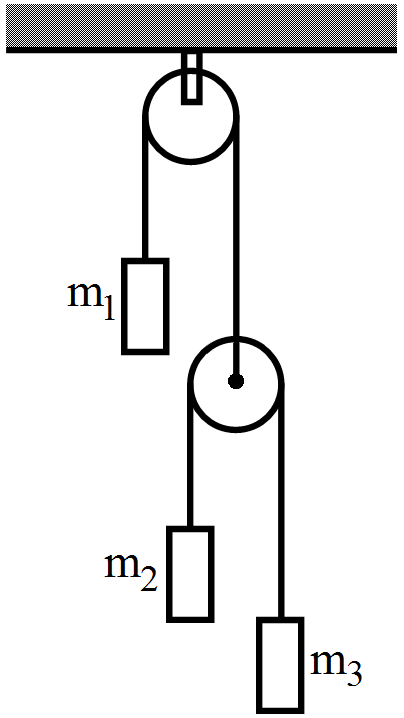
Let $m_1 = 1kg, m_2 = 2kg$ and $m_3 = 3kg$ in figure. Find the accelerations of $m_1, m_2$ and $m_3$. The string from the upper pulley to $m_1$​​​​​​​ is $20cm$ when the system is released from rest. How long will it take before m, strikes the pulley?
Four equal charges $2.0 \times 10^{-6}C$ each are fixed at the four corners of a square of side $5cm$. Find the Coulomb force experienced by one of the charges due to the rest three.
A motorcycle has to move with a constant speed on an overbridge which is in the form of a circular arc of radius R and has a total length L. Suppose the motorcycle starts from the highest point.
  1. What can its maximum velocity be for which the contact with the road is not broken at the highest point?
  2. If the motorcycle goes at speed $\frac{1}{\sqrt2}$ times the maximum found in part (a), where will it lose the contact with the road?
  3. What maximum uniform speed can it maintain on the bridge if it does not lose contact anywhere on the bridge?
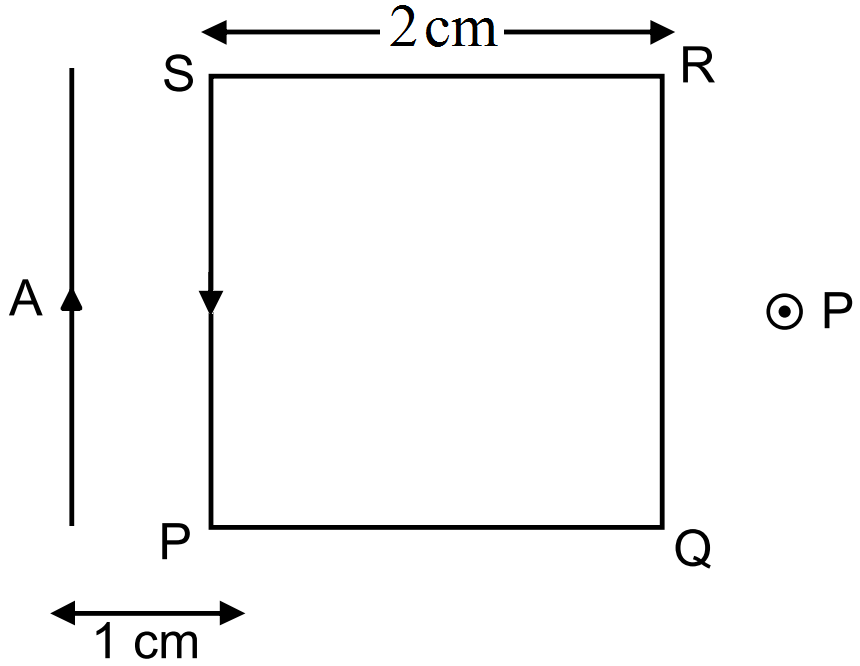
A square loop PQRS carrying a current of 6.0A is placed near a long wire carrying 10A as shown in figure.
  1. Show that the magnetic force acting on the part PQ is equal and opposite to that on the part RS.
  2. Find the magnetic force on the square loop.
An electron and a proton are detected in a cosmic ray experiment, the first with kinetic energy 10 keV , and the second with 100 keV . Which is faster, the electron or the proton? Obtain the ratio of their speeds. (electron mass = $9.11 \times 10^{-31} \mathrm{~kg}$, proton mass $=1.67 \times 10^{-27} \mathrm{~kg}, 1 \mathrm{eV}=1.60 \times 10^{-19} \mathrm{~J}$ ).
Show that a(b × c) is equal in magnitude to the volume of the parallelepiped formed on the three vectors a, b and c.