A circular hole of radius $1m$ is cut off from a disc of radius $6m$. The centre of the hole is $3m$ from the centre of the disc. Find the centre of mass of the remaining disc.
Download our app for free and get started
Let O be the centre of the disc and O' that of the hole. (see Fig.)
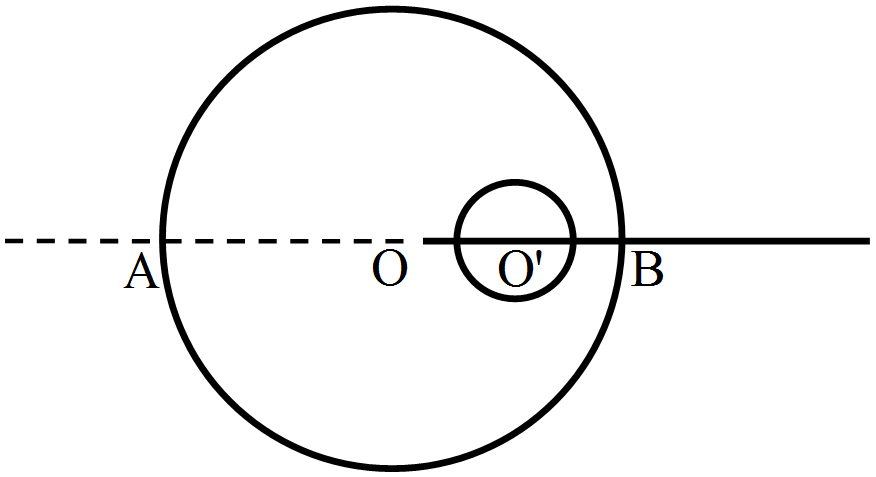
To find the centre of mass, we use the fact that a body balances at this point, i.e., the algebraic sum of the moments of the weights about the centre of gravity is zero. The weight $W_1$ of the disc acts at point O. The hole can be regarded as a negative weight $W_2$ acting at O'. If X is the distance of the centre of gravity of the combination from point O, then $\text{X}=\frac{\text{W}_1\times\text{O}+(-\text{W}_2)\times3}{\text{W}_1+(-\text{W}_2)}$ Also $\text{W}_1=\rho\pi\times(6)^2$ $=36\rho\pi;\text{W}_2=\rho\pi\times(1)^2=\rho\pi$ Where $\rho$ is the mass per unit area of the disc. Substituting the values of $W^1$ and $W^2$' we get $\text{X}=\frac{-\rho\pi\times3}{36\rho\pi-\rho\pi}\text{m}=\frac{-3}{35}\text{m}$ The negative sign indicates that the centre of gravity is to the left of the point O.
To find the centre of mass, we use the fact that a body balances at this point, i.e., the algebraic sum of the moments of the weights about the centre of gravity is zero. The weight $W_1$ of the disc acts at point O. The hole can be regarded as a negative weight $W_2$ acting at O'. If X is the distance of the centre of gravity of the combination from point O, then $\text{X}=\frac{\text{W}_1\times\text{O}+(-\text{W}_2)\times3}{\text{W}_1+(-\text{W}_2)}$ Also $\text{W}_1=\rho\pi\times(6)^2$ $=36\rho\pi;\text{W}_2=\rho\pi\times(1)^2=\rho\pi$ Where $\rho$ is the mass per unit area of the disc. Substituting the values of $W^1$ and $W^2$' we get $\text{X}=\frac{-\rho\pi\times3}{36\rho\pi-\rho\pi}\text{m}=\frac{-3}{35}\text{m}$ The negative sign indicates that the centre of gravity is to the left of the point O.

Download our appand get started for free
Experience the future of education. Simply download our apps or reach out to us for more information. Let's shape the future of learning together!No signup needed.*
Similar Questions
- 1View SolutionA metre stick is balanced on a knife edge at its centre. When two coins, each of mass 5g are put one on top of the other at the 12.0cm mark, the stick is found to be balanced at 45.0cm. What is the mass of the metre stick?
- 2View SolutionTorques of equal magnitude are applied to a hollow cylinder and a solid sphere, both having the same mass and radius. The cylinder is free to rotate about its standard axis of symmetry, and the sphere is free to rotate about an axis passing through its centre. Which of the two will acquire a greater angular speed after a given time.
- 3From a uniform disk of radius R, a circular hole of radius $\frac{\text{R}}{2}$ is cut out. The centre of the hole is at $\frac{\text{R}}{2}$ from the centre of the original disc. Locate the centre of gravity of the resulting flat body.View Solution
- 4View SolutionA uniform disc of radius R and mass M is mounted on an axis supported in fixed frictionless bearing. A light chord is wrapped around the rim of the wheel and suppose that we hang a body of mass m from the chord. Find the angular acceleration of the disc and tangential acceleration of point on the rim.
- 5A comet revolves around the sun in a highly elliptical orbit having a minimum distance of $7 \times 10^{10}m$ and a maximum distance of $1.4 \times 10^{13}m$. If its speed while nearest to the Sun is $60km s^{-1}$, find its linear speed when situated farthest from the Sun.View Solution
- 6View SolutionA uniform disc of radius R is put over another uniform disc of radius 2R of the same thickness and density. The peripheries of the two discs touch each other. Locate the centre of mass of the system.
- 7Separation of Motion of a system of particles into motion of the centre of mass and motion about the centre of mass: Show $\text{K}=\text{K}'+\frac{1}{2}\text{M}\text{V}^2$ where K' is the total kinetic energy of the system of particles, K′ is the total kinetic energy of the system when the particle velocities are taken with respect to the centre of mass and $\frac{\text{MV}^2}{2}$ is the kinetic energy of the translation of the system as a whole (i.e. of the centre of mass motion of the system). The result has been used in $\sec7.14$View Solution
- 8View Solution
- Prove the theorem of perpendicular axes.
- Prove the theorem of parallel axes.
- 9View SolutionA hoop of radius 2m weighs 100kg. It rolls along a horizontal floor so that its centre of mass has a speed of 20cm/s. How much work has to be done to stop it?
- 10View SolutionThe structure of a water molecule is shown in figure. Find the distance of the centre of mass of the molecule from the centre of the oxygen atom.