Show that a(b × c) is equal in magnitude to the volume of the parallelepiped formed on the three vectors a, b and c.
Download our app for free and get started
A parallelepiped with origin O and sides a, b, and c is shown in the following figure: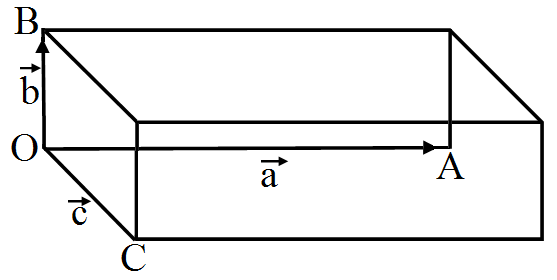
Volume of the given parallelepiped = abc $\vec{\text{O}}\text{C}=\vec{\text{a}}$ $\vec{\text{O}}\text{B}=\vec{\text{b}}$ $\vec{\text{O}}\text{C}=\vec{\text{c}}$ Let $\widehat{\text{n}}$ be a unit vector perpendicular to both b and c. Hence, $\widehat{\text{n}}$ and a have the same direction. $\therefore\ \vec{\text{b}}\times\vec{\text{c}}=\text{bc}\sin\theta\widehat{\text{n}}$ $=\text{bc}\sin90^{\circ}\widehat{\text{n}}$ $=\text{bc}\widehat{\text{n}}$ $\vec{\text{a}}\cdot\big(\vec{\text{b}}\times\vec{\text{c}}\big)$ $=\text{a}\cdot(\text{bc}\widehat{\text{n}})$ $=\text{abc}\cos\theta\widehat{\text{n}}$ $=\text{abc}\cos0^{\circ}$ $=\text{abc}$ = Volume of the parallelepiped.
Volume of the given parallelepiped = abc $\vec{\text{O}}\text{C}=\vec{\text{a}}$ $\vec{\text{O}}\text{B}=\vec{\text{b}}$ $\vec{\text{O}}\text{C}=\vec{\text{c}}$ Let $\widehat{\text{n}}$ be a unit vector perpendicular to both b and c. Hence, $\widehat{\text{n}}$ and a have the same direction. $\therefore\ \vec{\text{b}}\times\vec{\text{c}}=\text{bc}\sin\theta\widehat{\text{n}}$ $=\text{bc}\sin90^{\circ}\widehat{\text{n}}$ $=\text{bc}\widehat{\text{n}}$ $\vec{\text{a}}\cdot\big(\vec{\text{b}}\times\vec{\text{c}}\big)$ $=\text{a}\cdot(\text{bc}\widehat{\text{n}})$ $=\text{abc}\cos\theta\widehat{\text{n}}$ $=\text{abc}\cos0^{\circ}$ $=\text{abc}$ = Volume of the parallelepiped.

Download our appand get started for free
Experience the future of education. Simply download our apps or reach out to us for more information. Let's shape the future of learning together!No signup needed.*
Similar Questions
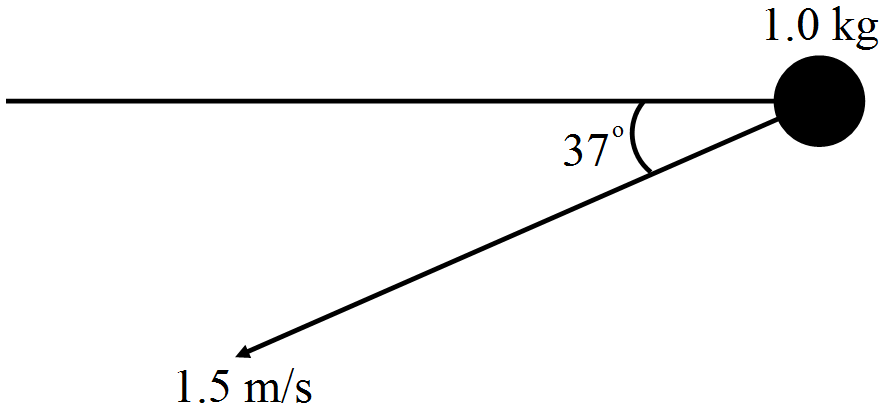
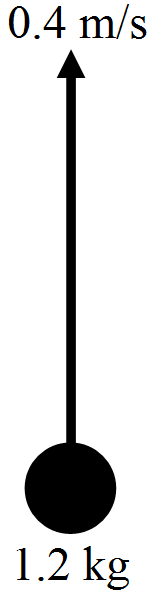
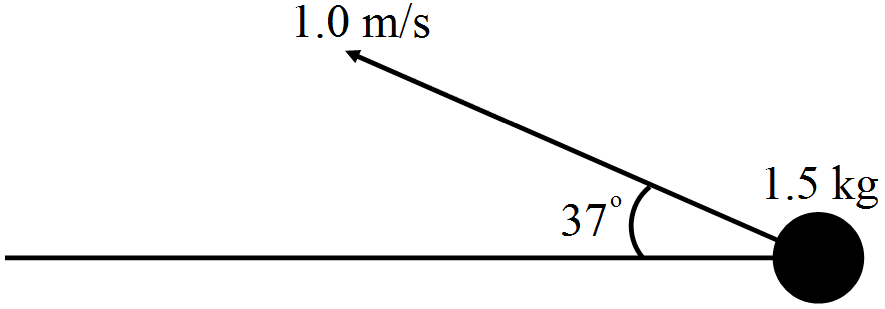
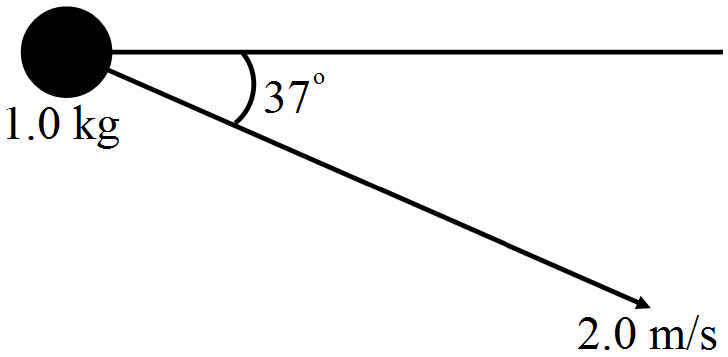
- 1View SolutionCalculate the velocity of the centre of mass of the system of particles shown in figure.

- 2Separation of Motion of a system of particles into motion of the centre of mass and motion about the centre of mass: Show $\text{K}=\text{K}'+\frac{1}{2}\text{M}\text{V}^2$ where K' is the total kinetic energy of the system of particles, K′ is the total kinetic energy of the system when the particle velocities are taken with respect to the centre of mass and $\frac{\text{MV}^2}{2}$ is the kinetic energy of the translation of the system as a whole (i.e. of the centre of mass motion of the system). The result has been used in $\sec7.14$View Solution
- 3Calculate the angular momentum and rotational kinetic energy of earth about its own axis. How long could this amount of energy supply one kilowatt power to each of the $3.5 \times 10^9$ persons on earth? (Mass of earth = $6.0 \times 1024kg$ and radius = $6.4 \times 10^{24}km)$.View Solution
- 4View SolutionFind the components along the x, y, z axes of the angular momentum l of a particle, whose position vector is r with components x, y, z and momentum is p with components px, py and pz. Show that if the particle moves only in the x-y plane the angular momentum has only a z-component.
- 5A uniform rod pivoted at its upper end hangs vertically. It is displaced through an angle of $60°$ and then released. Find the magnitude of the force acting on a particle of mass dm at the tip of the rod when the rod makes an angle of $37°$ with the vertical.View Solution
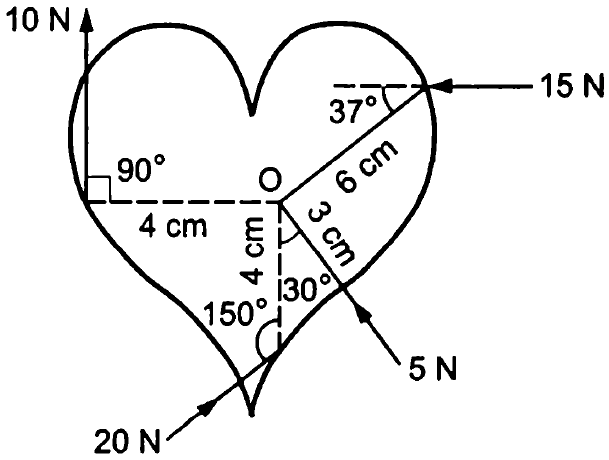
- 6View SolutionCalculate the total torque acting on the body shown in figure about the point O.
- 7View SolutionObtain an expression for linear acceleration of a cylinder rolling down an inclined plane and hence find the condition for the cylinder to roll down the inclined plane without slipping.
- 8View SolutionWhat do you mean by the term "equilibrium"? What are equilibrium of rest and equilibrium of motion? State the conditions for complete equilibrium of a body.
- 9Two masses $M_1$ and $M_2$ are separated by a distance r. Find the moment of inertia of this arrangement about an axis passing through the centre of mass and perpendicular to the line joining them.View Solution
- 10From a uniform disk of radius R, a circular hole of radius $\frac{\text{R}}{2}$ is cut out. The centre of the hole is at $\frac{\text{R}}{2}$ from the centre of the original disc. Locate the centre of gravity of the resulting flat body.View Solution