Question
Mention the changes occurring in the geomagnetic components.

Answer

Changes in the geomagnetic components : Magnitudes of geomagnetic components are not only different at different places on the earth and there are usual and unusual changes in their magnitudes at same place also. These changes are as follows:
(1) Long term changes: According to Kelvin, changes in magnitudes of geomagnetic components occur very slowly with time and after one thousand years, they again come back to their original value. According to him, the cause of this change is the spinning of magnetic poles around the geographic poles.
(2) Annual changes: These changes complete their cycle in one year. These changes are maximum in a particular month and minimum in another particular month and their characteristics is of opposite types in both hemispheres. For example, in the month of February, angle of dip is maximum in northern hemisphere and minimum in southern hemisphere. In contract to this, in the month of August, it is minimum in northern hemisphere and maximum in southern hemisphere.
(3) Daily changes : In magnitude of geomagnetic elements, there are daily changes. These changes are maximum at a particular time of the day and minimum at another particular time of the day. This time is different for three components.
(4) Non-periodic changes : Sometimes there are sudden changes in geomagnetic components which are known as magnetic disturbance. Whenever black spot in the sun is towards earth, then there is sudden change in geomagnetic elements.
Need a full question paper?

Generate a complete, print-ready paper with questions like this in minutes — across 16+ boards, with answer keys.

Start Generating Free

Similar questions

Photoelectric effect is the phenomenon of emission of electrons from a metal surface, when radiations of suitable frequency fall on them. The emitted electrons are called photoelectrons and the current so produced is called photoelectric current.
  1. With the increase of intensity of incident radiations on photoelectrons emitted by a photo tube, the number of photoelectrons emitted per unit time is:
  1. Increases.
  2. Decreases.
  3. Remains same.
  4. None of these.
  1. It is observed that photoelectron emission stops at a certain time t after the light source is switched on. The stopping potential $(V)$ can be represented as:
  1. $2(KE_{\text{max}}/e)$
  2. $(KE_{\text{max}}/e)$
  3. $(KE_{\text{max}}/3e)$
  4. $(KE_{\text{max}}/2e)$
  1. A point source of light of power $3.2 \times 10^{-3} W$ emits monoenergetic photons of energy $5.0eV$ and work function $3.0eV$. The efficiency of photoelectron emission is $1$ for every $10^6$ ncident photons. Assume that photoelectrons are instantaneously swept away after emission. The maximum kinetic energy of photon is:
  1. $4eV$
  2. $5eV$
  3. $2eV$
  4. Zero
  1. Which of the following device is the application of Photoelectric effect?
  1. Light emitting diode.
  2. Diode.
  3. Photocell.
  4. Transistor.
  1. If the frequency of incident light falling on a photosensitive metal is doubled, the kinetic energy of the emitted photoelectron is:
  1. Unchanged.
  2. Halved.
  3. Doubled.
  4. More than twice its initial value.
A closed bottle contains some liquid. The bottle is shaken vigorously for 5 minutes. It is found that the temperature of the liquid is increased. Is heat transferred to the liquid? Is work done on the liquid? Neglect expansion on heating.
A tungsten cathode and a thoriated-tungsten cathode have the same geometric dimensions and are operated at the same temperature. The thoriated-tungsten cathode gives 5000 times more current than the other cathode. Find the operating temperature. Take relevant data from the previous problem.
Huygen's principle is the basis of wave theory of light. Each point on a wavefront acts as a fresh source of new disturbance, called secondary waves or wavelets. The secondary wavelets spread out in all directions with the speed light in the given medium.
An initially parallel cylindrical beam travels in a medium of refractive index $\mu(\text{I})=\mu_0+\mu_2\text{I}$, where $\mu_0$ and $\mu_2$ are positive constants and I is the intensity of the light beam. The intensity of the beam is decreasing with increasing radius.
  1. The initial shape of the wavefront of the beam is:
  1. Planar.
  2. Convex.
  3. Concave.
  4. Convex near the axis and concave near the periphery.
  1. According to Huygens Principle, the surface of constant phase is:
  1. Called an optical ray.
  2. Called a wave.
  3. Called a wavefront.
  4. Always linear in shape.
  1. As the beam enters the medium, it will:
  1. Travel as a cylindrical beam.
  2. Diverge.
  3. Converge.
  4. Diverge near the axis and converge near the periphery.
  1. Two plane wavefronts oflight, one incident on a thin convex lens and another on the refracting face of a thin prism. After refraction at them, the emerging wavefronts respectively become.
  1. Plane wavefront and plane wavefront.
  2. Plane wavefront and spherical wavefront.
  3. Spherical wavefront and plane wavefront.
  4. Spherical wavefront and spherical wavefront.
  1. Which of the following phenomena support the wave theory of light?
  1. Scattering.
  2. Interference.
  3. Diffraction.
  4. Velocity of light in a denser medium is less than the velocity of light in the rarer medium.
  1. 1, 2, 3
  2. 1, 2, 4
  3. 2, 3, 4
  4. 1, 3, 4
A person goes to bed at sharp 10:00 pm every day. Is it an example of periodic motion? If yes, what is the time period? If no, why?
An astronomical telescope is an optical instrument which is used for observing distinct images of heavenly bodies libe stars, planets etc. It consists of two lenses. In normal adjustment of telescope, the final image is formed at infinity. Magnifying power of an astronomical telescope in normal adjustment is defined as the ratio of the angle subtended at the eye by the angle subtended at the eye by the final image to the angle subtended at the eye, by the object directly, when the final image and the object both lie at infinite distance from the eye. It is given by, $\text{m}=\frac{\text{f}_0}{\text{f}_\text{g}}.$ To increase magnifying power of an astronomical telescope in normal adjustment, focal length of objective lens should be large and focal length of eye lens should be small.
  1. An astronomical telescope of magnifying power $7$ consists of the two thin lenses $40\ cm$ apart, in normal adjustment. The focal lengths of the lenses are
  1. $5\ cm, 35\ cm$
  2. $7\ cm, 35\ cm$
  3. $17\ cm, 35\ cm$
  4. $5\ cm, 30\ cm$
  1. An astronomical telescope has a magnifying power of $10.$ In normal adjustment, distance between the objective and eye piece is $22\ cm.$ The focal length of objective lens is:
  1. $25\ cm$
  2. $10\ cm$
  3. $15\ cm$
  4. $20\ cm$
  1. In astronomical telescope compare to eye piece, objective lens has:
  1. Negative focal length.
  2. Zero focal length.
  3. Small focal length.
  4. Large focal length.
  1. To see stars, use:
  1. Simple microscope.
  2. Compound microscope.
  3. Endoscope.
  4. Astronomical telescope.
  1. For large magnifying power of astronomical telescope.
  1. $f_0 << f_e$
  2. $f_0 << f_e$
  3. $f_0 << f_e$
  4. None of these.
Photoelectric effect
It is the phenomenon of emission of electrons from a metallic surface when light of a suitable frequency is incident on it. The emitted electrons are called photoelectrons.
Nearly all metals exhibit this effect with ultraviolet light but alkali metals like lithium, sodium, potassium, cesium etc. show this effect even with visible light. It is an instantaneous process i.e. photoelectrons are emitted as soon as the light is incident on the metal surface. The number of photoelectrons emitted per second is directly proportional to the intensity of the incident radiation.
The maximum kinetic energy of the photoelectrons emitted from a given metal surface is independent of the intensity of the incident light and depends only on the frequency of the incident light. For a given metal surface there is a certain minimum value of the frequency of the incident light below which emission of photoelectrons does not occur. 
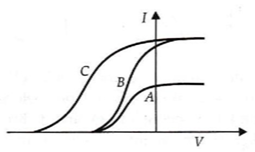
(I) In a photoelectric experiment plate current is plotted against anode potential.


Image

(A) A and B will have same intensities while B and C will have different frequencies.
(B) B and C will have different intensities while A and B will have different frequencies.
(C) A and B will have different intensities while B and C will have equal frequencies.
(D) B and C will have equal intensities while A and B will have same frequencies

(II) Photoelectrons are emitted when a zinc plate is
(A) Heated (B) hammered (C) Irradiated by ultraviolet light (D) subjected to a high pressure

(III) The threshold frequency for photoelectric effect on sodium corresponds to a wavelength of 500 nm. Its work function is about
(A) $4 \times 10^{-19} J$ (B) $2 \times 10^{-19} J$ (D) $3 \times 10^{-19} J$

(IV) The maximum kinetic energy of photoelectrons emitted from a surface when photons of energy 6 eV fall on it is 4 eV. The stopping potential is
(A) 2 V (B) 4 V (C) 6 V (D) 10 V

OR

The minimum energy required to remove an electron from a substance is called its
(A) work function (B) kinetic energy (C) stopping potential (D) potential energy
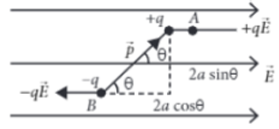
When electric dipole is placed in uniform electric field, its two charges experience equal and opposite forces, which cancel each other and hence net force on electric dipole in uniform electric field is zero. However these forces are not collinear, so they give rise to some torque on the dipole. Since net force on electric dipole in uniform electric field is zero. so no work is done in moving the electric dipole in uniform electric field. However some work is done in rotating the dipole against the torque acting on it.
Image
$(i)$ The dipole moment of a dipole in a uniform external field $\vec{E}$ is $\vec{P}$. Then the torque $\vec{\tau}$ acting on the dipole is
$(a) \vec{\tau}=2(\vec{P}+\vec{E})$
$(b) \vec{\tau}=\vec{P} \cdot \vec{E}$
$(c) \vec{\tau}=(\vec{P}+\vec{E})$
$(d) \vec{\tau}=\vec{P} \times \vec{E}$

$(ii)$ An electric dipole consists of two opposite charges, each of magnitude $1.0 \mu C$ separated by a distance of $2.0 \ cm$ . The dipole is placed in an external field of $10^5 NC ^{-1}$. The maximum torque on the dipole is
$(a) 4 \times 10^{-3} Nm$
$(b) 2 \times 10^{-3} Nm$
$(c) 1 \times 10^{-3} Nm$
$(d) 0.2 \times 10^{-3} Nm$

$(iii)$ Torque on a dipole in uniform electric field is minimum when $\theta$ is equal to
$(a) 0^{\circ}$
$(b) 90^{\circ}$
$(c) 180^{\circ}$
$(d)$ Both $0^{\circ}$ and $180^{\circ}$

$(iv)$ When an electric dipole is held at an angle in a uniform electric field, the net force $F$ and torque on the dipole are
$(a) F =0, \tau=0$
$(b) F \neq 0, \tau \neq 0$
$(c) F \neq 0, \tau=0$
$(d) F =0, \tau \neq 0$
OR
An electric dipole of moment $p$ is placed in an electric field of intensity $E$. The dipole acquires a position such that the axis of the dipole makes an angle $\theta$ with the direction of the field. Assuming that the potential energy of the dipole to be zero when $\theta=90^{\circ},$ the torque and the potential energy of the dipole will respectively be
$(a) pE \sin \theta,- pE \cos \theta$
$(b) pE \cos \theta,- pE \sin \theta$
$(c) pE \sin \theta, 2 pE \cos \theta$
$(d) pE \sin \theta,-2 pE \cos \theta$
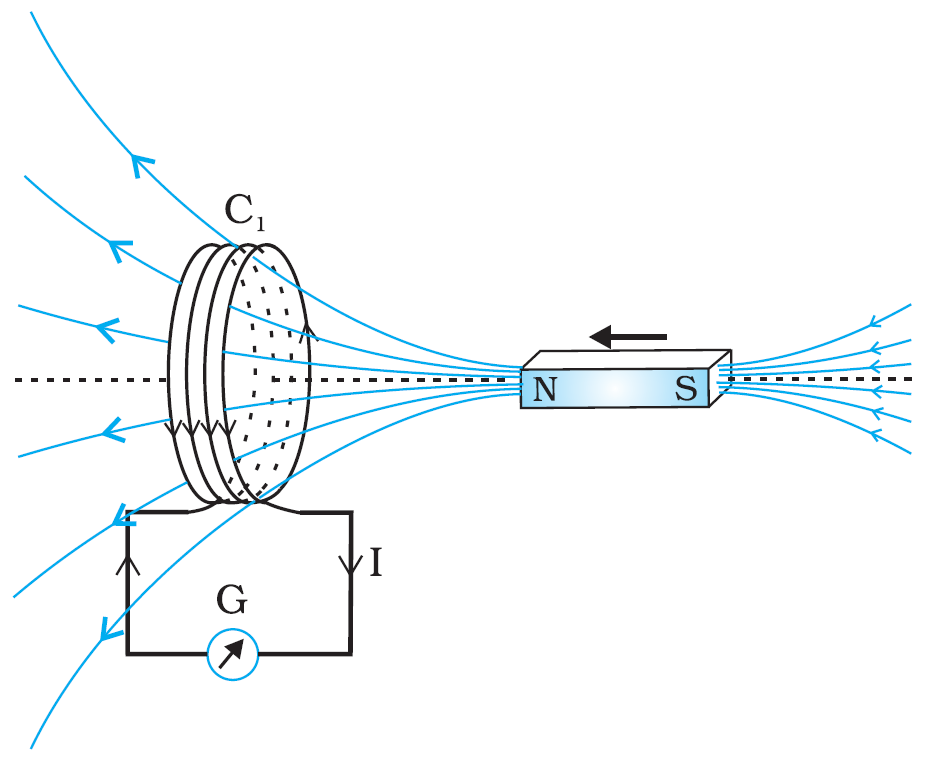
In year 1820 Oersted discovered the magnetic effect of current. Faraday gave the thought that reverse of this phenomenon is also possible i.e., current can also be produced by magnetic field. Faraday showed that when we move a magnet towards the coil which is connected by a sensitive galvanometer. The galvanometer gives instantaneous deflection showing that there is an electric current in the loop. Whenever relative motion between coil and magnet takes place an emf induced in coil. If coil is in closed circuit then current is also induced in the circuit. This phenomenon is called electromagnetic induction.
  1. The north pole of a long bar magnet was pushed slowly into a short solenoid connected to a galvanometer. The magnet was held stationary for a few seconds with the north pole in the middle of the solenoid and then withdrawn rapidly. The maximum deflection of the galvanometer was observed when the magnet was:
  1. Moving towards the solenoid.
  2. Moving into the solenoid.
  3. At rest inside the solenoid.
  4. Moving out of the solenoid.
  1. Two similar circular loops carry equal currents in the same direction. On moving the coils further apart, the electric current will.
  1. Remain unaltered.
  2. Increases in one and decreases in the second.
  3. Increase in both.
  4. Decrease in both.
  1. A closed iron ring is held horizontally and a bar magnet is dropped through the ring with its length along the axis of the ring. The acceleration of the falling magnet is.
  1. Equal to g.
  2. Less than g.
  3. More than g.
  4. Depends on the diameter of the ring and length of magnet.
  1. Whenever there is a relative motion between a coil and a magnet, the magnitude of induced emf set up in the coil does not depend upon the:
  1. Relative speed between the coil and magnet.
  2. Magnetic moment of the coil.
  3. Resistance of the coil.
  4. Number of turns in the coil.
  1. A coil of metal wire is kept stationary in a non-uniform magnetic field:
  1. A n emf and current both are induced in the coil.
  2. A current but no emf is induced in the coil.
  3. An emf but no current is induced in the coil.
  4. Neither emf nor current is induced in the coil.