MCQ
$M{n^{ + 2 }}$ can be converted into $M{n^{7 + }}$ by reacting with
- A$S{O_2}$
- B$C{l_2}$
- ✓$Pb{O_2}$
- D$SnC{l_2}$
Generate a complete, print-ready paper with questions like this in minutes — across 16+ boards, with answer keys.
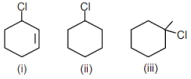
$C{{H}_{3}}-C\equiv CH\xrightarrow[{{H}_{2}}S{{O}_{4}}]{HgS{{O}_{4}}}A\xrightarrow{NaB{{H}_{4}}}B$
On addition of equal number of moles of a non-volatile solute $S$ in equal amount (in $kg$ ) of these solvents, the elevation of boiling point of solvent $X$ is three times that of solvent $Y$. Solute $S$ is known to undergo dimerization in these solvents. If the degree of dimerization is $0.7$ in solvent $Y$, the degree of dimerization in solvent $X$ is. . . . . . .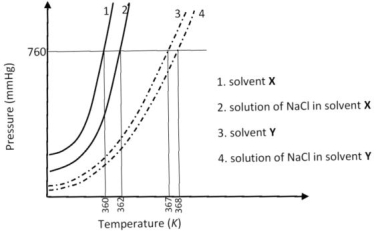
$Mn^{2+} + 2e^- \rightarrow Mn,\, $$E^o = - 1.18\, V$
$Mn^{2+} \rightarrow Mn^{3+} + e^-,$ $ E^o = - 1.51 \,V$
The $E^o$ for the reaction $3Mn^{2+} \rightarrow Mn^o + 2Mn^{3+},$
and possibility of the forward reaction are respectively
$F{e^{2 + }} + 2{e^ - } \to Fe( - 0.44\,V)$
$N{i^{2 + }} + 2{e^ - } \to Ni( - 0.25\,V)$
$S{n^{2 + }} + 2{e^ - } \to Sn( - 0.14V)$
$F{e^{3 + }} + {e^ - } \to F{e^{2 + }}( - 0.77\,V)$