Question
  1. Name an element which has higher melting point in group 13.
  2. Which element is best reducing agent in group 14.
  3. Why is $\text{CO}_2$ an oxidising agent?

Answer

  1. Boron has highest melting point due to strong cavalent bonds.
  2. Sn is best reducing agent due to lowest standard reduction potential.
  3. In $\text{CO}_2$, 'C' has highest oxidation state, it can gain electron, therefore acts as oxidising agent.

Need a full question paper?

Generate a complete, print-ready paper with questions like this in minutes — across 16+ boards, with answer keys.

Start Generating Free

Similar questions

What is the concentration of sugar $\left(\mathrm{C}_{12} \mathrm{H}_{22} \mathrm{O}_{11}\right) \mathrm{i} \mathrm{~mol} \mathrm{~L}^{-1}$ if its 20 g are dissolved in enough water to make a final volume up to 2 L ?
Beryllium and magnesium do not give colour to flame whereas other alkaline earth metals do so. Why?
Explain why the electron gain enthalpy of fluorine is less negative than that of chlorine.
Lifetimes of the molecules in the excited states are often measured by using pulsed radiation source of duration nearly in the nano second range. If the radiation source has the duration of 2 ns and the number of photons emitted during the pulse source is $2.5 \times 10^{15}$, calculate the energy of the source.
Write chemical equations only, involved in the preparation of each of the following:
  1. Plaster of Paris.
  2. Quick lime.
  3. Slaked lime.
Also write any one use of each.
A cell is constructed using $\frac{\text{Cu}^{2+}}{\text{Cu}}$ and $\frac{\text{Al}^{3+}}{\text{Al}}$ electrodes.
  1. Identify cathode and anode.
  2. Write the reactions at anode, cathode and net cell reaction.
  3. Calculate $\text{E}^0_\text{cell}$
$\text{E}^0_\frac{\text{Al}^{3+}}{\text{Ag}}=-1.66\text{V}$

$\text{E}^0_\frac{\text{Cu}^{2+}}{\text{Cu}}=+0.34\text{V}$
Define electron gain enthalpy. What are its units?
  1. What is the main difference between electro magnetic waves theory and Planck's quantum theory.
  2. Which rule is violated in the following orbital diagram:
The heat of combustion of $\mathrm{C}_2 \mathrm{H}_6$ is -368.4 kcal . Calculate heat of combustion of $\mathrm{C}_2 \mathrm{H}_4$, heat of combustion of $\mathrm{H}_2$ is $68.32 \mathrm{kcal} \mathrm{mol}{ }^{-1} . \Delta \mathrm{H}$ for the following reaction is $-37.1 \mathrm{kcal} . \mathrm{C}_2 \mathrm{H}_4(\mathrm{~g})+\mathrm{H}_2(\mathrm{~g}) \longrightarrow \mathrm{C}_2 \mathrm{H}_6(\mathrm{~g})$
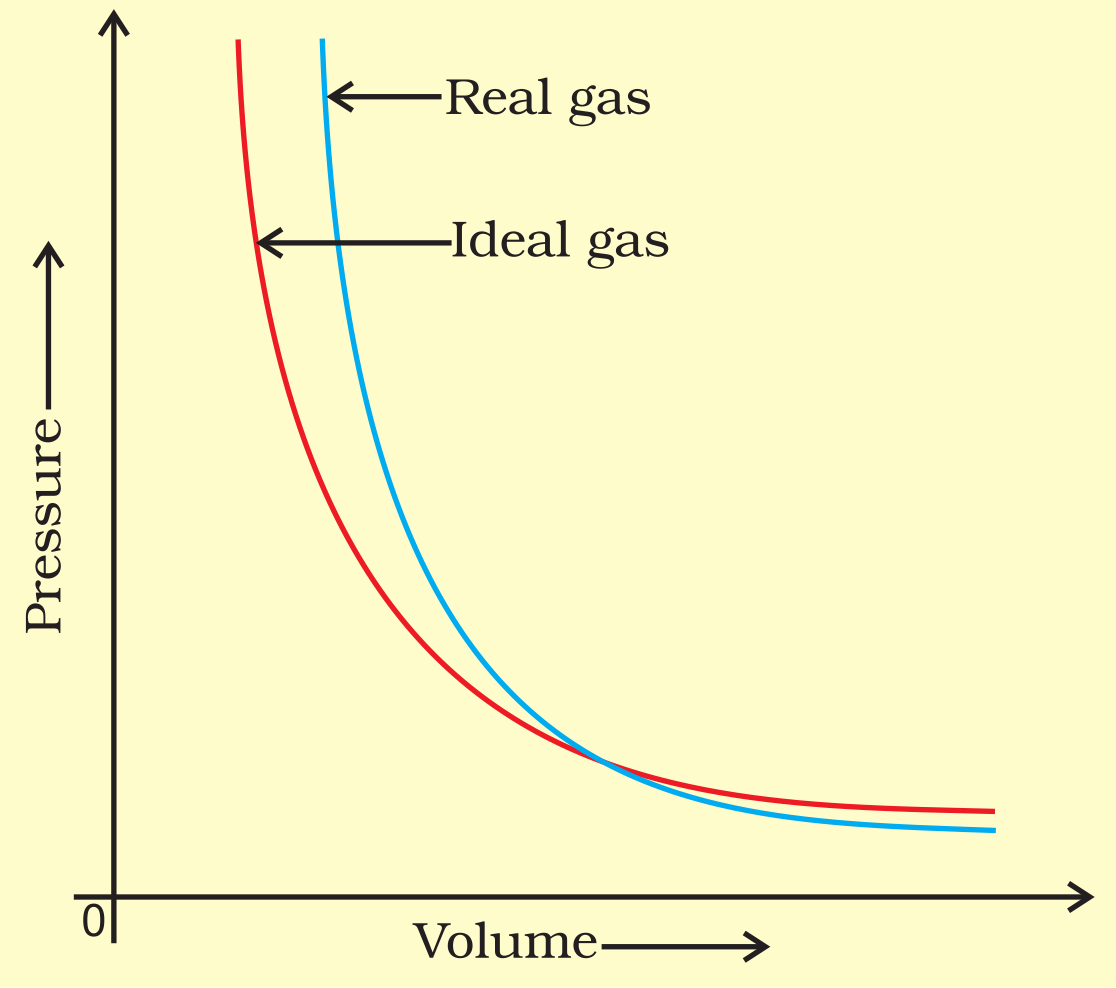
Pressure versus volume graph for a real gas and an ideal gas are shown in Fig. Answer the following questions on the basis of this graph.
  1. Interpret the behaviour of real gas with respect to ideal gas at low pressure.
  2. Interpret the behaviour of real gas with respect to ideal gas at high pressure.
  3. Mark the pressure and volume by drawing a line at the point where real gas behaves as an ideal gas.