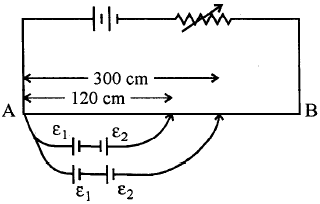
In the figure a long uniform potentiometer wire $AB$ is having a constant potential gradient along its length. The null points for the two primary cells of emfs $\varepsilon_{1}$ and $\varepsilon_{2}$
connected in the manner shown are obtained at a distance of $120 \ cm $ and $300 \ cm$ from the end $A$.
Find $(i) \varepsilon_{1} / \varepsilon_{2}$ and $(ii)$ position of null point for the cell $\varepsilon_{1}$. How is the sensitivity of a potentiometer increased?
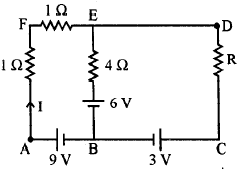
Using Kirchoffs rules determine the value of unknown resistance $R$ in the circuit so that no current flows through 4 $\Omega$ resistance. Also find the potential difference between $A$ and $D.$
CBSE DELHI - SET 1 2012
Download our app for free and get startedPlay store
  1. $\varepsilon_{1} + \varepsilon_{2} = 300k \ (k$ is potential gradient in $\text{volt/cm)}$
$\varepsilon_{1} - \varepsilon_{2} = 120 \text{k}$
$\Rightarrow\frac{\varepsilon_{1}}{\varepsilon_{2}} = 7 / 3$
  1. $\varepsilon_{1} + \varepsilon_{2} = 300\text{k}$
$\therefore\varepsilon_{1} + \frac{3}{7}\varepsilon_{1} = 300 \text{k}$
$\Rightarrow\varepsilon_{1} = 210 \text{k}$
Therefore, balancing length for cell $\varepsilon_{1}$ is $210\ cm.$
  1. By decreasing potential gradient.
$[$Or through Increasing length, reducing potential drop across wire, increasing resistance put in series with the main cell etc.$]$
Alternate Answer
Applying Kirchhoff's Voltage rule
for loop $\text{ABEFA}$
$-9 + 6 + 4 x 0 +2 I = 0$
$2 I – 3 = 0$
$\text{I} =\frac{3}{2}\text{A} = 1.5\text{A}$
For loop $\text{BCDEB}$
$3 + I R + 4 x 0– 6 = 0$
$\therefore\text{IR} = 3 $
Substituting the value of current $I,$
$\frac{3}{2}\times\text{R} = 3 $
$\therefore\text{R} = 2\Omega$
Potential difference between $A D$
Through path $\text{ABCD}$
$+9V – 3V – IR = V_{AD}$
$ + 9 - 3 - \frac{3}{2}\times2 = \text{V}_{AD}$
$\Rightarrow\text{V}_{AD} = 3\text{V}$
Alternate Answer
through path $\text{AFD}$
$\frac{3}{2}\times2 =\text{V}_{AD}$
$\Rightarrow\text{V}_{AD} = 3 \text{V}.$
art

Download our app
and get started for free

Experience the future of education. Simply download our apps or reach out to us for more information. Let's shape the future of learning together!No signup needed.*

Similar Questions

  • 1
    A cell of emf 'E' and internal resistance 'r' is connected across a variable load resistor R. Draw the plots of the terminal voltage V versus (i) R and (ii) the current I.
    It is found that when R = 4$\Omega$, the current is 1 A and when R is increased to 9$\Omega$, the current reduces to 0.5 A. Find the values of the emf E and internal resistance r.
    View Solution
  • 2
    Figure shows a potentiometer circuit for comparison of two resistances. The balance point with a standard resistor $\text{R}=10.0\ \Omega$ is found to be $58.3 \ cm,$ while that with the unknown resistance $X$ is $68.5 \ cm$. Determine the value of $X$. What might you do if you failed to find a balance point with the given cell of emf $\varepsilon?$
    View Solution
  • 3
    1. Write the principle of working of a metre bridge.
    2. In a metre bridge, the balance point is found at a distance $l_1$ with resistances R and S as shown in the figure.

    An unknown resistance X is now connected in parallel to the resistance S and the balance point is found at a distance $l_2$. Obtain a formula for X in terms of $l_1$, $l_2$ and S.
    View Solution
  • 4
    A parallel$-$plate capacitor with plate area $20\ cm^2$ and plate separation $1.0\ mm$ is connected to a battery. The resistance of the circuit is $10\text{k}\Omega.$ Find the time constant of the circuit.
    View Solution
  • 5
    How many time constants will elapse before the current in a charging RC circuit drops to half of its initial value? Answer the same question for a discharging RC circuit.
    View Solution
  • 6
    1. Six lead-acid type of secondary cells each of emf 2.0 V and internal resistance $0.015\Omega$ are joined in series to provide a supply to a resistance of $8.5\ \Omega.$ What are the current drawn from the supply and its terminal voltage?
    2. A secondary cell after long use has an emf of 1.9 V and a large internal resistance of $380\ \Omega$ What maximum current can be drawn from the cell? Could the cell drive the starting motor of a car?
    View Solution
  • 7

    The figure shows experimental set up of a meter bridge. When the two unknown resistances X and Y are inserted, the null point D is obtained 40 cm from the end A. When a resistance of 10 Ω is connected in series with X, the null point shifts by 10 cm. Find the position of the null point when the 10 Ω resistance is instead connected in series with resistance ‘Y’. Determine the values of the resistances X and Y.
    View Solution
  • 8
    The four arms of a Wheatstone bridge $($Fig. $3.19)$ have the following resistances:
    $AB =100 \Omega, BC =10 \Omega, CD =5 \Omega \text {, and } DA =60 \Omega \text {. }$
    Image
    A galvanometer of $15 \Omega$ resistance is connected across $BD$. Calculate the current through the galvanometer when a potential difference of $10 V$ is maintained across $AC$.
    View Solution
  • 9
    Write the mathematical relation for the resistivity of a material in terms of relaxation time, number density and mass and charge of charge carriers in it. Explain, using this relation, why the resistivity of a metal increases and that of a semi-conductor decreases with rise in temperature.
    View Solution
  • 10
    The earth’s surface has a negative surface charge density of $10^{-9} Cm^{-2}.$ The potential difference of $400 kV$ between the top of the atmosphere and the surface results $($due to the low conductivity of the lower atmosphere$)$ in a current of only $1800 A$ over the entire globe. If there were no mechanism of sustaining atmospheric electric field, how much time $($roughly$)$ would be required to neutralise the earth’s surface? $($This never happens in practice because there is a mechanism to replenish electric charges, namely the continual thunderstorms and lightning in different parts of the globe$). ($Radius of earth $= 6.37 \times 10^6 m.)$
    View Solution