A heater coil is cut in two parts and only one of them is used in the heater. What is the ratio of the heat produced by this half coil to that by the original coil if the voltage applied is the same?
Download our app for free and get started
For same p.d. the heat produced per second,
$\text{H}=\frac{\text{V}^2}{\text{R}}\propto\frac{1}{\text{R}}.$
As the one part of heater coil has resistance $\text{R}_2=\frac{\text{R}}{2}$ being the resistance of original coil; therefore the ratio of heat produced,
$\frac{\text{H}_2}{\text{H}_1}=\frac{\text{R}_1}{\text{R}_2}=\frac{\text{R}}{\frac{\text{R}}{2}}=2:1$
$\text{H}=\frac{\text{V}^2}{\text{R}}\propto\frac{1}{\text{R}}.$
As the one part of heater coil has resistance $\text{R}_2=\frac{\text{R}}{2}$ being the resistance of original coil; therefore the ratio of heat produced,
$\frac{\text{H}_2}{\text{H}_1}=\frac{\text{R}_1}{\text{R}_2}=\frac{\text{R}}{\frac{\text{R}}{2}}=2:1$

Download our appand get started for free
Experience the future of education. Simply download our apps or reach out to us for more information. Let's shape the future of learning together!No signup needed.*
Similar Questions
- 1A potential difference $V$ is applied across a conductor of length $L$ and diameter $D.$ How is the drift velocity, $V_d,$ of charge carriers in the conductor affected when $(i) \ V$ is halved, $(ii) \ L$ is doubled and $(iii) \ D$ is halved? Justify your answer in each case.View Solution
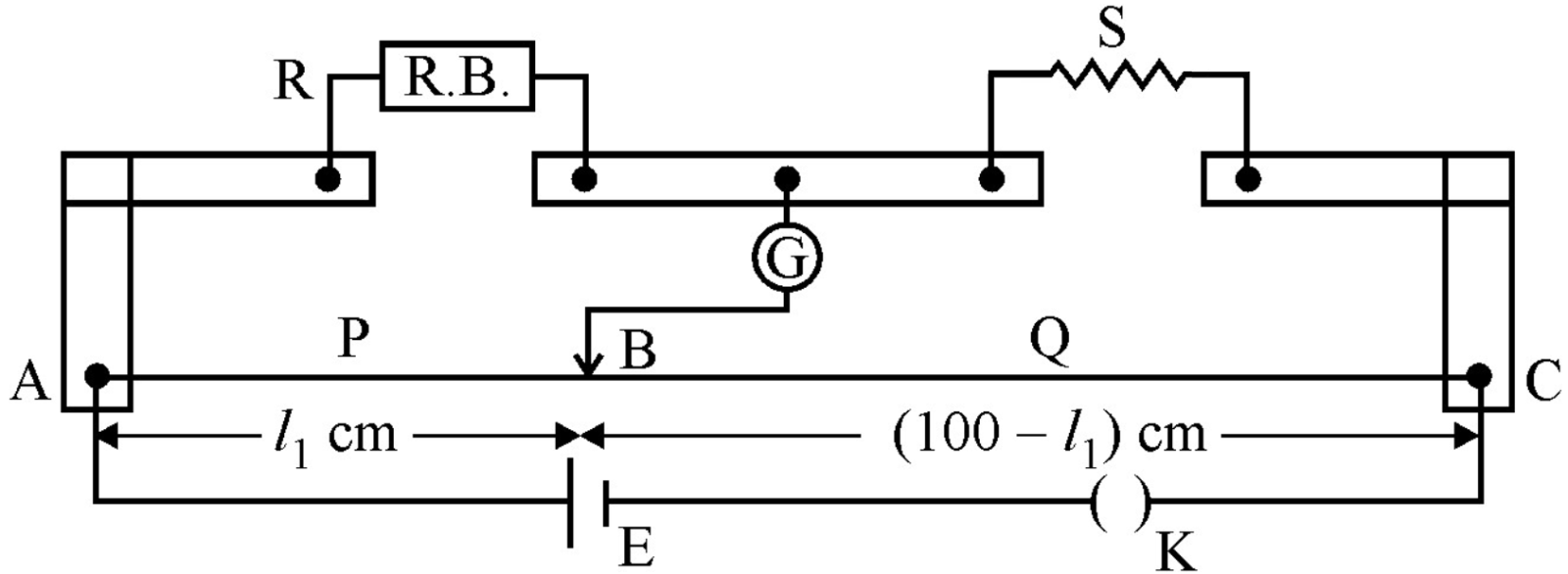
- 2What is end error in a metre bridge? How is it overcome? The resistances in the two arms of the metre bridge are $\text{R}=5\Omega$ and $S$ respectively. When the resistance $S$ is shunted with an equal resistance, the new balance length found to be $1.5 l_1 ,$ where $l_1$ is the initial balancing length. Calculate the value of $S.$View Solution
- 3View Solution
- Derive an expression for drift velocity of free electrons.
- How does drift velocity of electrons in a metallic conductor vary with increase in temperature? Explain.
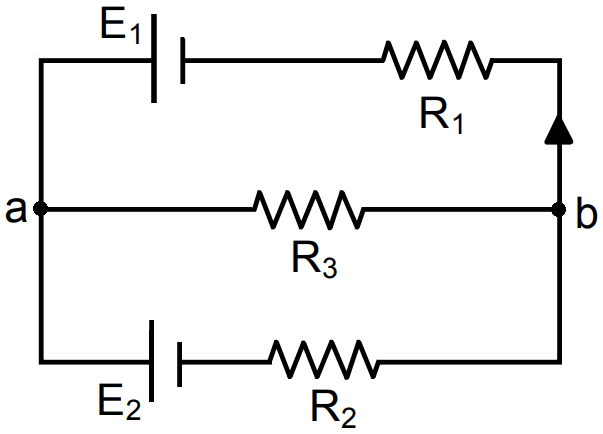
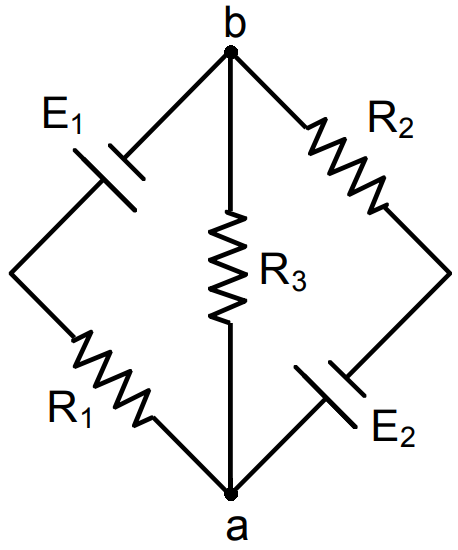
- 4Find the potential difference $V_a - V_b$ in the circuits shown in figure.View Solution
- 5View SolutionHow many time constants will elapse before the power delivered by a battery drops to half of its maximum value in an RC circuit?
- 6View SolutionHow many time constants will elapse before the current in a charging RC circuit drops to half of its initial value? Answer the same question for a discharging RC circuit.
- 7View SolutionWrite the principle of working of a potentiometer. Describe briefly, with the help of a circuit diagram, how a potentiometer is used to determine the internal resistance of a given cell.
- 8View SolutionHow many time constants will elapse before the charge on a capacitors falls to 0.1% of its maximum value in a discharging RC circuit?
- 9View SolutionIs the motion of a charge across junction momentum conserving? Why or why not?
- 10View SolutionThe graph shown here shows the variation of terminal potential difference V, across a combination of three cells in series to a resistor, versus current i:
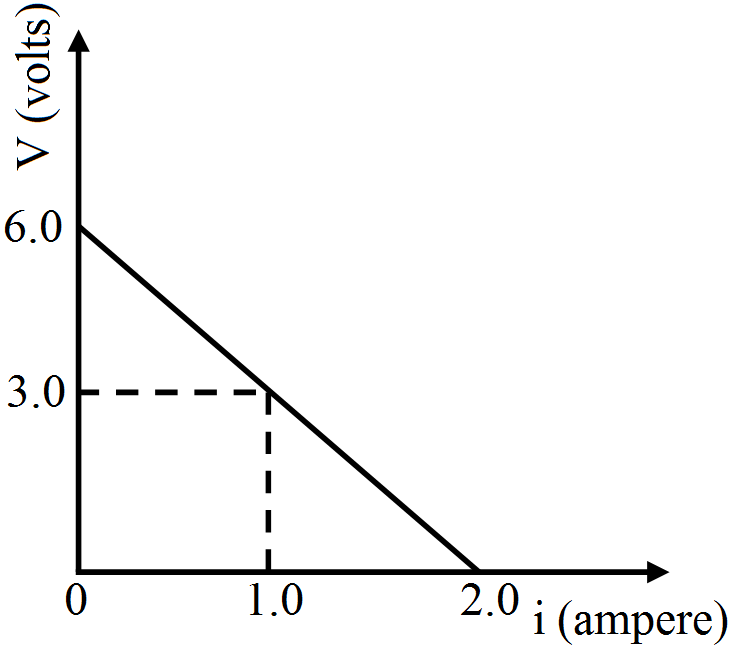
- Calculate the emf of each cell.
- For what current i, will the power dissipation of the circuit be maximum?