Question
Natality and Mortality.

Answer

Natality Mortality
1. Birth rate of any population is called its natality.1. Death rate of any population is called its mortality.
2. Rise in natality increase the population density.2. Rise in mortality decrease the population density.
3. Decline in natality decrease the population.3. Decline in mortality increase the population.
4. Natality is the positive factor for population growth.4. Mortality is the negative factor for population growth.
5. Absolute natality will always be more than realized natality.5. Absolute mortality will always be less them realized mortality.

Need a full question paper?

Generate a complete, print-ready paper with questions like this in minutes — across 16+ boards, with answer keys.
Start Generating Free

Similar questions

Read the following and answer any four questions from (i) to (v) given below:
Priya was 4 years old when she contracted chicken pox. It took her around 15 days to recover completely. Now Priya is 5 years old, so her mother got her vaccinated few days back for DPT ($5^{th}$​​​​​​​ dose) as per immunisation program. Recently she was playing with her friend in the park when her friend accidently fell on iron pipe and badly bruised her knee. She was taken to the hospital where doctor gave her ATS injection and painkillers. Based on the above information, answer the following questions.
  1. Select the correct statement.
  1. Priya has developed natural active immunity against chicken pox.
  2. Priya has developed artificial active immunity against DPT.
  3. Priya's friend has developed artificial passive immunity against tetanus.
  4. All of these
  1. Which of the following do you think is an example of natural passive immunity?
  1. Administration of AGS (anti gas gangrene serum) in a person.
  2. Transfer of IgA antibodies from mother to baby through mother's milk.
  3. A person recovered from viral infection.
  4. A child vaccinated for polio.
  1. Which of the following is true for active immunity?
  1. It provides immediate relief.
  2. It is temporary, not long lasting
  3. It has no side effects.
  4. None of these
  1. Select the incorrect match.
  1. Passive immunity-IgG antibodies crossing placental barrier to reach fetus.
  2. Active immunity-Vaccination against corona virus.
  3. Active immunity-Administration of antidiphtheria serum in patient.
  4. Passive immunity-Fetus having mother's milk.
  1. Assertion: A person recovered from measles develops an active immunity against this infection.
Reason: In active immunity, person's own cells develop antibodies in response to infection.
  1. Both assertion and reason are true and reason is the correct explanation of assertion.
  2. Both assertion and reason are true, but reason is not the correct explanation of assertion.
  3. Assertion is true, but reason is false.
  4. Both assertion and reason are false.
Distinguish between : Extero and entero receptors.
Read the following and answer any four questions from (i) to (v) given below:
While studying inheritance of characters, a teacher gave the example of inheritance of attached earlobe and hypertrichosis of the ear to her students. A man with attached earlobes and extensive hair on pinna married a woman having free earlobes. The couple had four children, one son with attached earlobes and hairy pinna, one son with a free earlobes and hairy pinna and two daughters with attached earlobes. One of the daughters married a man with free earlobes and sparse hair on pinna. Teacher said if this couple would have sons there would be equal chances for both having free or attached earlobes and sparse hair on pinnae.
  1. Attached and free earlobe are respective example of?
  1. Dominant and recessive traits.
  2. Recessive and recessive traits.
  3. Recessive and dominant traits.
  4. Dominant and dominant traits.
  1. Hypertrichosis of the ear is.
  1. X linked trait
  2. Y linked trait
  3. Autosomal dominant trait
  4. Autosomal recessive trait.
  1. If a female with attached earlobe married a male homozygous for free earlobe sparse hair on pinna then what would be the chances of daughter to have attached earlobe?
  1. 0%
  2. 100%
  3. 25%
  4. 75%
  1. If a man with attached earlobe and hairy pinna married a woman with attached earlobe then what would be the chances of son to have hairy pinna?
  1. 50%
  2. 100%
  3. 75%
  4. 0%
  1. A male with attached earlobe, sparse hair on pinna married a female with attached earlobe. Which of the following is correct regarding their progenies?
  1. All sons have a free earlobe with hairy pinna.
  2. All daughters have an attached earlobe.
  3. 50% daughters have an attached earlobe whereas 50% daughters have a free earlobe.
  4. 50% sons have attached earlobe with hairy pinna and 50% sons have a free earlobe
Write a self-explanatory note on biopatent.
What is the cause of frameshift mutation?
Read the following and answer any four questions from (i) to (v) given below:
ln a plant species that follows Mendelian inheritance yellow flower colour is dominant over white and round fruits shape is dominant over elongated. Crossing was performed between two purelines-one having yellow-flower and round fruit and another with white flower and elongated fruits. About 20 plants survived in $F_1$ progeny. Plants of $F_1$ were allowed to self fertilise and about 960 plants survived in $F_2$
  1. How many plants would have yellow flower and round fruit in $F_1$ generation?
  1. 20
  2. 10
  3. 5
  4. 0
  1. How many plants would have yellow flower and round fruit in $F_2$​​​​​​​ generation?
  1. 960
  2. 540
  3. 180
  4. 60
  1. Which of the following is correct for the condition when plant heterozygous for yellow flower and round fruit is back crossed with the double recessive parent?
  1. 9 : 3 : 3 : 1 ratio of phenotype only.
  2. 9 : 3 : 3 : 1 ratio of genotype only.
  3. 1 : 1 : 1 : 1 ratio of phenotype only.
  4. 1 : 1 : 1 : 1 ratio of phenotype and genotype.
  1. When the plant heterozygous for yellow flower and round fruit are self crossed, then the plant with yellow flower and elongated fruit will be represented by the genotype?
  1. YyRr, YyRR, YYRr
  2. Yyrr, YYrr, yyrr
  3. yyRr, yyRR
  4. Yyrr, YYrr
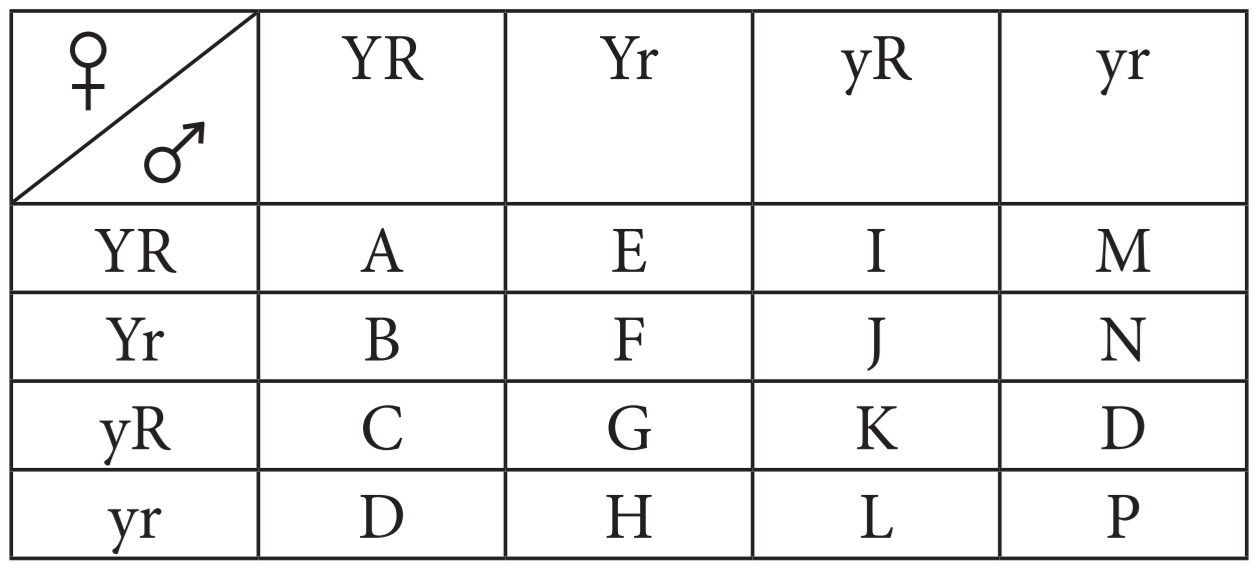
  1. 'Tile given Punnett's square represents the pattern of inheritance in a dihybrid cross where yellow flower and round fruit (R) condition is dominant over white flower (y) and elongated fruit (r) condition.


Plant 'C' will produce fruits with the genotype identical to fruits produced by the plant of
  1. type H
  2. type E
  3. type K
  4. type 1
Active absorption and Passive absorption.
Distinguish between : Natural ecosystem and artificial ecosystem.
Read the following and answer any four questions from (i) to (v) given below:
Haemophilia is a sex linked disease which is also known as bleeder's disease as the patient will continue to bleed even from a minor cut since he or she does not possess the natural phenomenon of blood clotting due to absence of anti -haemophilic globulin or factor VIII and plasma thromboplastin factor IX essential for it. As a result of continuous bleeding the patient may die of blood loss. Colour blindness is another type of sex linked trait in which the eye fails to distinguish red and green colours. Vision is however, not affected and the colour blind can, lead a normal life, reading, writing and driving (distinguishing traffic lights by their position).
  1. If a haemophilic man marries a woman whose father was haemcphihc and mother was normal then which of the following holds true for their progenies?
  1. Of the total number of daughters, 50% daughters are carrier and $50 \%$ are haemophilic.
  2. All the daughters are haemophilic.
  3. All sons are haemophilic and all daughters are normal.
  4. All sons are normal, all daughters are carriers.
  1. A man whose father was colourblind and mother was normal marries a woman whose father was haemophilic and mother was normal. Which of the following is true for their progenies? [Note: Percentage is from the total number of progenies]
  1. $25 \%$ female progenies carry the gene for both haemophilia and colourblindness.
  2. $25 \%$ male progenies carry only the gene of colourblindness.
  3. $25 \%$ female progenies carry only the gene of colourblindness.
  4. $25 \%$ male progenies and 25% female progenies carry the gene of haemophilia.
  1. Which of the following statements is incorrect regarding haemophilia?
  1. It is a dominant disease.
  2. A single protein involved in clotting of blood is affected.
  3. It is recessive disease.
  4. It is Mendelian disorder.
  1. Anup is having colourblindness and is married to Soni who is normal. What is the chance that their son will have the disease?
  1. $100 \%$
  2. $50 \%$
  3. $25 \%$
  4. $0 \%$
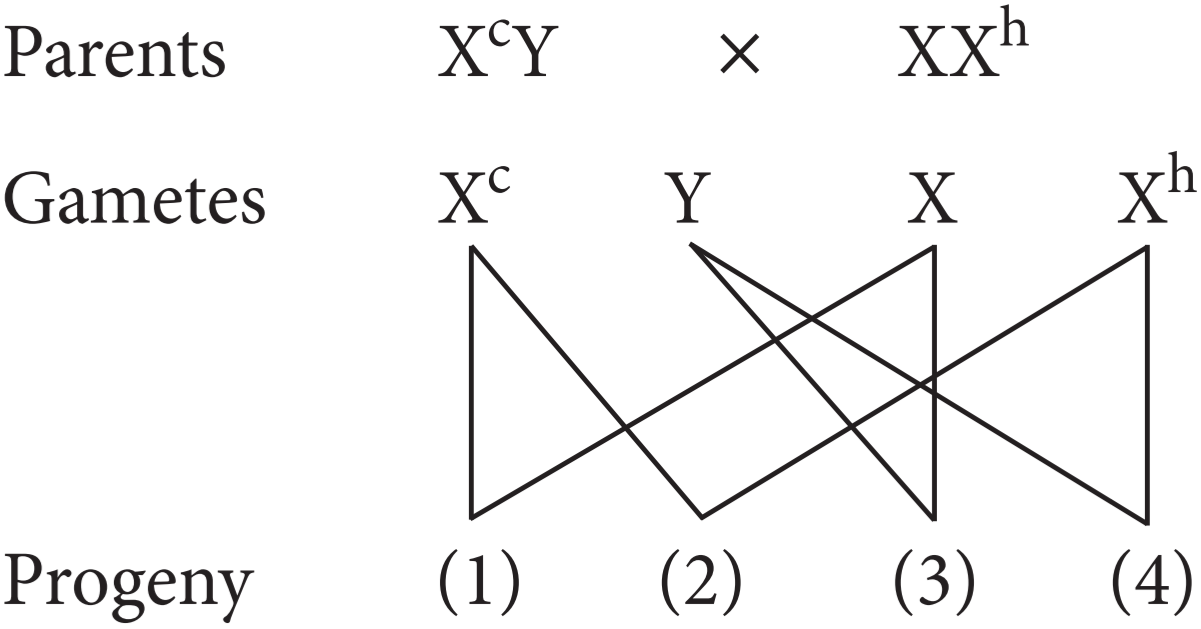
  1. Refer to the given cross?


Select the correct option regarding $1, 2, 3$ and $4$.
  1. The options are as follow:
  1. Colourblind carrier female.
  2. Colourblind haemophilic female.
  3. Normal male.
  4. Haemophilic male
  1. The options are as follow:
  1. Colourblind people
  2. Haemophilic female.
  3. Normal male
  4. Haemophilic male
  1. The options are as follow:
  1. Colourblind female
  2. Colourblind and haemophilic female
  3. Normal male
  4. Normal male.
  1. The options are as follow:
  1. Colourblind carrier female.
  2. Normal female.
  3. Normal male.
  4. Haemophilic male.
Distinguish between : T. S. of artery and T.S. of vein.